Salesforce Ventures: OpenAI and Anthropic valuations became too aggressive for the market
AI company valuations have reached a new level. Following OpenAI's $122 billion funding round, its valuation rose to $852 billion, while Anthropic is valued at $380 billion. Salesforce Ventures believes the market is already pricing in an almost perfect growth scenario — sharply raising demands for revenue, margins, and monetization speed for all sector leaders.
AI-processed from Bloomberg Tech; edited by Hamidun News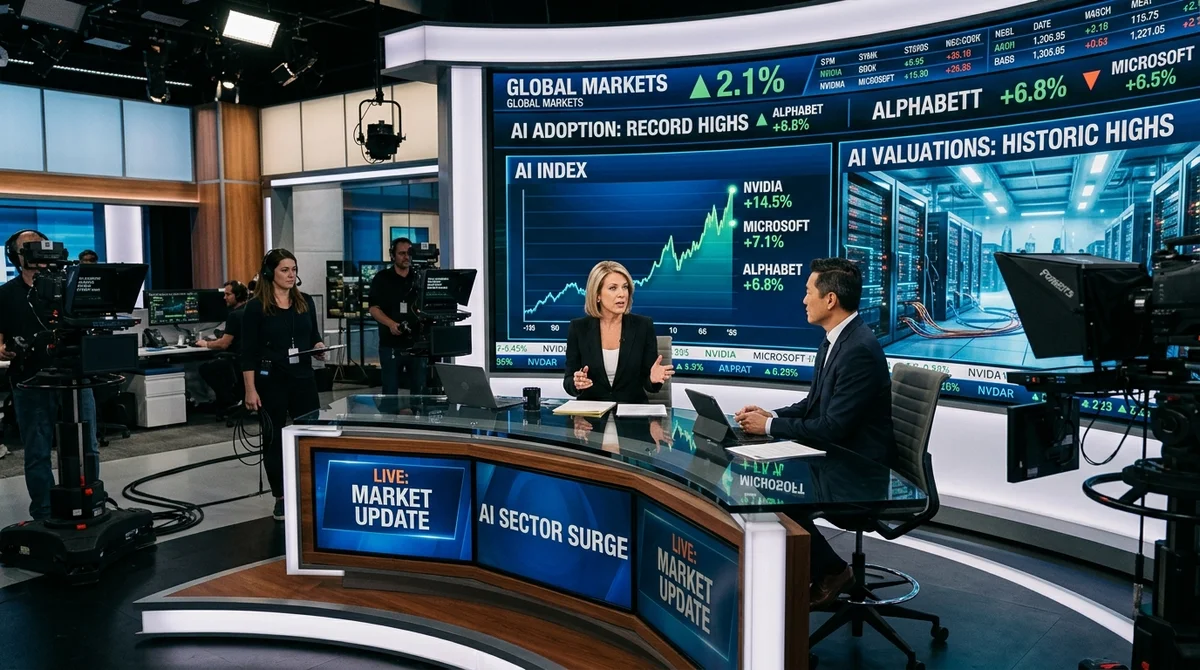
The AI market has reached a point where investors pay not just for current growth, but for an almost flawless future, and this is already starting to look too aggressive even for those financing tech companies themselves. Such an assessment was discussed on Bloomberg Deals by Salesforce Ventures partner Paul Drews and head of US investments at WestBridge Capital Mandan Shah. The occasion was OpenAI's largest financing round in its history: the company raised $122 billion from technology corporations, venture funds, and private investors.
After the deal, OpenAI's valuation grew to $852 billion, and the market values Anthropic at $380 billion. For market participants, these are no longer just two expensive AI companies, but new benchmarks for the entire private technology sector. This is precisely why commentary from Salesforce Ventures matters: corporate funds and growth investors typically watch not only the hype but also how quickly an asset can be turned into a sustainable business.
When Drews says valuations have become too aggressive, the point is not that the market will necessarily turn downward tomorrow. Rather, it's that almost a perfect scenario is already priced into current valuations. Investors assume that generative AI leaders will simultaneously maintain technological advantage, scale infrastructure, protect margins, and establish themselves in the corporate ecosystem as a foundational layer for development, search, automation, and office tasks.
At such valuation heights, companies need more than just growth faster than the market. They need to prove that growth can be sustained for years without losing control over compute costs, chip procurement, model training, and support for increasingly complex products. The composition of OpenAI's round investors is particularly telling.
Money came not only from technology giants and specialized funds, but also from a wider circle of capital, including retail investors. This usually means the story has gone beyond the narrow venture community and become a bet on an entire economic cycle. For the company itself, this is a plus: access to huge capital allows faster growth of computing power, building data centers, expanding service lines, and more aggressively entering the enterprise segment.
But for valuation, it's additional pressure. The higher the entry price, the less the market is willing to forgive delayed launches, controversial monetization, or weaker-than-expected conversion of user interest into actual revenue. Anthropic's story is also important here because we're no longer talking about a single exception, but about a revaluation of the entire upper tier of the AI market.
If a company with an alternative model strategy gets a $380 billion valuation, investors essentially acknowledge that the sector can have several ultra-expensive platforms, not just one absolute winner. This raises the overall level of market expectations: startups are expected to have not just strong technology, but the ability to build sales channels, retain major clients, embed themselves in company workflows, and transform model intelligence into repeatable cash flow. In other words, AI businesses are still presented as fast-growing innovators, but at prices they're now required to demonstrate the discipline of mature technology corporations.
For the enterprise software market, this is a separate signal. Salesforce Ventures is positioned close to the segment where generative AI must prove practical value not in demos and not in user enthusiasm, but in the concrete economics of implementation. Corporate customers are willing to pay for automation, development acceleration, service improvement, and productivity gains, but they also carefully count the cost of model usage, integration, security, and support.
So the debate over high valuations actually comes down to a very practical question: can market leaders turn technological leadership into predictable cash flows of a scale that justifies hundreds of billions of dollars right now, not at some point in the future. The conclusion is simple: capital remains ready to support the main winners of the AI race without hesitation, but with the money comes a new bar of expectations. If OpenAI and Anthropic confirm that their scale and monetization match current prices, the sector will receive an even more powerful influx of investment and acceleration of consolidation around several platforms.
If growth turns out to be less linear than the market currently assumes, the conversation about overheated valuations will quickly become the central theme of the next investment cycle.
Need AI working inside your business — not just in your newsfeed?
I build production AI for companies — custom CRM, internal tools, autonomous agents, workflow automation. Owned by you, shaped to your process, no per-seat tax. Built by Zhemal Khamidun, CPO of AlpinaGPT (AI platform, 6,000+ users).
The AI world, distilled — once a week
Seven stories that actually mattered, hand-picked. No noise, no reposts, no press releases.
Done! Check your inbox for a confirmation.