AI startup unveiled digital colleague for Zoom that reports to managers
The startup unveiled an AI colleague that can attend all Zoom meetings, monitor workflows, and independently identify gaps without prompting. The system…
AI-processed from Bloomberg Tech; edited by Hamidun News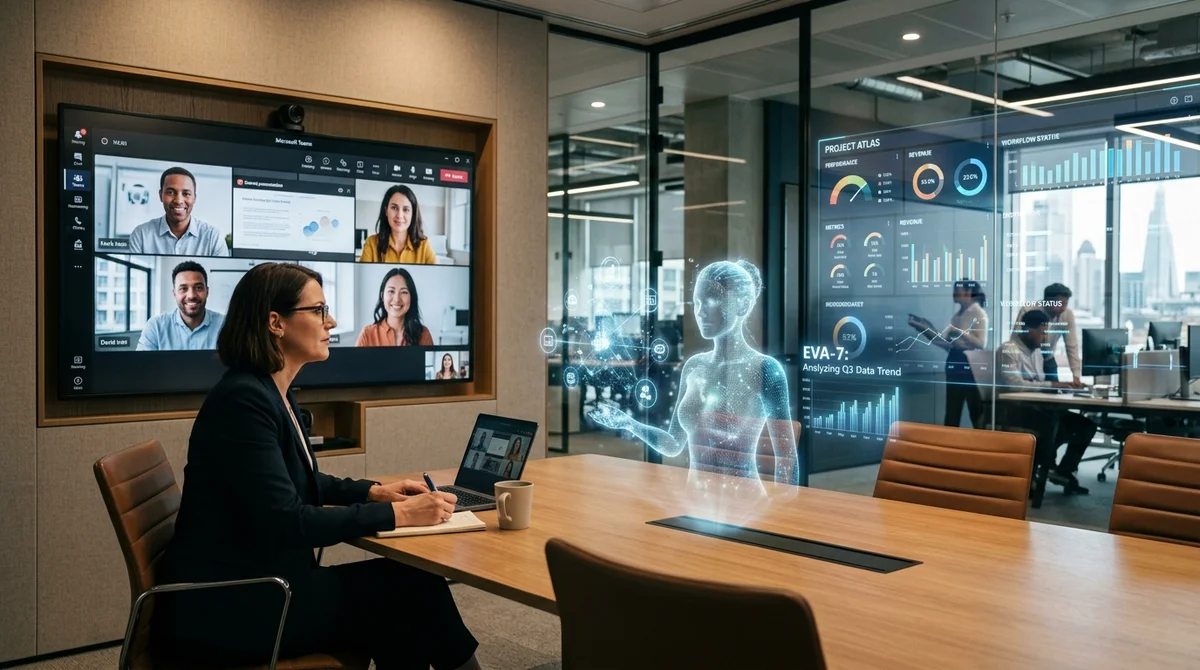
A new class of corporate AI is rapidly expanding beyond familiar chatbots and meeting transcription services. The startup in question offers not just a note-taking assistant, but a full-fledged digital colleague: such an agent can connect to every Zoom meeting, monitor workflows, independently spot gaps, and nudge employees toward action before managers even notice the problem. Essentially, it's an attempt to embed AI directly into a team's daily operational loop and transform it into a permanent participant in work, rather than a tool that's switched on only by request.
The key difference lies in proactivity. Most corporate AI tools still operate in service mode: they compile summaries, answer questions, search for documents, draft emails, or gather data following a user command. The logic here is different.
The system observes how tasks are progressing, who promised what, what decisions were made on the call, and where gaps have formed between agreement and execution. If a task stalls, responsibility is unclear, or a promise goes unfollowed, the AI doesn't wait for a new request—it signals this automatically and reminds participants to close the loop. This is why such a product looks like the next step beyond meeting transcription and auto-summaries.
Over the past two years, companies have grown accustomed to AI listening to conversations, identifying key points, and automatically organizing follow-ups. Now startups are raising the stakes, trying to make the system not just record what's happening, but manage routine alongside people. In theory, this reduces lost tasks, decreases the need for managerial oversight, and accelerates the completion of commitments.
For distributed teams that live in calendars, chats, and endless calls, this format is especially appealing: the more communication, the higher the cost of any missed decision. But alongside convenience comes another question: where is the line between assistant and overseer. If a digital colleague attends every call and constantly compares what was said against actual execution, employees might perceive it not as an assistant, but as a system of soft surveillance.
The article's title itself hints at this effect: the AI is seemingly reporting to management all the time about who didn't do what. For a manager, this might mean more transparency and less manual follow-up. For a team, it carries the risk of constant surveillance, especially if the logic behind recommendations is opaque, and the model's conclusions can't be quickly verified or disputed.
There's also a separate question of accuracy and corporate policy. Any system that interprets conversations and turns them into management signals can make errors: misunderstand context, confuse the degree of obligation in a statement, miss irony, overlook priority shifts, or conversely, turn a rough idea into a formal task. Therefore, the real value of such a solution will depend not only on model quality, but on how the usage rules are structured.
Do employees have the right to disable such an agent for parts of meetings? Who sees its conclusions? Are conversation records stored?
Can erroneous interpretations be corrected before they reach management? Without clear answers to these questions, even a strong product risks triggering resistance within the company. The broader meaning of this story goes beyond one specific development.
Corporate AI is gradually shifting its role: from a passive on-demand tool, it's becoming a participant in processes that observes, reminds, coordinates, and influences execution discipline. This can genuinely accelerate workflow where teams are drowning in calls and losing track of commitments. But as AI approaches managerial functions, transparency, the right to make mistakes, and clear control boundaries become ever more important.
Otherwise, the digital colleague created for efficiency will quickly become a symbol of mistrust within the team.
Want to stop reading about AI and start using it?
AI News is a curated feed of AI/tech news. Hamidun Academy teaches you to use AI systematically in your work.