AI startup unveils a digital coworker for Zoom that reports to managers
A startup has shown off an AI coworker that can attend every Zoom meeting, monitor workflows and identify gaps without being prompted. The system does more than take notes: it nudges employees to close tasks that have stalled. For managers, this means a new level of visibility. For teams, it raises the question of where help ends and digital surveillance begins.
AI-processed from Bloomberg Tech; edited by Hamidun News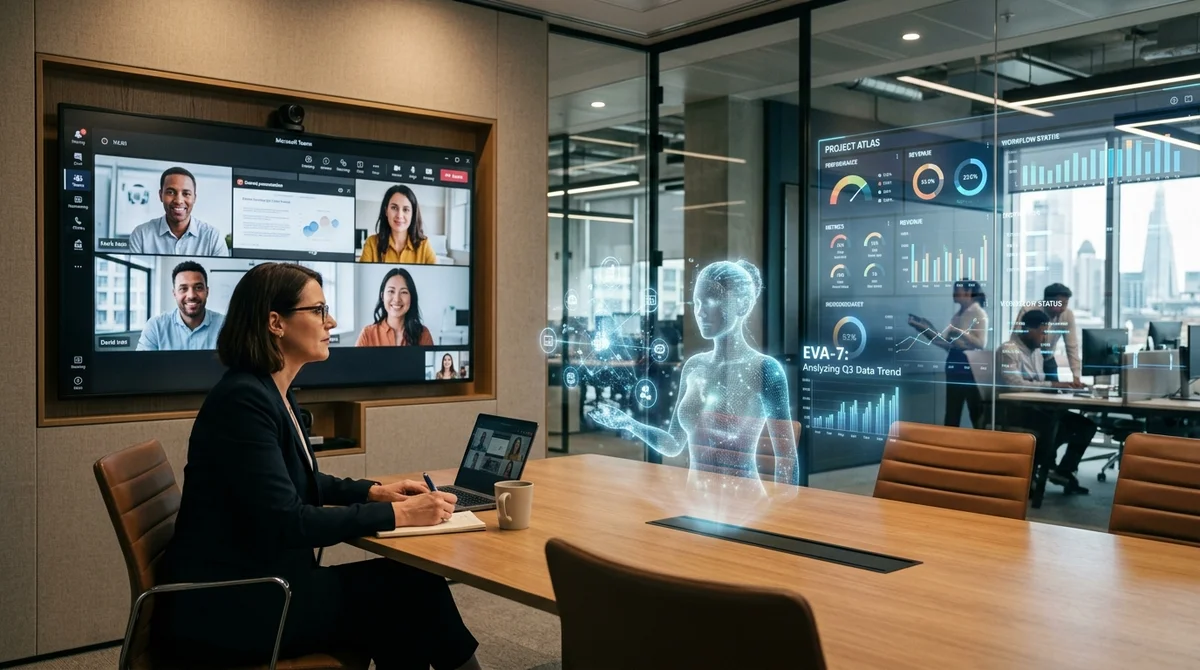
A new class of enterprise AI is quickly moving beyond familiar chatbots and meeting-transcription services. The startup in question offers more than a note-taking assistant: a full-fledged digital coworker. The agent can join every Zoom meeting, monitor workflows, notice gaps on its own and nudge employees to act before a manager sees the problem. In essence, this is an attempt to embed AI directly into a team's day-to-day operations and make it a permanent participant in the work, rather than a tool that is switched on only on request.
The main difference is proactivity. Most enterprise AI tools still work in service mode: they write summaries, answer questions, search for documents, draft emails or gather data after a user's command. Here the logic is different. The system watches how tasks move, who promised what, which decisions were made on a call and where a gap has opened between agreement and execution. If a task has stalled, no owner has been assigned or a promise has gone unfollowed, the AI does not wait for a new request. It raises the alarm itself and reminds participants to tie up loose ends.
That is why the product looks like the next step after transcription and automatic meeting summaries. Over the past two years, companies have grown used to AI that can listen to a conversation, pull out key points and draft a follow-up automatically. Now startups are trying to raise the stakes, so that the system does not just record what happens but manages the routine alongside people. In theory, this reduces the number of lost tasks, cuts the manual oversight managers must do and speeds up delivery on agreements. For distributed teams that live in calendars, chats and endless calls, the format is especially appealing: the more communication, the higher the cost of each missed decision.
But along with convenience comes another question: where is the line between assistant and overseer? If a digital coworker sits in on every call and constantly compares what was said with what was actually done, employees may see it not as an assistant but as a system of soft control. The title of the original piece hints at exactly this effect: the AI seems to be constantly reporting to the boss on who failed to do what.
For a manager, that can mean more transparency and less manual chasing. For a team, it carries the risk of a constant feeling of being watched, especially if the logic behind its recommendations is opaque and the model's conclusions cannot be quickly checked or challenged.
Accuracy and corporate policy are a separate issue. Any system that interprets conversations and turns them into management signals can make mistakes: misread context, confuse how binding a remark was, miss irony, overlook a change in priorities or, conversely, turn a rough idea into a formal assignment. So the real value of such a product will depend not only on the quality of the model but also on how the usage rules are set up.
Can employees switch the agent off for part of their meetings? Who sees its conclusions? Are recordings of conversations stored?
Can a wrong interpretation be corrected before it reaches management? Without clear answers to these questions, even a strong product risks provoking resistance inside the company.
The meaning of this story is broader than one particular product. Enterprise AI is gradually changing roles: from a passive on-request tool, it is becoming a participant in processes that observes, reminds, coordinates and influences execution discipline. That can genuinely speed up work where teams are drowning in calls and losing track of agreements. But the closer AI gets to a manager's functions, the more important transparency, the right to make mistakes and clear limits on oversight become. Otherwise a digital coworker built for efficiency will quickly become a symbol of distrust within the team.
- Nov 2, 2026Karpathy builds a YouTube clone with 6454 videos from Hacker News recommendations in two hours
- Nov 2, 2026Karpathy used Claude to build HackerTube from 6,454 videos recommended on Hacker News
- Nov 2, 2026Arca gives AI agents finance tasks lasting up to 10 days, but leaves the trades to humans
- Nov 2, 2026DeepSeek open-sources Super-agent prototype: p95 task completion time of 15.7 minutes vs. 29.5
Test Frontier LLMs & Autonomous Agents in One Workspace
Run Claude Opus 5.5, GPT-6, Gemini 3.1, and DeepSeek side-by-side in Nomad AI (nomadnet.ai) — unified model routing, deep research, and multimodal workflows under one subscription.
The AI world, distilled — once a week
Seven stories that actually mattered, hand-picked. No noise, no reposts, no press releases.
Done! Check your inbox for a confirmation.