Google Gemma 4, NVIDIA, and OpenClaw: Local AI Agents Without Per-Token Billing
Google and NVIDIA are promoting Gemma 4 as the foundation for local AI agents. Models can run on Jetson Orin Nano, RTX PCs, and DGX Spark, and the integration with OpenClaw removes the main barrier for always-on scenarios—ongoing API costs. Notably, for corporate and sensitive data, NVIDIA separately promotes NemoClaw with sandbox restrictions and access policies.
AI-processed from MarkTechPost; edited by Hamidun News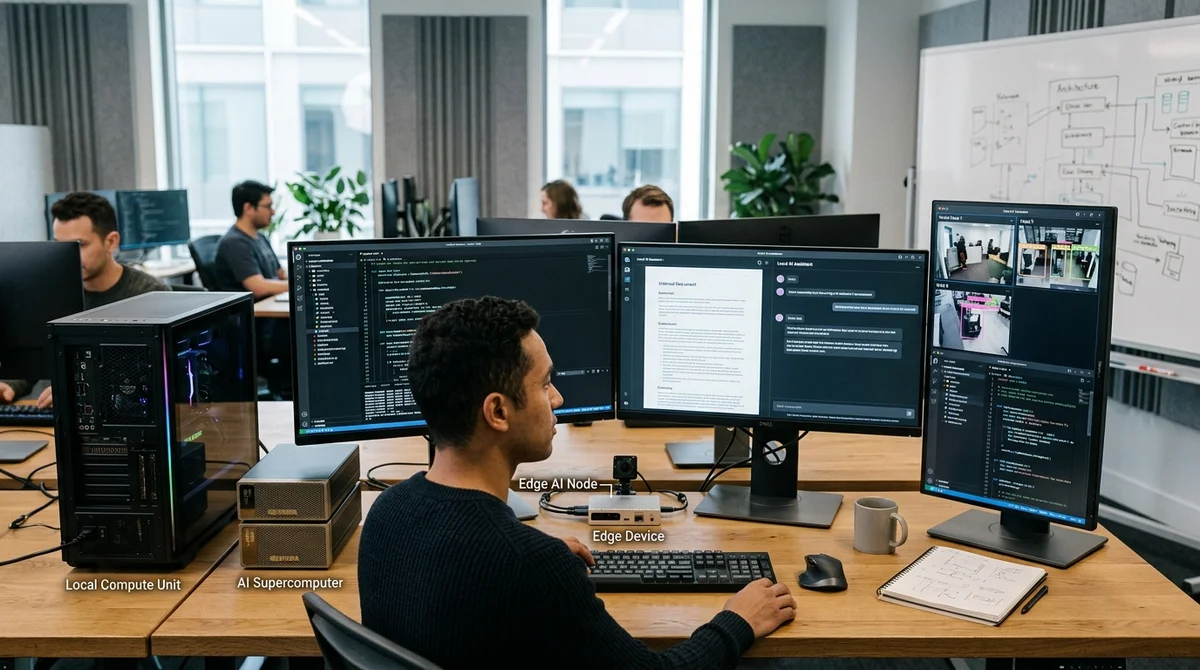
The idea of this article is simple: if an AI agent needs to work constantly, see the screen, read local files, process documents, and run actions in the background, then a model billed per token via cloud API quickly becomes an expensive service. Google, NVIDIA, and the OpenClaw ecosystem offer a different path — keep the model close to the data, run it on local hardware, and thereby eliminate not only latency but also the very logic of "payment for each step" in the agent's work. The "token tax" here refers not to one-time chatbot costs, but to the cumulative effect of always-on assistants.
Such systems constantly read context: correspondence, application windows, code, documents, calendar, folders, and notifications. If every observation, intermediate reasoning, and every action is sent through a cloud model, the cost quickly becomes unpredictable. For a personal assistant, this hits the budget; for a corporate scenario, it adds privacy concerns: sensitive data must be regularly sent outside.
That's why local execution here is important not as ideology, but as an economic and operational necessity. In this scheme, Google Gemma 4, unveiled on April 2, 2026, plays a key role. Google released four variants: E2B, E4B, 26B, and 31B.
The smaller models are designed for edge devices and mobile scenarios, the larger ones for reasoning, code, and agent workflows on workstations, and 26B uses a Mixture of Experts architecture and activates only 3.8 billion parameters during inference. Gemma 4 has native support for function calling, structured JSON output, and system instructions — everything needed for a reliable tool-using agent.
All models work with images and video, while E2B and E4B also support native audio input. Context windows reach 128K tokens for edge models and 256K for the larger ones. According to Google as of April 2, 2026, the 31B version ranked third among open models in Arena AI, and 26B ranked sixth, with the company emphasizing that the lineup outperforms models significantly larger in size.
It's also important that Gemma 4 is distributed under the Apache 2.0 license, and the Gemma family had accumulated over 400 million downloads and over 100,000 variants in the ecosystem by the time of release. The second part of the story involves hardware and the runtime stack.
NVIDIA promotes Gemma 4 as a model lineup that scales from Jetson Orin Nano to GeForce RTX, RTX Pro, and DGX Spark with almost no change in approach. For edge scenarios, Jetson Orin Nano supports E2B and E4B, enabling autonomous visual and voice systems with low latency directly on the device. For local workstations and personal assistants, the focus shifts to 26B and 31B, which can be run through Ollama, llama.
cpp, vLLM, and Unsloth. DGX Spark is especially important here: NVIDIA specifically highlights the configuration with GB10 Grace Blackwell Superchip and 128 GB unified memory as a convenient entry point for local prototyping, fine-tuning, and running large models without the cloud. In this mode, OpenClaw transforms from a "wrapper over a remote API" into a truly local agent that takes context from files, applications, and workflows directly on the user's machine.
In fact, OpenClaw makes this story understandable on a practical level. It's a local-first agent that can live on a computer permanently, connect to messengers, remember task state, and invoke tools. For it, a local model is not a nice bonus but a basic condition for normal economics.
If an agent must spend all day reading a codebase, tracking projects, responding in chats, or processing financial documents, cloud tokenization becomes the primary constraint. At the same time, locality itself doesn't solve the security question: an agent with access to files, networks, and accounts remains a risky entity. That's why NVIDIA is simultaneously pushing NemoClaw — an open stack with OpenShell and policy-based guardrails that should limit the behavior of always-on agents, sandbox execution, and keep sensitive data within the local perimeter.
In practice, this means a shift in the very consumption model of AI. It's no longer just about how smart a model is in benchmarks, but whether you can keep it running all day without worrying about cost, latency, and data leaks. The combination of Gemma 4, NVIDIA RTX, or DGX Spark, and OpenClaw demonstrates that the market is moving toward personal and corporate agents that work closer to data and closer to the user.
The cloud won't disappear, but for always-on assistants, local code, document workflows, robotics, and sensitive files, local inference stops being a niche option and becomes the basic architecture.
Need AI working inside your business — not just in your newsfeed?
I build production AI for companies — custom CRM, internal tools, autonomous agents, workflow automation. Owned by you, shaped to your process, no per-seat tax. Built by Zhemal Khamidun, CPO of AlpinaGPT (AI platform, 6,000+ users).
The AI world, distilled — once a week
Seven stories that actually mattered, hand-picked. No noise, no reposts, no press releases.
Done! Check your inbox for a confirmation.