Google employees demand Pichai keep the company's AI models away from the Pentagon
A major internal dispute has erupted at Google over possible Pentagon access to the company's AI models. More than 600 employees, including DeepMind developers and over 20 executives, sent Sundar Pichai a letter demanding that he not allow such cooperation. The episode shows that military use of AI is becoming a reputational issue for Big Tech, not just a commercial one.
AI-processed from 3DNews AI; edited by Hamidun News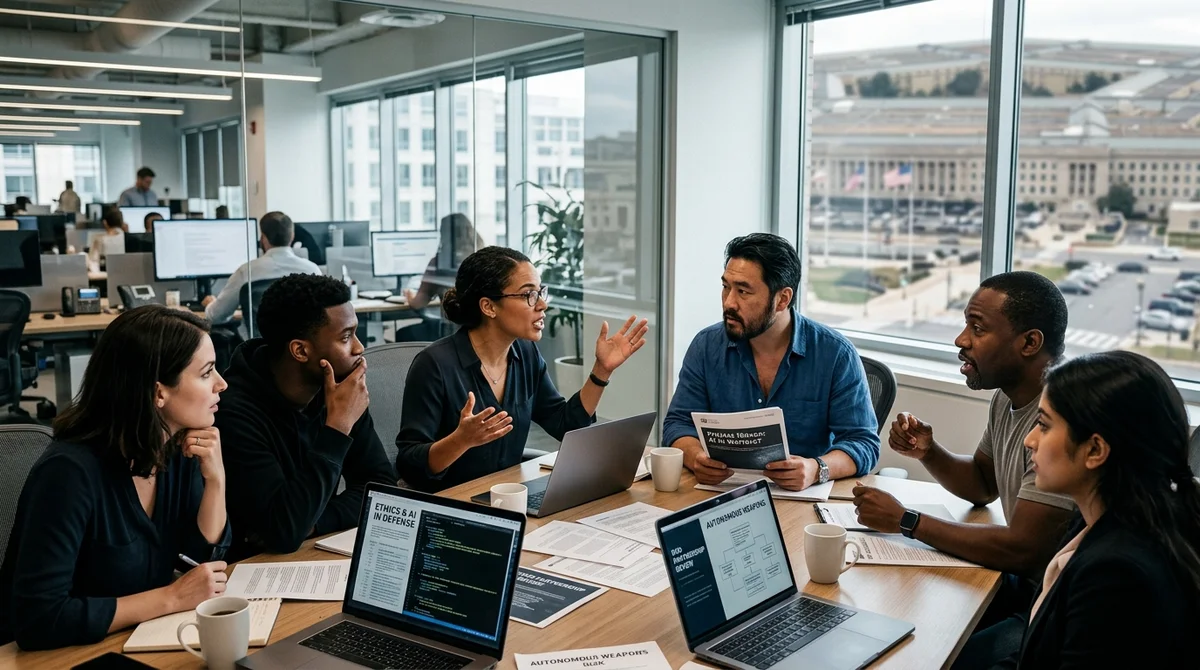
A new dispute has flared up inside Google over the limits of artificial intelligence use: more than 600 employees have demanded that CEO Sundar Pichai not give the Pentagon access to the company's proprietary AI models. The letter was signed not only by rank-and-file engineers but also by DeepMind specialists and more than 20 senior executives. This is not local grumbling but a visible internal conflict over how the company should use its most sensitive technologies.
The letter matters for several reasons. First, the signatories include employees of units directly tied to the development of Google's most advanced AI systems. Second, the participation of top managers shows that doubts about working with the military exist not only among individual developers but also among people who make management decisions. When a protest against possible Pentagon access to the models comes from several layers of the company at once, leadership can no longer treat it as the private initiative of a small group of activists.
The demand itself is worded quite firmly: employees want the Pentagon not to get access to Google's AI models. Behind that wording lies a broader fear that technologies for generation, data analysis and decision automation could be used in military infrastructure, and therefore in tasks where the consequences of errors or contested decisions are far more serious than in consumer products. Even if the company formally restricts use cases, handing such tools to a defense agency looks to many inside Google like crossing a fundamental line.
For Google this is a strategic question as well as an ethical one. Big tech companies increasingly find themselves caught between two sources of pressure. On one side, governments and defense bodies want faster access to cutting-edge AI, seeing it as a way to improve efficiency, analyze large data sets and speed up decision-making. On the other, the employees of those companies are demanding transparency with growing volume: who exactly uses the models, on what terms, what restrictions are written into contracts, and who is responsible for the consequences.
At Google the conflict is especially sensitive, because the company has long tried to combine its status as a global AI leader with the image of a technology platform that professes responsibility. Any decision will be judged not only on its legal wording but also on whether management can keep the trust of its own teams and avoid turning an internal dispute into a prolonged crisis of corporate culture.
DeepMind's involvement sharpens the situation further. The division is associated with Google's most advanced AI research, so its employees' voice is read as a signal from the center of the company's AI expertise. If even the people who help build the key models oppose their potential use by the Pentagon, that raises pressure on leadership and makes Pichai's eventual response politically and reputationally significant. For the outside market it is also a marker: disputes over AI now play out not only between companies and regulators but inside the teams that build these systems.
The main takeaway is that for Google, AI and defense contracts are no longer a technical topic or a matter for closed-door negotiations. The issue has become a public internal debate about the limits of the acceptable, employees' influence on company strategy, and the price of cooperating with the state in the era of generative AI. And the more powerful these tools become, the harder it will be for the largest developers to separate commercial gain from decisions that touch security, politics and trust in the company itself.
- Nov 2, 2026The Verge reviewer builds a $50 Meta Muse Charm alternative with Claude Code
- Nov 1, 202616 models tested on 7 search tools: Exa averaged 10.5 out of 14, SearXNG about 3
- Nov 1, 2026Google's StreamVibe video agent beats other models by 10.7% on response timing and quality
- Nov 1, 2026OpenAI Rewrites GPT Behavior Rules: Five Values and a Chain of Command
Test Frontier LLMs & Autonomous Agents in One Workspace
Run Claude Opus 5.5, GPT-6, Gemini 3.1, and DeepSeek side-by-side in Nomad AI (nomadnet.ai) — unified model routing, deep research, and multimodal workflows under one subscription.
The AI world, distilled — once a week
Seven stories that actually mattered, hand-picked. No noise, no reposts, no press releases.
Done! Check your inbox for a confirmation.