Why AI in UI design matters as a source of visual mutations, not as a production tool
AI-generated UI does not have to become a production mockup right away. Its main benefit lies elsewhere: a neural network quickly throws out rare visual combinations that can highlight a new direction for a product. In this process, the designer increasingly does not invent the first image from scratch. Instead, they select the successful deviations, normalize them and turn them into a working system.
AI-processed from Habr AI; edited by Hamidun News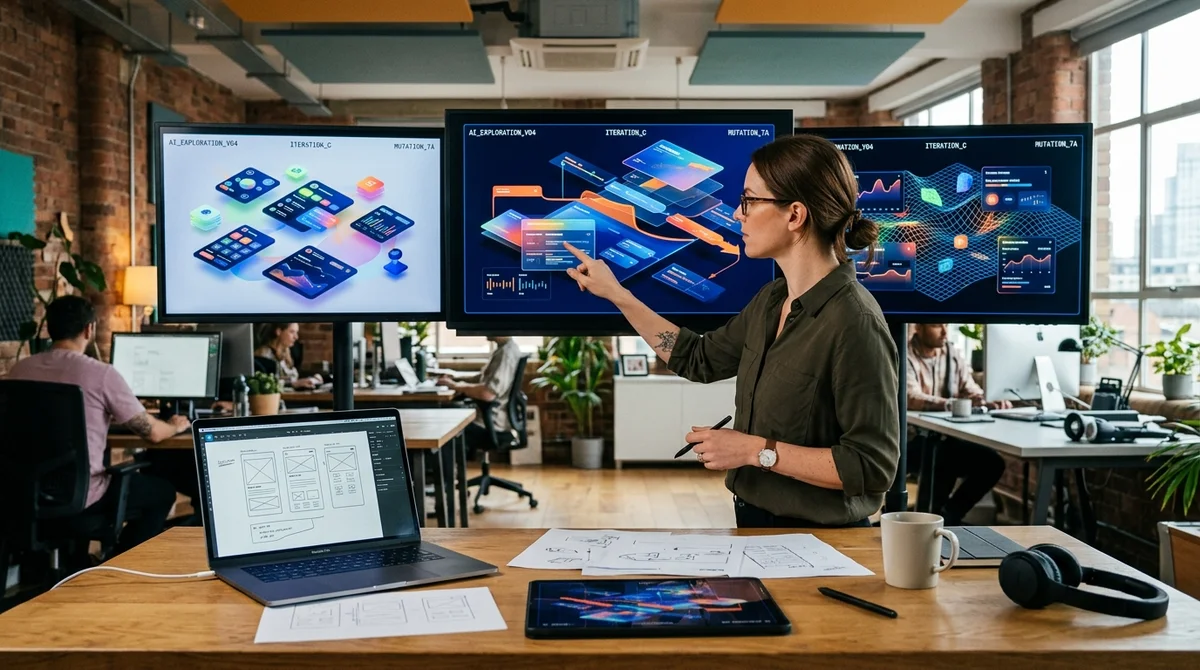
AI-generated UI is best treated not as a nearly finished interface but as a machine for finding unexpected visual moves. Its main value often lies not in handing a screen straight to development, but in quickly showing combinations of shapes, rhythms and accents that a designer might take noticeably longer to reach.
Discussion of neural-network-made interfaces usually slides into two extremes. The first: can the result go straight into production? The second: how closely does it resemble familiar systems such as Apple Human Interface Guidelines or Material Design? Both lenses are too narrow. They make us look at an AI image as a half-finished product, when more often it is raw, unstable and unpredictable material for exploration. Its strength is not reproducibility but the ability to quickly throw out variants that break the usual path of thinking. Even failed generations are useful: they show which visual solutions look overloaded, where hierarchy breaks down and which effects work only as one-off attractions.
That is why it is worth studying AI-generated UI as a source of visual mutations. Here, mutations can mean rare combinations of grids, density, contrasts, decorative layers, micro-shapes and compositional accents that are not necessarily good in themselves but may highlight a new direction. A person working by hand usually moves through familiar patterns, past references and the internal constraints of the team or product.
A model produces intermediate forms in bulk and sometimes lands on an unexpected point: strange, uneven, but visually alive. Out of ten or a hundred such deviations, one can give a stronger impulse than a carefully assembled moodboard. For product teams, this matters most at stages where the task is not to pick the best pixel-level option, but to notice at all that a different kind of interface character is possible.
This leads to a more important shift in the designer's role. Previously, a strong first image was usually born inside the author's head: they found the idea, developed it and then turned it into a system. With generative tools, the entry point moves outside.
The machine increasingly offers the initial visual impulse, and the human works as editor and systematizer: selecting successful deviations, cutting the excess, normalizing composition, checking applicability and translating an eye-catching image into the language of the product. In essence, the designer competes less and less with the machine on the speed of the first sketch and wins more and more through interpretation, editing and the ability to turn a random form into a consistent rule. This does not cancel design expertise; on the contrary, it raises the bar for taste, visual literacy and the ability to tell a disposable visual trick from the seed of a durable system.
The practical meaning of this approach is that AI-generated UI is better placed not in the final assembly of mockups but in the early stages of search. It can speed up the search for options, widen the range of solutions and help a team move beyond overly safe choices. But human work is still needed afterward: checking scenarios, accessibility, consistency, technical feasibility and brand fit. Otherwise the mutation remains just a pretty anomaly. The value appears when the designer does not copy the model's output but extracts a principle from it: an unusual rhythm, contrast, navigation structure, handling of depth or a new logic for grouping elements.
The main conclusion is this: today the value of AI-generated UI lies less in automated screen production than in supplying external visual deviations from which new interface solutions can be grown. The sooner teams stop measuring such results only by production readiness and similarity to existing design languages, the sooner they will see AI not as a replacement for the designer but as a tool for directed evolution of a visual system.
- Nov 1, 2026Local models lose to Opus and Codex: 0.21 on a MacBook versus 1.00 for Codex
- Oct 29, 2026Claude Code Edits Video From a Transcript: How the video-use Skill With 30 000 Stars Works
- Oct 29, 2026Stanford AI tool verifies part of Signal's code in half a day for under $500, versus five months of expert work
- Oct 29, 2026Liquid AI releases LFM3: six multimodal 2B models with a 256K context window
Test Frontier LLMs & Autonomous Agents in One Workspace
Run Claude Opus 5.5, GPT-6, Gemini 3.1, and DeepSeek side-by-side in Nomad AI (nomadnet.ai) — unified model routing, deep research, and multimodal workflows under one subscription.
The AI world, distilled — once a week
Seven stories that actually mattered, hand-picked. No noise, no reposts, no press releases.
Done! Check your inbox for a confirmation.