Nvidia demonstrated neural texture compression for games: VRAM usage decreased by nearly seven times
Nvidia demonstrated one of the most practical AI technologies for games at GTC 2026 — Neural Texture Compression. In the demo, VRAM usage dropped from 6.5 GB…
AI-processed from 3DNews AI; edited by Hamidun News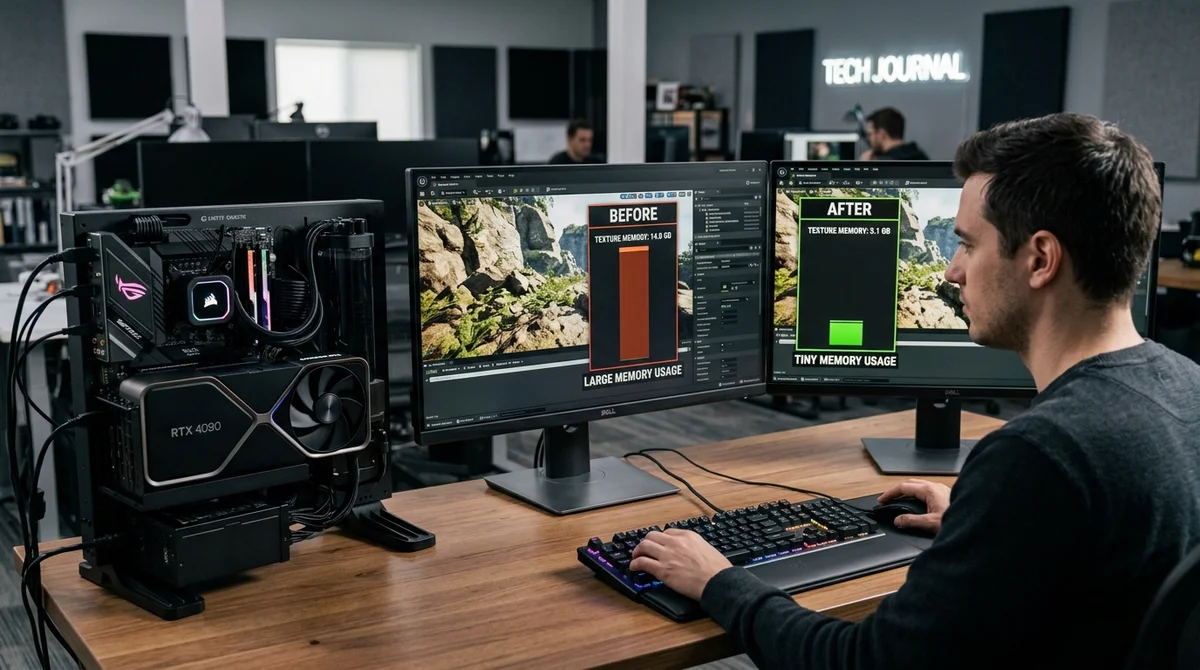
Nvidia showed at GTC 2026 that the video memory deficit in games can be addressed not only with more expensive GPUs, but also with different logic for working with textures themselves. At the conference in San Jose, which took place March 16-19, 2026, the company demonstrated Neural Texture Compression — a system that in a test scene reduced VRAM consumption from 6.5 GB to 970 MB with comparable visual quality.
For an industry where texture volume has long been one of the main constraints, this looks not like a laboratory trick, but like a very practical step. Essentially, this is about neural compression of materials. Instead of storing large texture sets in familiar block formats, Nvidia proposes encoding them into a compact representation, then restoring them directly during rendering using a small neural network.
Such a network is trained for a specific material and runs directly in shaders, using the tensor cores of RTX graphics cards. An important point is that the technology does not require a complete departure from existing graphics pipelines: developers can integrate it as a separate tool into an already familiar scene assembly and output process. The idea itself is not new to Nvidia.
The company published research on this topic as far back as SIGGRAPH 2023, and now shows how the approach is turning from research work into an applied SDK for game engines and graphics applications. In official materials, Nvidia says that neural compression can save up to seven times more VRAM or system memory compared to traditional formats while maintaining the same quality level. In early examples, the company also showed that this approach allows for higher effective detail: in one of the comparisons, neurally compressed textures provided four times higher resolution with less memory than quality block compression.
In the long term, this could also affect the size of game packages themselves, since the benefits extend not only to graphics card memory, but also to data storage. Why this matters right now is clear without much explanation. Modern games increasingly hit not just computational power limits, but memory limits: open worlds, 4K and 8K textures, complex materials, path tracing, and a large number of unique assets quickly consume VRAM even on powerful graphics cards.
When memory runs out, aggressive data loading, microfreezes, and unpleasant quality compromises begin. If textures can be stored much more compactly and decoded on demand, developers get more freedom in populating a scene, and users get a better chance of less often hitting a hard memory limit. The technology, of course, has its limitations.
It is not a magic switch that will automatically make any old game more efficient. It requires developer-side tools, training small models for specific materials, and support for a modern GPU stack, including acceleration of such computations through Tensor Cores and new mechanisms like Cooperative Vectors in DirectX. In other words, a mass effect will only appear when support for NTC begins to be built into real game projects, not just tech demos and SDKs.
But the main conclusion is already quite clear now: Nvidia has found one of the few AI applications in graphics where the benefit is measured not by marketing promises, but by very concrete megabytes. Neural Texture Compression does not try to "paint in" the scene for the artist, but solves a narrow and expensive problem — how to fit more visual complexity into the same amount of memory. If the technology really reaches mass games without noticeable quality and performance degradation, the debate about how much VRAM is needed for new releases could become noticeably less painful.
Want to stop reading about AI and start using it?
AI News is a curated feed of AI/tech news. Hamidun Academy teaches you to use AI systematically in your work.