T1 Cloud: H200 vs. L40S — a technical look at GPUs for generative AI
Not every AI workload needs a flagship H200. T1 Cloud has released a technical review of its servers built on NVIDIA H200 and L40S accelerators, complete with photos from its data center. The H200, with 141 GB of HBM3e memory, targets large-model training and video generation. The Ada Lovelace-based L40S handles inference, RAG systems, and enterprise chatbots. The provider expanded its GPU lineup so customers don't overpay for capacity they don't need.
AI-processed from Habr AI; edited by Hamidun News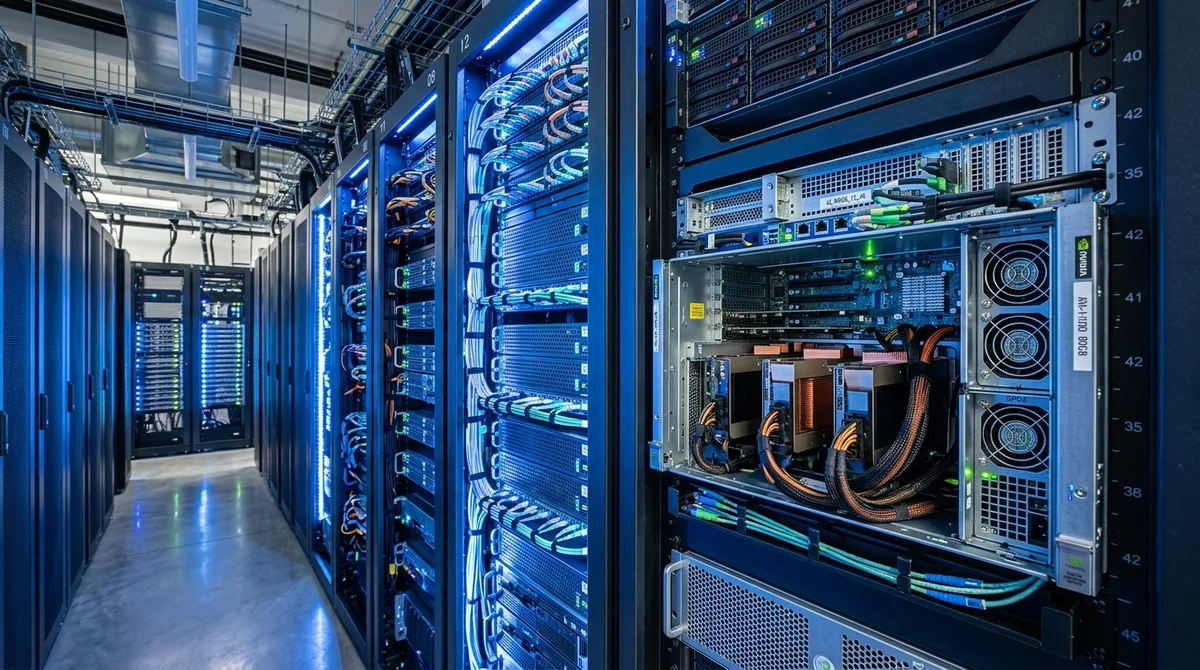
Choosing a GPU for AI work isn't only a budget question. It's about matching the tool to the job: getting exactly as much compute as a given workload needs, without paying for specs that will never be used. That principle drove T1 Cloud's expansion of its GPU lineup. The company has published a detailed technical review of its servers with NVIDIA H200 and L40S accelerators, including photos taken inside its data center.
The review arrives as demand for GPU compute keeps climbing. As LLMs move from experimental tools to standard enterprise infrastructure, companies increasingly face a practical question: which accelerator actually fits a specific task?
The H200 sits at the top of the GPU market. The successor to the H100, it gets next-generation HBM3e memory with 4.8 TB/s of bandwidth and more capacity: 141 GB versus its predecessor's 80 GB. This is the card for workloads that need to keep huge models in memory: large multimodal networks that generate text, images, and video; training from scratch at hundreds of billions of parameters; and high-resolution video processing. The H200 supports NVLink for connecting multiple GPUs within a server, plus high-speed Infiniband interconnect between nodes. That matters for large-scale training runs, where data has to move quickly across dozens of nodes.
The L40S is a different story. It's an Ada Lovelace accelerator with 48 GB of GDDR6 memory and fourth-generation Tensor Cores optimized for FP8 and BF16 operations. Its strength isn't record memory bandwidth but versatility. The L40S handles mid-sized language model inference, rendering, video processing, computer vision, and generative design equally well. If a company needs to deploy an enterprise chatbot over internal documents, build a RAG system for a knowledge base, or automate image processing, the L40S will get the job done without the premium for the H200's flagship specs.
T1 Cloud deliberately broadened its GPU lineup so it wouldn't push overly expensive hardware on customers who don't need it. Its data center now has servers for different classes of workloads, from lightweight inference and RAG systems to heavy distributed training. That's a meaningful step in a market where many providers have historically offered only flagship configurations, leaving businesses to overpay for compute they simply don't need.
The practical value is clear. A company that needs an enterprise knowledge base with semantic search across thousands of internal documents shouldn't rent an H200 cluster. One or two L40S cards will do. But if that same company trains its own specialized multimodal model or works with 8K video, it will only see real gains from the H200, and cutting corners on hardware there will cost it time and quality.
The format of the publication deserves its own mention: detailed data center photos are a rarity in the Russian cloud market. Most providers stick to spec-sheet PDFs and marketing slides. Showing the actual hardware alongside a technical description adds transparency and helps engineers and procurement teams understand how the infrastructure is built, which matters especially when choosing a long-term technology partner.
The takeaway: the growing AI accelerator market is forcing cloud providers to think not only about flagship capacity but also about smart segmentation. The H200 and L40S aren't competitors; they're tools for fundamentally different jobs. Providers that understand this and offer both options with clear usage guidance gain a real competitive edge: customers pay for exactly what they need, no more and no less.
- Nov 2, 2026Cosmos generated training video for drones: detector mAP@50–95 up 10.3%
- Nov 2, 2026Karpathy builds a YouTube clone with 6454 videos from Hacker News recommendations in two hours
- Nov 2, 2026Karpathy used Claude to build HackerTube from 6,454 videos recommended on Hacker News
- Nov 2, 2026The Verge reviewer builds a $50 Meta Muse Charm alternative with Claude Code
Test Frontier LLMs & Autonomous Agents in One Workspace
Run Claude Opus 5.5, GPT-6, Gemini 3.1, and DeepSeek side-by-side in Nomad AI (nomadnet.ai) — unified model routing, deep research, and multimodal workflows under one subscription.
The AI world, distilled — once a week
Seven stories that actually mattered, hand-picked. No noise, no reposts, no press releases.
Done! Check your inbox for a confirmation.