Hyundai expands its bet on robotics and physical AI for industry
Hyundai is increasingly stepping beyond automotive and building strategy around robotics and physical AI. The main bet is on factories where Boston Dynamics humanoid robots will work alongside people and take on routine tasks. By 2028, the group plans major investments in the US, and by 2030 expects to scale production of such machines to 30,000 per year.
AI-processed from AI News; edited by Hamidun News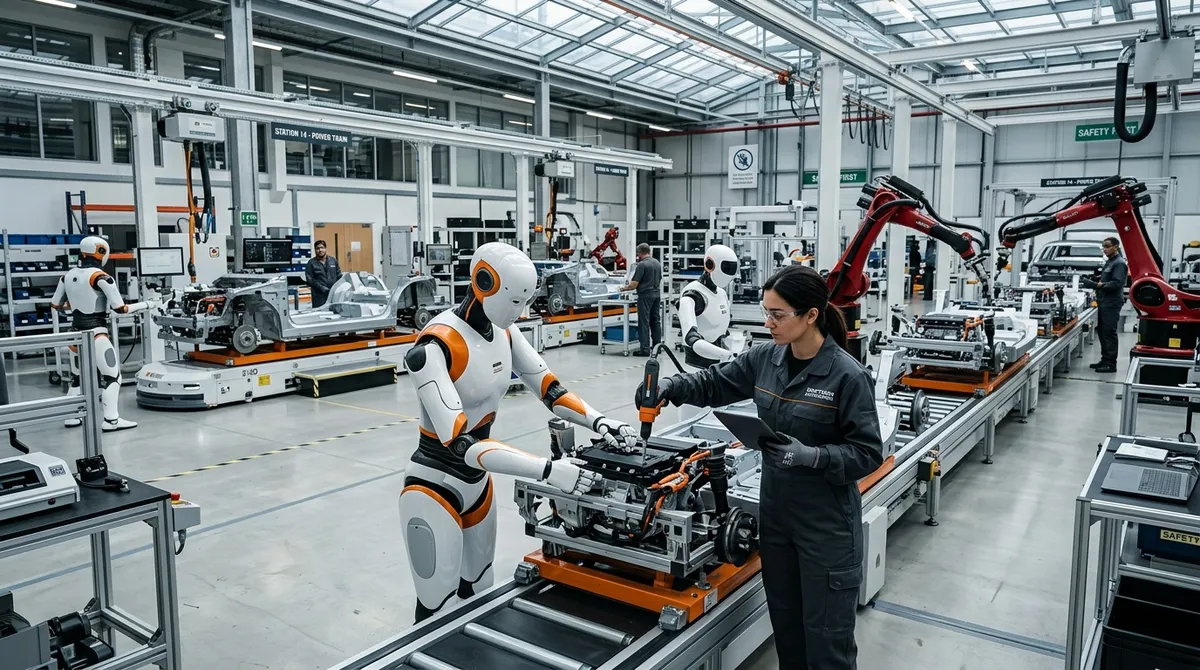
Hyundai clearly demonstrates that it wants to be not just an automaker, but a developer of machines that act in the physical world. The company is betting on so-called physical AI: systems where algorithms are embedded in robots, production lines, and infrastructure capable of moving, responding to conditions, and working alongside people. For now, factories and industry remain the main testing ground for this strategy, but the direction appears broader than just another wave of automation.
In an interview with Semafor, Hyundai Motor Group Chairman Jung Ui-sung identified robotics and AI as one of the key drivers of the group's next growth phase. According to data cited in the material, Hyundai plans to invest $26 billion in the US by 2028, supplementing approximately $20.5 billion invested over the previous 40 years.
This is not just about expanding the automotive business. The company is trying to combine manufacturing, robots, software-controlled factories, and services where physical devices make decisions based on real-time data. Hyundai emphasizes the importance of collaboration between people and machines, rather than complete displacement of personnel.
For this, the group needs not just an industrial manipulator, but more flexible robotics capable of sharing space with humans and taking on repetitive or physically demanding tasks. Here, Boston Dynamics plays a key role, a majority stake in which Hyundai acquired in 2021. The company is preparing humanoid robots primarily for manufacturing applications: deployment is expected around 2028, and by 2030, Hyundai aims to reach production of up to 30,000 such machines per year.
The logic is clear: humans are responsible for control, coordination, and exceptions, while robots handle routine tasks, precision, and operational stability. Factories remain the first and most obvious platform for physical AI. In manufacturing, the effects are easier to measure in numbers: assembly speed, number of defects, downtime, safety, and workforce utilization.
Hyundai is already moving toward software-controlled manufacturing in its American operations, combining data, software management, and automation. The next step involves transitioning to systems that don't just execute preset commands, but change behavior based on circumstances: adapt to parts flow, detect deviations, redistribute tasks, and help standardize processes across regions. For a global manufacturer, this is particularly important given regulatory changes, supply chain localization, and growing customer demands for quality and timelines.
The strategy also has an infrastructure dimension. Hyundai continues to invest in hydrogen through the HTWO brand, which covers hydrogen production, storage, and usage. The group's leadership links the growing interest in this area not only to transportation but also to increased demand from AI infrastructure and data centers, where energy consumption is becoming an increasingly critical constraint.
In this context, electric transport and hydrogen for Hyundai don't appear as mutually exclusive bets, but as a set of different energy scenarios for different tasks. This is an important point: as AI moves from data centers into the real world, success increasingly depends not just on models and sensors, but on energy, logistics, and the reliability of the physical environment. For the end user, the effect of this shift will likely first become apparent not as a humanoid home assistant, but in more practical matters: faster-assembled vehicles, consistent quality, more flexible logistics services, and new forms of mobility.
Hyundai already sells over 7 million vehicles per year in more than 200 countries, so any shift in its manufacturing model quickly scales. The main conclusion is simple: Hyundai is gradually transforming AI from a digital overlay into part of real machines and processes. If the company manages to bring this strategy to industrial scale, it will compete not only in the automotive market but also in the market for robotic systems for the physical world.
Need AI working inside your business — not just in your newsfeed?
I build production AI for companies — custom CRM, internal tools, autonomous agents, workflow automation. Owned by you, shaped to your process, no per-seat tax. Built by Zhemal Khamidun, CPO of AlpinaGPT (AI platform, 6,000+ users).
The AI world, distilled — once a week
Seven stories that actually mattered, hand-picked. No noise, no reposts, no press releases.
Done! Check your inbox for a confirmation.