Christine Lagarde Praises Anthropic for Cautious Release of New AI Model
Christine Lagarde has publicly backed Anthropic's cautious approach to releasing its new AI model. The ECB president argues that a limited release with extra safeguards matters more than an unconditional race for speed. For the market, it is a signal: regulators are looking not only at what models can do, but also at how safely companies bring them into the real world.
AI-processed from Bloomberg Tech; edited by Hamidun News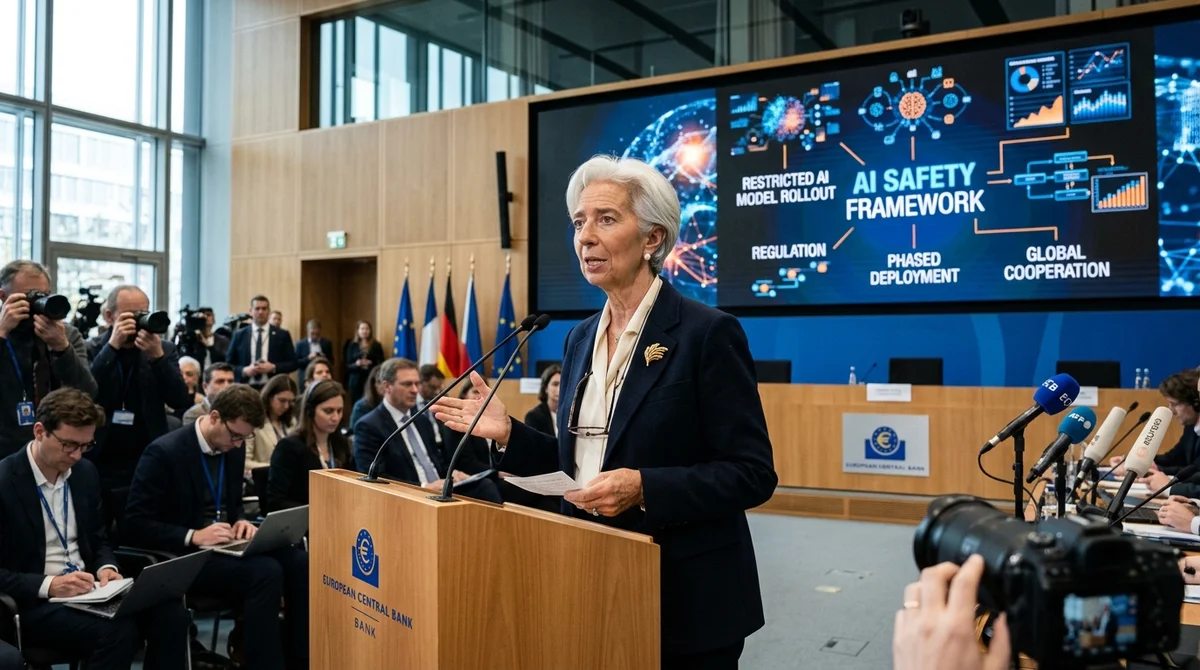
Major regulators are starting to treat artificial intelligence not as an abstract technology of the future, but as a source of very concrete risks to economies and institutions. European Central Bank President Christine Lagarde has publicly backed Anthropic's decision to limit the release of its new AI model, marking an important turn in the debate: a cautious launch is now seen not as a sign of a weak product, but as an example of responsible behavior as systems grow more powerful.
The statement carries particular weight because of who is making it. The ECB is one of Europe's key financial institutions, and its head, by definition, looks at technology through the lens of systemic stability, trust and risk management. For central banks, AI is not just a handy automation tool. These are technologies that already affect data analysis, customer service, fraud detection, cybersecurity and decision-making in sensitive sectors. If such systems scale faster than control mechanisms emerge, errors, bias or abuse can reach far beyond a single company.
Against that backdrop, Anthropic received praise that is rare in the industry, and it was for restraint. Lagarde's point is simple: when a developer does not open the widest possible access to a new model right away and limits its distribution instead, it buys time to check how the system behaves in real conditions and reduces the likelihood of instant, large-scale harm.
This approach matters for more than technical failures. The more powerful a model is, the higher the risk that it will be used for manipulation, generating false information, automating fraud schemes, or being deployed too quickly in processes where the cost of error is especially high. In that light, a limited release looks like a risk-management tool, not a marketing pause.
For Europe, this story fits regulatory logic that is already familiar. Brussels has spent several years consistently pushing for tougher AI rules, with an emphasis on risk assessment, transparency, developer accountability and oversight of use in sensitive areas. Lagarde's words fit neatly into that line. In effect, she is sending technology companies a signal: the question is no longer only how impressive a new model is, but how convincingly the company can demonstrate its safeguards before a large-scale launch.
The public praise for Anthropic also works as a benchmark for the market. Regulators are showing which behavior they are prepared to regard as mature and trustworthy. For the industry itself, this may matter no less than the next jump in model quality. For a long time, the main measures of success were release speed, user base growth and the ability to outpace competitors in a public race. But if major institutions start rewarding cautious launches, the balance of incentives will shift. Companies will have to explain not only what a model can do, but also the limits of its use, failure scenarios, testing methods and the reasons access is granted gradually rather than to everyone at once.
This is especially sensitive for players working where AI meets industries with a high cost of error: finance, healthcare, education, public services and corporate analytics. In these fields, trust in the launch process is gradually becoming part of the product itself.
The main takeaway is that the AI debate is entering a new phase. The focus is shifting from the question of "who built the more powerful model" to "who can safely control its distribution and use." Lagarde's support strengthens Anthropic's position as a company betting on a more careful way of bringing technology to market. For everyone else, it is a warning: the era when speed alone counted as an unconditional advantage is ending. The next field of competition is trust in release rules.
- Nov 1, 2026Local models lose to Opus and Codex: 0.21 on a MacBook versus 1.00 for Codex
- Nov 1, 2026Kimi scores 96.2% on a 1C database analytics test and emerges as a fallback if Claude access is blocked
- Nov 1, 2026OpenAI Rewrites GPT Behavior Rules: Five Values and a Chain of Command
- Nov 1, 2026Google admits AI Mode cuts search revenue, shares fall 15%
Test Frontier LLMs & Autonomous Agents in One Workspace
Run Claude Opus 5.5, GPT-6, Gemini 3.1, and DeepSeek side-by-side in Nomad AI (nomadnet.ai) — unified model routing, deep research, and multimodal workflows under one subscription.
The AI world, distilled — once a week
Seven stories that actually mattered, hand-picked. No noise, no reposts, no press releases.
Done! Check your inbox for a confirmation.