Guidesly Shows How Jack AI on AWS Transforms Trip Media into Reports and Marketing
Guidesly demonstrated how to turn trip photos, videos, and data into a finished report without manual assembly. Their Jack AI system on AWS connects media content with context, uses computer vision and generative models, and then prepares marketing materials for various channels. This is an example of AI for a specific operational task, not just a demo. This approach helps guides reduce manual editing work and provides businesses with a way to quickly transform field materials into publishable content across different platforms. The system's ability to link media with specific trip details, such as participants, locations, activities, and conditions, is crucial for creating compelling narratives.
AI-processed from AWS Machine Learning Blog; edited by Hamidun News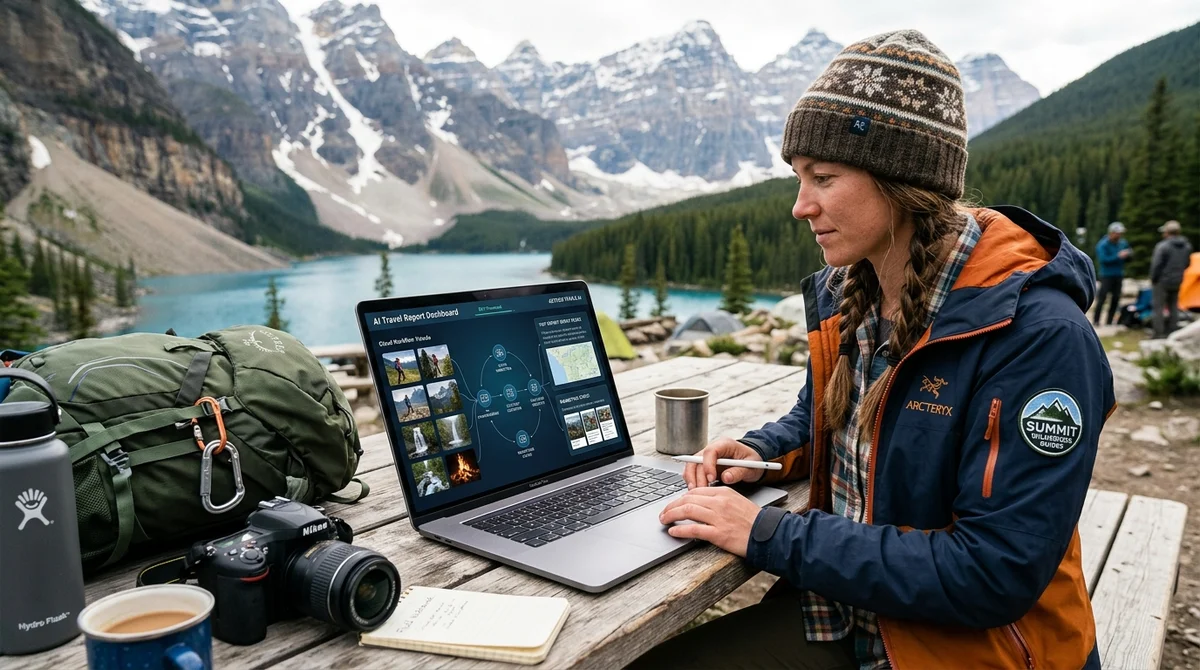
Guidesly has transformed the routine post-trip work of guides into an automated AI pipeline: Jack AI collects photos, videos, and accompanying trip data, analyzes them using computer vision and generative models, and then produces ready-made reports and promotional materials. As a result, guides have less manual editing work, and businesses gain a way to quickly turn field materials into content that can be published across various channels. For Guidesly, the task was not just to generate beautiful text from a few images.
The platform needed to link media content with the context of a specific trip: who led the group, where and when the trip took place, what activities occurred, what conditions were on the route, and what should be included in the final story. This scenario is especially important for the outdoor segment, where the quality of the story affects not only audience engagement but also sales of future tours, bookings, and trust in the guide.
Guidesly built the solution's architecture on a set of managed AWS services. AWS Lambda and AWS Step Functions are responsible for event reception and processing, allowing the process to be broken down into sequential stages rather than keeping everything in one monolith. Media files and intermediate artifacts are stored in Amazon S3, and structured trip data in Amazon RDS.
Further down the chain, Amazon SageMaker AI and Amazon Bedrock are connected: the first assists with ML components and data processing, the second with generative models that transform recognized context into texts, descriptions, and materials suitable for marketing. The key idea of such a pipeline is not to limit generation to just an image. First, the system retrieves original photos and videos, then enriches them with additional trip data, after which it applies computer vision to extract facts and objects from the media.
Based on this, the LLM can write not an abstract text, but a report that better reflects the client's real experience: where fishing or hiking took place, what happened during the day, what moments should be shown to potential new clients. This makes the result useful not only as an internal note but also as ready-made material for a website, newsletter, or social media.
An operational layer is separately important. Guidesly emphasizes security, reliability, and scalability because working with user photos, videos, and commercial content quickly runs into issues of access, storage, and pipeline predictability under load. The use of serverless components and managed AWS services allows the team to avoid spending resources on their own infrastructure where they can focus on product logic: task orchestration, recognition quality, and the tone of the final materials. For the company, this is also a way to quickly add new publication channels without completely redeveloping the entire system.
From a product perspective, the Guidesly case shows an important shift: the value of generative AI increasingly arises not in a separate chat interface, but within a specific vertical workflow. Here, the model does not just answer a user's question, but completes a business process from uploading raw content to publishing a marketing-ready result. For travel and outdoor services, this is particularly illustrative: the most valuable data is born in the field, and the winner is whoever transforms it into an understandable story and a commercially useful asset the fastest.
The main conclusion is that Jack AI is not a demonstration of AI for AI's sake, but an example of how generative AI, computer vision, and cloud orchestration come together in an applied service with measurable utility. If this approach becomes more widespread, the next step will be industry-specific AI pipelines that automatically transform unstructured materials into ready-made reports, cards, emails, and sales content.
Need AI working inside your business — not just in your newsfeed?
I build production AI for companies — custom CRM, internal tools, autonomous agents, workflow automation. Owned by you, shaped to your process, no per-seat tax. Built by Zhemal Khamidun, CPO of AlpinaGPT (AI platform, 6,000+ users).
The AI world, distilled — once a week
Seven stories that actually mattered, hand-picked. No noise, no reposts, no press releases.
Done! Check your inbox for a confirmation.