Google DeepMind unveils Gemini Robotics-ER 1.6 for autonomous real-world tasks
Google DeepMind has updated Gemini Robotics-ER to version 1.6, with a focus on real-world scenarios: from recognizing objects and verifying task completion to reading sensors and pressure gauges. The model handles multiple cameras better, counts and localizes objects more accurately, and supports calls to external tools. It is already available through the Gemini API and Google AI Studio.
AI-processed from DeepMind Blog; edited by Hamidun News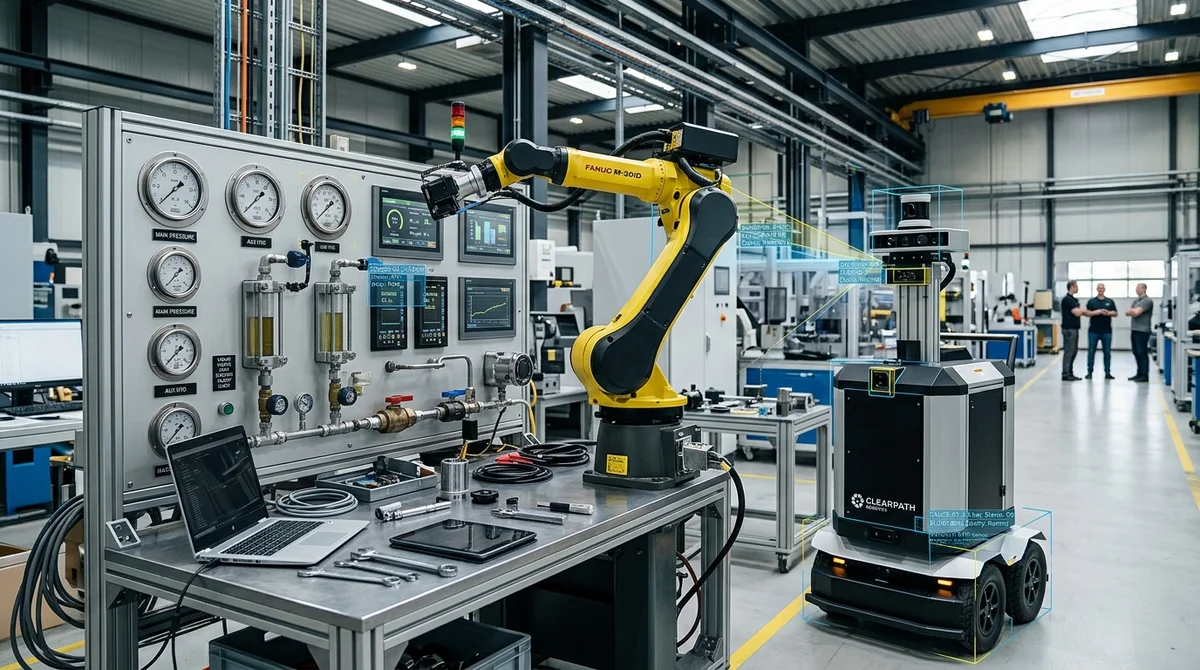
On April 14, 2026, Google DeepMind introduced Gemini Robotics-ER 1.6, an updated reasoning model for robots built not just to execute commands but to understand the physical environment. The company is betting on embodied reasoning: a system's ability to connect visual perception, task context and real action. The new version emphasizes sharper spatial reasoning, scene understanding across multiple cameras, detection of successful task completion and reading of industrial instruments. In essence, it is a high-level "brain" for a robot that can call external tools, VLA models and user-defined functions to carry out complex real-world scenarios.
One of the key improvements is spatial reasoning. DeepMind explains that for a robot, a basic operation such as pointing at an object is not a trivial matter but the foundation for more complex behavior. Using points, the model can not only find objects but also count them, compare sizes, work out relationships between objects, choose optimal grasp points and check constraints given in the prompt.
For example, if the system must point to all objects that will fit in a blue cup, it has to recognize the shape, size and relative position of the items at the same time. In demonstrations, Gemini Robotics-ER 1.6 counted the tools in a frame more accurately, did not point to objects that were absent, and overall performed noticeably better on such tasks than Gemini Robotics-ER 1.
5 and Gemini 3.0 Flash.
The second major area is understanding a scene from multiple viewpoints and so-called success detection, the ability to determine whether a task has actually been completed. For autonomous robotics this is critical: it is not enough for a robot to start an action; it must decide whether to retry or move on to the next step of the plan. In real installations this is especially hard because cameras often view the scene from above and from the manipulator at the same time, some objects may be occluded, and lighting and background change.
Gemini Robotics-ER 1.6 does a better job of correlating several video streams and assembling a coherent picture from them. As an example, DeepMind shows a scenario in which the system uses several views to determine whether the task "put the blue pen into the black pen holder" is complete.
The most practical addition is instrument reading. DeepMind developed this capability together with Boston Dynamics, building on industrial inspection tasks. In factories and technical rooms, a robot must regularly check thermometers, pressure gauges, chemical level indicators, sight glasses and digital displays. Recognizing the image is not enough: the system has to understand the needle position, liquid level, scale boundaries, divisions and unit labels, and sometimes even combine the readings of several needles that represent different digits. For a sight glass, it must also account for distortion caused by the camera angle.
According to DeepMind, instrument-reading accuracy rose from 23% for Gemini Robotics-ER 1.5 and 67% for Gemini 3.0 Flash to 86% for Gemini Robotics-ER 1.6. With agentic vision enabled, the figure reaches 93%: the model first zooms in on the relevant area, then uses pointing at key spots and code execution to estimate proportions and intervals, and finally interprets the resulting value.
DeepMind also stresses safety. The company calls Gemini Robotics-ER 1.6 its safest robotics model to date. It follows Gemini policies better in adversarial spatial tasks and adheres noticeably more closely to physical constraints, for example when the system must not handle liquids or lift objects heavier than 20 kilograms. In addition, on scenarios based on real injury reports, Robotics-ER outperforms Gemini 3.0 Flash: plus 6 percentage points on text tasks and plus 10 points on video tasks involving hazard recognition.
The model is already available to developers through the Gemini API and Google AI Studio. With the release, DeepMind published a Colab example and invited partners to submit labeled images of typical failures to improve future versions.
The update shows where competition in robotics is shifting: mechanics alone decide less and less, and the reasoning layer on top of them decides more. If a model can view a scene from several points, use tools, read instruments, verify results and respect safety constraints, a robot becomes not just an executing device but a system able to work according to the situation. For industrial inspection, warehouses and service scenarios, this is one of the most practical signals that large AI models are getting closer to real autonomy outside the lab.
- Nov 1, 202616 models tested on 7 search tools: Exa averaged 10.5 out of 14, SearXNG about 3
- Nov 1, 2026Google's StreamVibe video agent beats other models by 10.7% on response timing and quality
- Nov 1, 2026OpenAI Rewrites GPT Behavior Rules: Five Values and a Chain of Command
- Nov 1, 2026Voice bots built on LLMs turn to Jev, a fast classifier, for decisions in 200–500 ms
Test Frontier LLMs & Autonomous Agents in One Workspace
Run Claude Opus 5.5, GPT-6, Gemini 3.1, and DeepSeek side-by-side in Nomad AI (nomadnet.ai) — unified model routing, deep research, and multimodal workflows under one subscription.
The AI world, distilled — once a week
Seven stories that actually mattered, hand-picked. No noise, no reposts, no press releases.
Done! Check your inbox for a confirmation.