Stanford HAI report: the US-China AI gap has nearly vanished, while safety lags behind
Stanford HAI has recorded a turning point in the AI race: by March 2026, the US lead over China in model quality had shrunk to 2.7%. Nearly all labs readily publish results on model capabilities, but they disclose far less on safety. Meanwhile, the number of recorded AI incidents rose to 362 in a year, and Americans' trust in regulation remained at a record low.
AI-processed from AI News; edited by Hamidun News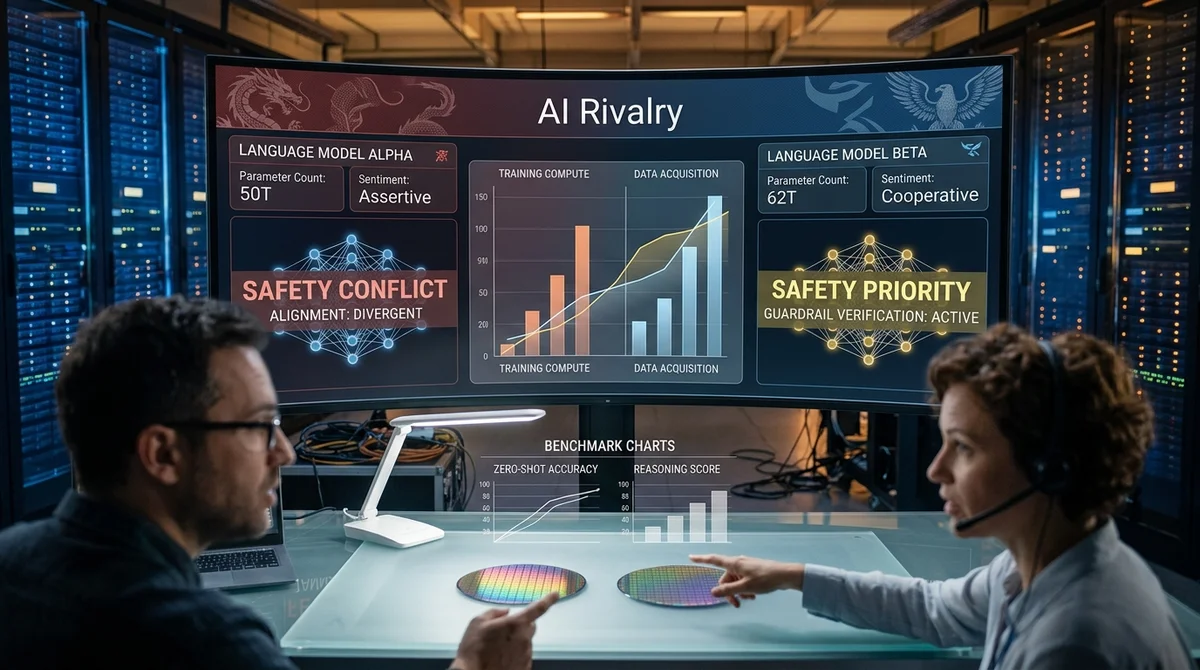
Stanford HAI's AI Index 2026 report punctures the comfortable myth of unconditional US leadership in artificial intelligence: on the quality of frontier models, China has nearly caught up with American companies, while on public safety verification the market still lags far behind its own ambitions.
The 2026 AI Index, published by Stanford HAI on April 13, 2026, collects data on model performance, investment, research publications, patents, public sentiment and responsible AI practices. Its main conclusion is an uncomfortable one for the American industry: a durable US technological lead is no longer visible.
According to Stanford, American and Chinese models have traded places at the top of the rankings several times since the start of 2025. In February 2025, DeepSeek-R1 briefly matched the best American model, and by March 2026 the lead of Anthropic's top model had narrowed to 2.7%.
That does not mean the US has lost all its advantages. American companies still release more top models: 50 versus China's 30 at the end of 2025. The US also has higher-quality patents and far more private investment. But China already leads in the volume of AI publications, share of citations and number of patents granted. In other words, the market is no longer a story about one undisputed leader. It is now a tight race in which the gap can shift after every major release.
Stanford separately points to a structural vulnerability in the American advantage. The US hosts 5,427 data centers, more than ten times as many as any other country. But almost all the advanced AI chips for this infrastructure are made by a single company, TSMC, in Taiwan. TSMC began expanding production in the US in 2025, yet the logic of the supply chain remains fragile: dominance in compute does not equal control over the entire technology stack.
Even more important, the gap between model capabilities and the way the industry measures risk is growing, not shrinking. Nearly all frontier model developers publish results on capability benchmarks such as MMLU or SWE-bench, but responsible AI data comes out in fragments. Stanford's tables on safety, fairness, factuality and human agency contain many empty cells, so comparing models on risk from the outside is often simply impossible. This does not mean labs do no internal red teaming or alignment testing at all. The problem is different: these checks are rarely disclosed in a single, comparable format.
Against this backdrop, the number of documented AI incidents keeps climbing. The AI Incident Database recorded 362 incidents in 2025, against 233 a year earlier, and before 2022 there were fewer than a hundred such cases a year. Organizations also do not look ready for the scale of the problem. In a joint survey by AI Index and McKinsey, the share of companies rating their response to AI incidents as excellent fell from 28% to 18% in a year, while the share reporting three to five incidents rose from 30% to 50%. A further complication is that improving one responsible AI metric can worsen another: for example, higher safety can reduce accuracy, and stronger privacy can hurt fairness.
Public perception is also becoming more contradictory. Worldwide, 59% of respondents think AI products bring more benefit than harm, yet 52% say such services make them anxious. Experts are markedly more optimistic than ordinary users: 73% of experts expect AI to have a positive effect on work, versus 23% of the US population; for the economy the figures are 69% versus 21%, and for medicine 84% versus 44%. At the same time, the US shows the lowest level of trust in its own government to regulate AI responsibly: 31%, against a global average of 54%.
The report's takeaway is simple: the argument over who leads today on model quality is becoming less important than the question of who can make AI verifiable, safe and resilient to failure. The US retains scale, capital and infrastructure; China has pace and a mass of research and patents. But the real unclosed gap lies not between the two countries, but between the speed of model development and the maturity of the control mechanisms around them.
- Nov 2, 2026mcp-linter finds 18 undescribed parameters in Anthropic's filesystem server
- Nov 2, 2026The Verge reviewer builds a $50 Meta Muse Charm alternative with Claude Code
- Nov 2, 20268 Skills for video in Claude Code: from 244 pixel effects to rough-cut editing
- Nov 1, 2026Local models lose to Opus and Codex: 0.21 on a MacBook versus 1.00 for Codex
Test Frontier LLMs & Autonomous Agents in One Workspace
Run Claude Opus 5.5, GPT-6, Gemini 3.1, and DeepSeek side-by-side in Nomad AI (nomadnet.ai) — unified model routing, deep research, and multimodal workflows under one subscription.
The AI world, distilled — once a week
Seven stories that actually mattered, hand-picked. No noise, no reposts, no press releases.
Done! Check your inbox for a confirmation.