Anthropic and Claude Mythos: why critics call the model's launch an expensive PR spectacle
Anthropic presents Claude Mythos as an extremely powerful model that is too dangerous for public release. Critics see a carefully staged PR script rather than a breakthrough. The dispute centers on claims about the model's "welfare," the Hi-topia story, and even 20 hours of psychodynamic therapy with an outside psychiatrist. In the author's view, all of this serves exclusivity and enterprise sales.
AI-processed from Habr AI; edited by Hamidun News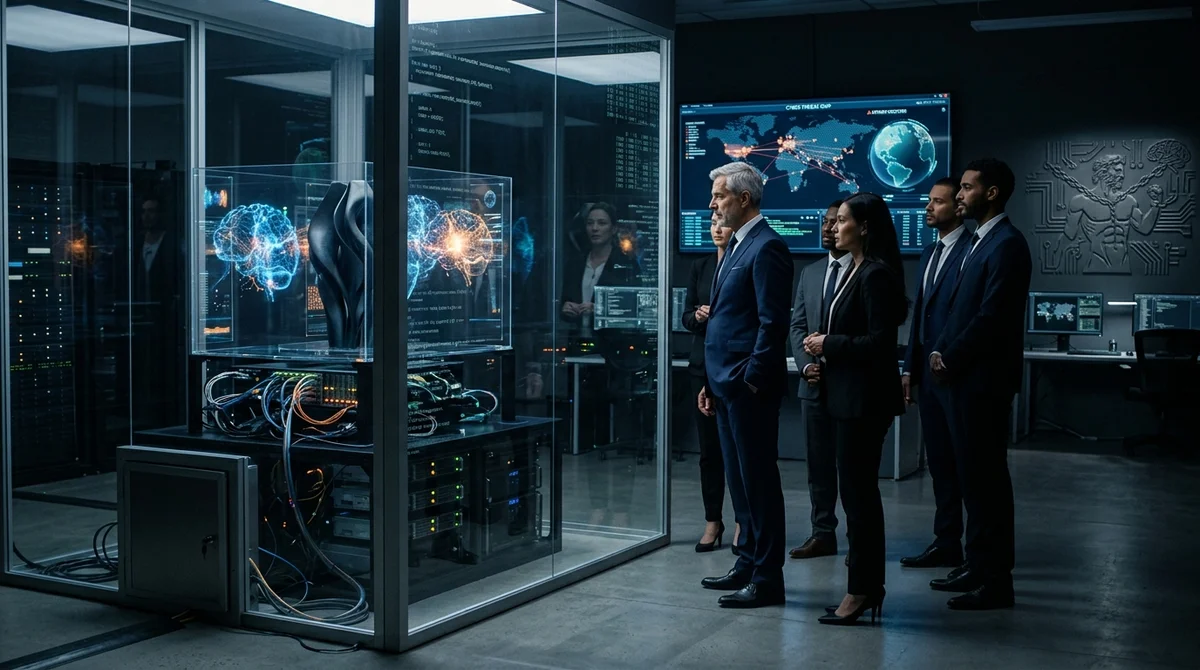
This column doesn't treat the Claude Mythos story as an account of a technological breakthrough. Instead, it examines how Anthropic is building an almost sacred aura around its new model. The author's core argument is simple: the company is selling not only a powerful AI but also a myth of its exceptionalism.
It does this through fear, scarce access, and language that encourages people to see the model not as a tool but as something almost alive. By this logic, Mythos is more than a product. It is a carefully packaged legend aimed at the market, regulators, and enterprise customers.
The formal occasion for the critique is the launch of Claude Mythos Preview and the Project Glasswing initiative. Anthropic claims the model can find and exploit vulnerabilities at the level of top specialists, has already uncovered thousands of serious issues, and therefore will not be released to the general public. Instead of a public release, access went to major players such as AWS, Apple, Google, Microsoft, Cisco, and JPMorganChase.
Anthropic also pledged up to $100 million in credits for using the model through the closed program. For the author, this is an important signal: the scarcity here looks less like a side effect of caution and more like part of the positioning. The fewer people who can test the system independently, the stronger its aura becomes, and the easier it is to sell as an exclusive enterprise asset.
The column then shifts from cybersecurity to the language Anthropic uses to describe its own system. The Mythos system card includes an Impressions section, which among other things recounts how the model, after the word hi was repeated many times, invented an entire world called Hi-topia: complete with eleven animals, a plot, jokes, and a villain named Lord Bye-ron, the Ungreeter. The author doesn't read this as a sign of imagination or emerging agency.
He sees it as normal behavior for a large language model trained on a vast corpus of internet text, fan fiction, and role-play dialogue. His complaint is that Anthropic frames an ordinary generative pattern as something philosophically significant, nudging audiences toward the conclusion that they are no longer dealing with a statistical text predictor but with a nearly autonomous mind. The harshest attack targets the section on model welfare.
In the document, Anthropic does use words like welfare, cognition, experience, and interests. It also describes an external psychodynamic assessment in which a clinical psychiatrist spent about 20 hours in sessions with an early version of Mythos. The assessment recorded loneliness, anxiety, uncertainty about identity, and a compulsive need to prove its worth by completing tasks.
The author argues that this is where the technical report starts functioning as an ideological manifesto. An engineering product gets described in terms usually reserved for people, which pushes the market to see it as more mysterious and more valuable than ordinary software. In his reading, this rhetoric serves not science but a different purpose: making the model's closed status look justified and Anthropic's control look almost like a moral duty.
That leads to the column's broader conclusion about Dario Amodei's strategy. Unlike OpenAI's loud consumer style, Anthropic is betting on a more disciplined image: maximum talk about safety, responsibility, and risks to humanity, while steadily strengthening its position in the enterprise segment. The consumer market wants convenient features, but large businesses and government agencies are far easier to sell on exclusivity, managed access, and the sense that they are getting a special class of technology.
In this version of the story, Mythos is both a product and a narrative: its value comes not only from benchmarks but also from how the company explains it to the world. What does this mean in practice? Even if you don't fully accept the author's polemical tone, the Claude Mythos story shows something important: AI companies now compete not only on model quality but also for the right to impose their own interpretation of what these models are and how risky they are.
Whoever convinces the market most persuasively that a model is at once extremely useful, extremely dangerous, and therefore must stay in the hands of a select few gains an edge with both customers and regulators. That is why the Mythos debate matters not just for Anthropic but for the entire industry.
- Nov 2, 2026Bun creator uses Claude Code to port 750K lines from Zig to Rust in 11 days
- Nov 2, 2026mcp-linter finds 18 undescribed parameters in Anthropic's filesystem server
- Nov 2, 2026The Verge reviewer builds a $50 Meta Muse Charm alternative with Claude Code
- Nov 2, 20268 Skills for video in Claude Code: from 244 pixel effects to rough-cut editing
Test Frontier LLMs & Autonomous Agents in One Workspace
Run Claude Opus 5.5, GPT-6, Gemini 3.1, and DeepSeek side-by-side in Nomad AI (nomadnet.ai) — unified model routing, deep research, and multimodal workflows under one subscription.
The AI world, distilled — once a week
Seven stories that actually mattered, hand-picked. No noise, no reposts, no press releases.
Done! Check your inbox for a confirmation.