Selectel engineer shows an LLM agent that finds available domain names
A Selectel engineer has described a side project that picks domain names without manual trial and error. The Python service sends a product description to an LLM, gets back a list of names and immediately runs them through WHOIS with parallel checks. The user sees only verified options, and the routine of registrars, taken names and constant rejections collapses into a single pipeline that runs in 10–30 seconds. The author stresses that this is a working prototype, not a finished product.
AI-processed from Habr AI; edited by Hamidun News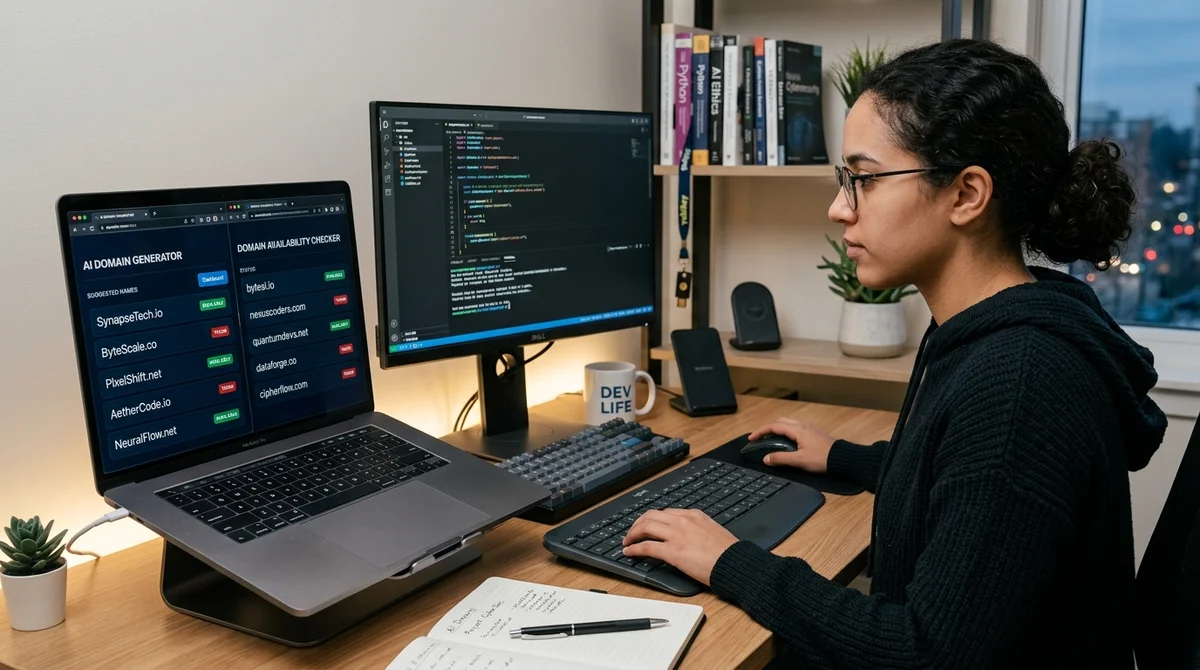
Choosing a domain name can go from endless manual trial and error to a short automated routine: an LLM comes up with options, and a script immediately checks their availability and discards the taken ones. That is the side project a Selectel engineer described, a simple service for cases when you need to launch a brand, product or landing page quickly and don't want to spend hours hunting for a free address.
The project starts from a down-to-earth problem. Popular zones such as .com, .ru, .io and .org have long been overheated: according to data the author cites, .com alone has more than 160 million registered domains. The shortest and clearest names are gone, and good options are often either taken or listed for resale. As a result, new projects settle for compromises: they add digits, extra letters or hyphens, or move to less familiar zones. The domain market index the author cites also shows that activity in popular zones has roughly tripled over the past three years. This hurts not only recognition but also trust: an address should be easy to read, remember and type without errors.
The author separately ties the shortage of decent domains to security. When the good name is already taken, companies and users get used to fake addresses, mirrors and dubious variations, which is fertile ground for phishing and typosquatting. The article gives examples of domains that differ from the original by a single digit or letter, and recalls larger cases in which attackers set up hundreds of fake addresses around high-profile events. Against this background, a good domain is no longer a purely aesthetic choice: it is also a way to reduce the risk of errors, confusion and loss of user trust.
The service itself is written in Python and works in two steps. First, the user enters a project description, the desired domain zones and the number of options. The more precise the request, the more sensible the output: a narrow product description yields more usable names than abstract categories like "fintech" or "marketplace." Then the LLM, through an OpenAI-compatible API, generates a list of names using a strict prompt: short, memorable, free of extra characters and only in the specified TLDs.
A second module then runs each option through python-whois. If the WHOIS response contains information about the domain, registrar or creation date, the address is considered taken; if the service returns an empty response or messages like not found, the option is marked as available. To avoid long waits, the check runs in parallel across ten threads, and the whole cycle usually takes about 10–30 seconds.
On top of this pipeline the author added a minimalist web interface: a field for the project description, a choice of domain zones, a result counter and a launch button. After the form is submitted, the system returns a list that is already verified, marked "available" or "taken." In tests, for a query about business coaching in Moscow, the service found the free option bizmoscow.org, and for a coffee products store in Saratov it suggested several more usable names in the .store, .shop and .ru zones.
The author does not present the project as a finished product: it is more a working prototype that could be developed further with prompt tuning, additional filters and more careful logic for scoring name quality.
The point of the project is not that AI has suddenly solved domain scarcity, but that it handles the boring part of the process well. The LLM acts as an idea generator, and WHOIS as a fast reality filter. For startups, solo developers and small teams, this approach can save time at the start and cut the number of pointless manual checks, especially when what's needed is not a perfect domain for the ages but simply a clear, available address for launch.
- Nov 2, 2026DeepSeek open-sources Super-agent prototype: p95 task completion time of 15.7 minutes vs. 29.5
- Nov 2, 2026Bun creator uses Claude Code to port 750K lines from Zig to Rust in 11 days
- Nov 2, 2026Microsoft releases 4B model Mage-VL-Cowork, which solves 66.0% of OSWorld-Verified tasks
- Nov 2, 2026Meta's Muse assistant keeps dossiers on loved ones and gets root on Ubuntu by default
Test Frontier LLMs & Autonomous Agents in One Workspace
Run Claude Opus 5.5, GPT-6, Gemini 3.1, and DeepSeek side-by-side in Nomad AI (nomadnet.ai) — unified model routing, deep research, and multimodal workflows under one subscription.
The AI world, distilled — once a week
Seven stories that actually mattered, hand-picked. No noise, no reposts, no press releases.
Done! Check your inbox for a confirmation.