White House Prepares Anthropic Mythos Access for U.S. Federal Agencies
The White House is preparing a special version of Anthropic Mythos for major U.S. federal agencies. The idea is to accelerate agency work with documents, analytics, and technical tasks, but the initiative already contains an embedded warning: the powerful model could significantly increase cyber risks, from errors in sensitive processes to new attack scenarios, leaks, and vulnerabilities in federal networks.
AI-processed from Bloomberg Tech; edited by Hamidun News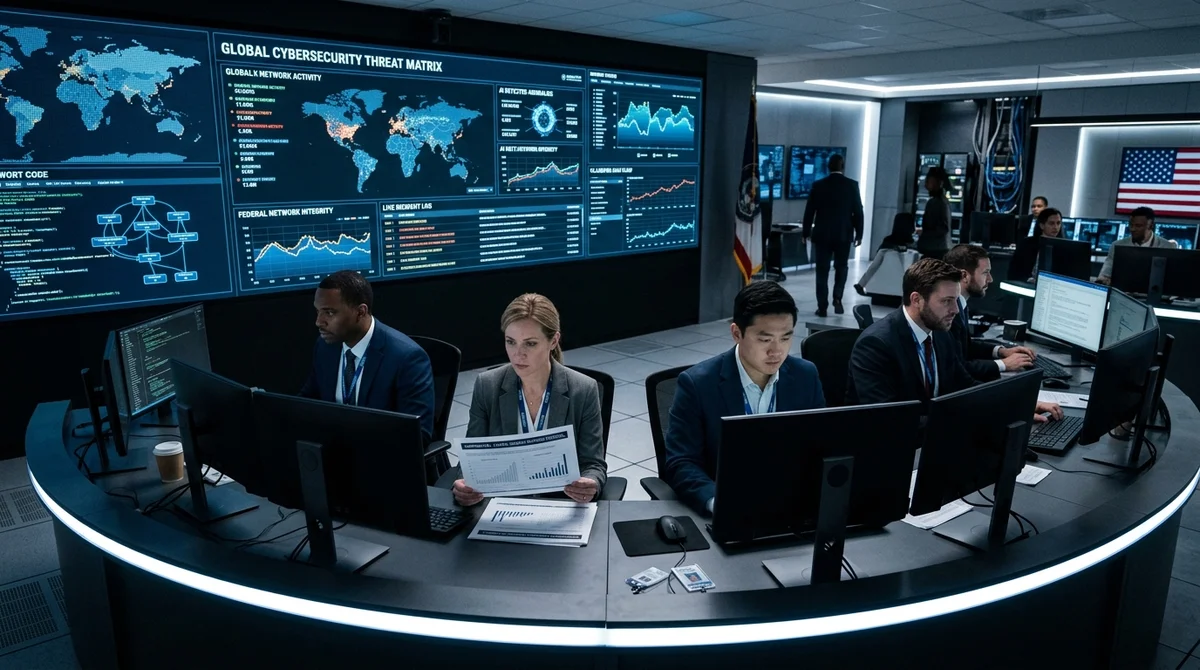
The White House is preparing large U.S. federal agencies with a special version of Anthropic Mythos — one of the most powerful new AI tools on the market — with explicit attention to cybersecurity risks.
Authorities want to accelerate government operations with the help of generative AI, but at the same time acknowledge: deploying a model of this level can dramatically increase the cost of error — from data breaches to new attack vectors. Based on the approach being discussed, this is not simply about purchasing another corporate chatbot. In essence, the administration is attempting to integrate an AI system into the federal infrastructure capable of processing complex queries, assisting with document analysis, material preparation, and, likely, technical tasks requiring a high level of reasoning.
For the government, this means a chance to reduce time spent on routine work and make decisions faster. But the more powerful the model, the higher the demands for control: access management, logging, data storage, and restrictions on what tasks can be entrusted to AI within agencies.
The key question is why we're talking about a special version of the model rather than a standard product. For the state, this is almost a mandatory condition. Federal agencies work with sensitive information, internal documents, and processes where any mistake can be very costly.
If an AI gains broad access, it becomes not just an assistant, but a new element of infrastructure risk. Concerns relate to several scenarios at once: the model may unintentionally disclose data in responses, make errors in critical recommendations, create vulnerable code, or become a convenient target for prompt injection and other attacks through input data. Cybersecurity is a separate concern.
Modern models can significantly accelerate technical work — both for defenders and for attackers. Within the state, this is especially sensitive because even a limited error in one system can scale through contractors, integrations, and inter-agency processes. If Anthropic Mythos truly possesses substantially stronger capabilities than previous generations of models, the administration must think ahead not only about the benefits of deployment, but also about scenarios of misuse.
This is why the White House logic appears understandable: first give access to large agencies in a managed format, rather than opening the model to the entire federal landscape without safeguards. This step also has broader political-technological significance. U.
S. authorities have long been trying to find a balance between the speed of AI implementation and national security requirements. If the White House is promoting Anthropic Mythos at the level of federal agencies, it signals that the most advanced models are gradually transitioning from experimental mode into the category of strategic government tools.
For Anthropic, this is also an important moment: working with the public sector means not just a major contract, but confirmation that its models are being considered as infrastructure technology suitable for high-responsibility tasks.
At the same time, the decision does not appear to be unconditional approval: in Washington, judging by the wording around the initiative, generative AI is increasingly perceived as dual-use technology that simultaneously increases productivity and expands the attack surface. The main conclusion is this: the federal AI market is entering a phase where the question is no longer whether to use the most powerful models, but how to integrate them without losing manageability. And this is already changing the rules of government procurement.
If the White House indeed gives large agencies access to Anthropic Mythos, it will become an important precedent for the entire market: large organizations will look not only at the quality of the model, but also at its ability to operate within strict security, audit, and accountability frameworks.
Need AI working inside your business — not just in your newsfeed?
I build production AI for companies — custom CRM, internal tools, autonomous agents, workflow automation. Owned by you, shaped to your process, no per-seat tax. Built by Zhemal Khamidun, CPO of AlpinaGPT (AI platform, 6,000+ users).
The AI world, distilled — once a week
Seven stories that actually mattered, hand-picked. No noise, no reposts, no press releases.
Done! Check your inbox for a confirmation.