OpenProtein.AI Opens Access to AI Tools for Protein Design for Biologists
OpenProtein.AI aims to make AI-driven protein engineering accessible not only to ML teams but also to conventional biologists. The startup founded by Tristan…
AI-processed from MIT News; edited by Hamidun News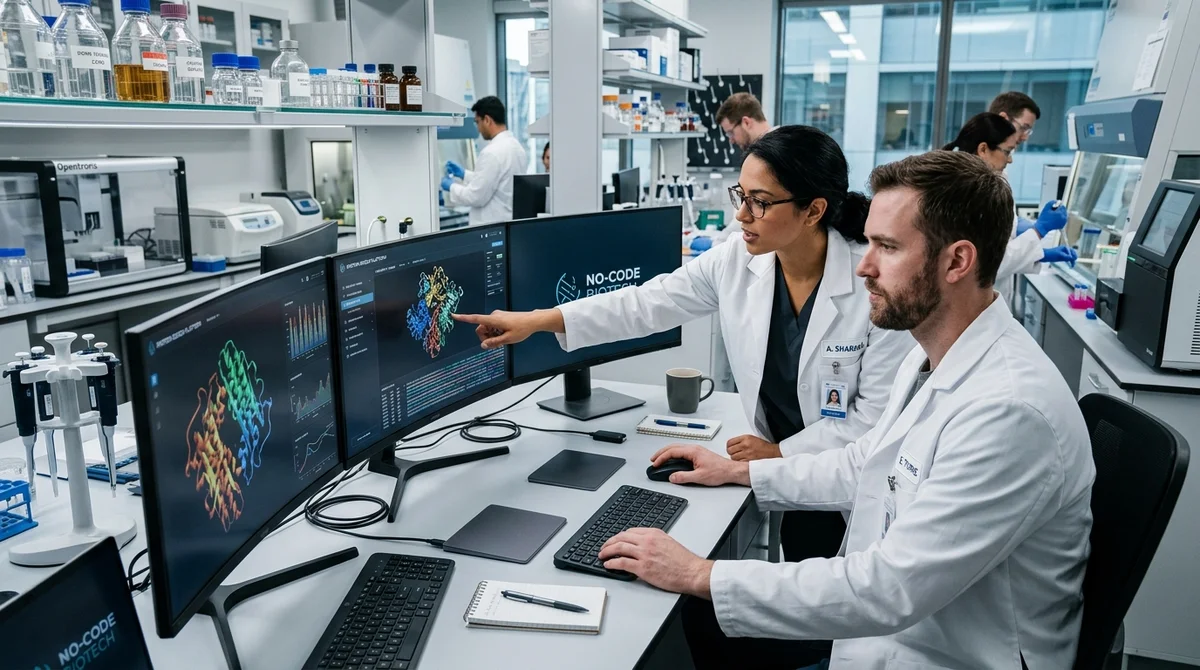
OpenProtein.AI is trying to remove one of the main barriers at the intersection of AI and biology: powerful models for protein work already exist, but for most researchers they remain too complex to use without machine learning skills, access to GPU, and a separate engineering team. The startup was founded by MIT graduate Tristan Bepler and former MIT lecturer Tim Lu.
Their idea is simple: give biologists a no-code web platform through which they can upload their own data, run models for protein engineering, predict the structure and function of molecules, and train and fine-tune models for specific tasks. The company already works with pharmaceutical and biotechnology organizations of various scales, and provides the platform for free to scientists from academic environments. Essentially, this is not just one narrow tool, but a complete working toolkit for research, where AI becomes part of the laboratory process rather than a separate experiment for data scientists.
The project's history grew out of Bepler's academic work at MIT. While studying in a computational and systems biology program under the direction of Professor Bonnie Berger, he worked on a question that remains central to the entire field: how to better understand the relationship between protein sequence, structure, and function. Even before AlphaFold appeared, Bepler was researching how to use evolutionary data to predict protein properties, and ultimately arrived at one of the early generative models of this class — essentially a protein language model.
The logic was not only to predict the shape of the molecule, but to move faster from sequence to understanding what this protein is capable of doing. Later, after receiving his PhD in 2020, Bepler joined Tim Lu's laboratory as a postdoc. There it became especially clear how large the gap was between cutting-edge AI tools and the real needs of biologists.
The models themselves were becoming stronger, but their implementation required too much technical preparation: you had to write code, configure computations, assemble sequence libraries, engage in fine-tuning and result interpretation. OpenProtein.AI is built as a response to exactly this problem.
Instead of forcing researchers to become ML engineers, the company hides the complexity in the infrastructure and leaves the user with an understandable interface and ready-made work scenarios.
OpenProtein's key proprietary development is the PoET model — Protein Evolutionary Transformer. It was trained on groups of proteins so that the model could generate related sequences and capture evolutionary constraints that determine molecular properties. The company claims that PoET can generalize such constraints and accept new information about sequences without complete retraining, which is especially important for laboratories that constantly receive fresh experimental data. Researchers can use their own data to train models, optimize protein sequences, and then run the resulting variants through analysis tools, structure predictors and other in silico checks before moving to work in a wet laboratory. For those who need programmatic access, the platform has an API, but the basic scenario remains no-code.
The company continues to expand the platform. In 2025, it introduced PoET-2 — a new version of the protein language model that, according to OpenProtein, significantly outperforms much larger models while requiring only a fraction of the computational resources and experimental data. This is an important point not only in terms of quality, but also in terms of research costs: if efficient models become lighter, they can be used not only by the largest pharmaceutical companies. At the same time, big business is already getting involved. Boehringer Ingelheim began using the platform in early 2025, and then expanded collaboration with OpenProtein for tasks related to protein engineering in therapy for cancer, autoimmune and inflammatory diseases.
The next step for the company is to teach the models to work better not only with static protein properties, but also with their dynamic behavior. This is about cases where a protein must simultaneously participate in multiple biological mechanisms or change function after binding with another molecule. If such scenarios can be described and designed with the help of AI, this will expand the range of therapeutic approaches and make the design of biological systems noticeably more accurate.
The main point of this story is that the market is gradually moving from rare, custom AI experiments in biology to more accessible infrastructure for everyday research work. If OpenProtein.AI really manages to maintain a balance between openness, convenience and model quality, this will lower the barrier to entry for laboratories, speed up hypothesis testing and shorten the path from computer protein design to a real candidate for therapy or industrial application. And, perhaps equally important, it will prevent the strongest AI tools from becoming locked within just a few major players.
Want to stop reading about AI and start using it?
AI News is a curated feed of AI/tech news. Hamidun Academy teaches you to use AI systematically in your work.