OpenAI introduced GPT-Rosalind — a specialized AI model for biologists
OpenAI introduced GPT-Rosalind — a language model trained specifically for biology. Unlike universal chatbots, it targets research tasks where precision of…
AI-processed from 3DNews AI; edited by Hamidun News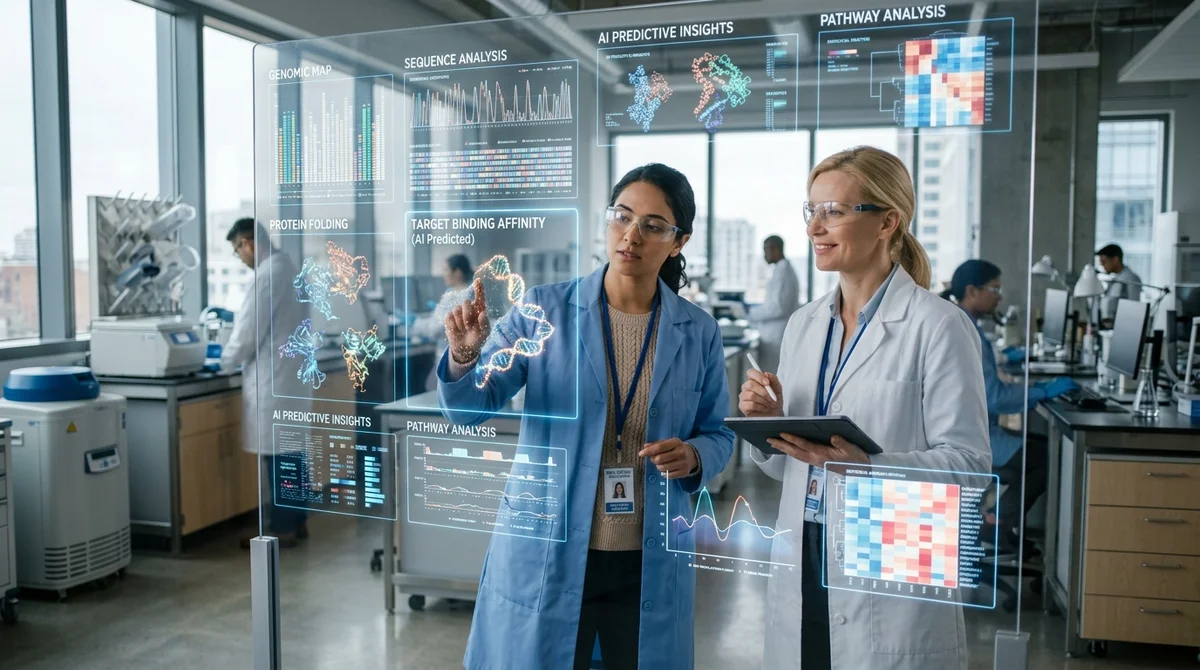
OpenAI has introduced GPT-Rosalind — a language AI model trained specifically for biology tasks, and the fact of its emergence is no less important than the possible technical details. For a company known for universal models, this is a notable shift toward narrowly specialized scientific tools designed not for mass users, but for researchers who need the context of a specific discipline. Based on the description, GPT-Rosalind was created for work in biological science: analysis of specialized literature, formulation of hypotheses, data structuring, and assistance in research tasks where the general knowledge of the model is already insufficient.
Ordinary LLMs handle broad questions well, but in science this is not enough: there, the precision of terminology, understanding of experimental limitations, connections between publications, and careful work with uncertainty are important. Therefore, a separate model for biology seems like a logical development if OpenAI truly wants to go deeper into applied science. It is also a rare example of how a large technology company releases a product not for the widest possible audience, but for a comparatively narrow professional circle.
Usually, large players bet on universal models that can be adapted to dozens of scenarios at once — from office tasks to programming. GPT-Rosalind, in contrast, is presented as a tool with more clearly defined specialization. This approach could prove useful where the cost of error is particularly high and surface-level "intelligence" of the model quickly reaches the limits of domain expertise.
For biologists and related teams, the value of such systems is not reduced to quick answers. Much more important is the ability to work with a large volume of scientific texts, find non-obvious connections between results, help in preparing literature reviews, and accelerate the early stages of research. If the model can maintain domain context better than ordinary chatbots, it could become a working assistant for laboratories, biotech startups, pharmaceutical teams, and university groups.
But in this area, quality requirements are particularly strict: any AI conclusion must be verified by an expert, and the generation of plausible errors here is more dangerous than in everyday user scenarios. For now, the name itself is less important than how deeply the model is integrated into the research process. For real use, it is not enough to be able to answer questions about biology beautifully.
Researchers need tools that help parse papers, compare results, see experimental limitations, and not confuse preliminary conclusions with confirmed knowledge. Therefore, the success of GPT-Rosalind will depend not only on the quality of text generation, but also on how it demonstrates confidence levels, works with sources, and behaves with disputed or incomplete data. The issue of access is no less important.
If the model remains an experiment for a limited circle of partners, its market impact will be symbolic. If OpenAI turns it into a service for universities, biotech teams, and corporate research groups, we are talking about a new class of working tools. In that case, competition will shift from demonstrations of capabilities to specific use cases: from literature reviews to help with research planning and preliminary interpretation of results.
The broader context is also important. The AI market is gradually moving away from the idea of "one model for everything" toward a set of systems tailored to specific industries: law, finance, medicine, development, research. Biology is one of the most complex candidates for such specialization because it combines vast bodies of literature, complex terminology, and a high cost of misinterpretation.
If GPT-Rosalind demonstrates practical value, this could push other companies to more actively develop vertical scientific models rather than just increasing the overall power of universal assistants. The main conclusion from OpenAI's announcement is simple: competition in AI is increasingly being waged not only over model size and dialogue quality, but also over the depth of understanding of a specific domain. GPT-Rosalind is a signal that the next wave of competition may unfold around industry-specific tools for specialists.
For science, this is potentially good news: if such models prove sufficiently accurate and convenient, they will be able to accelerate research work not at the level of marketing promises, but in real everyday processes.
Want to stop reading about AI and start using it?
AI News is a curated feed of AI/tech news. Hamidun Academy teaches you to use AI systematically in your work.