Liz Kendall urges Britain to embrace AI as sovereign fund makes first investment
The UK has made its first investment from a £500 million sovereign AI fund and launched a political campaign in support of AI at the same time. Liz Kendall urged people to see the technology as a source of growth and new jobs, even as concerns about automation and cyber threats persist across the market. In effect, London is signaling that it wants to be not just a regulator but also an investor in its own AI companies.
AI-processed from Guardian; edited by Hamidun News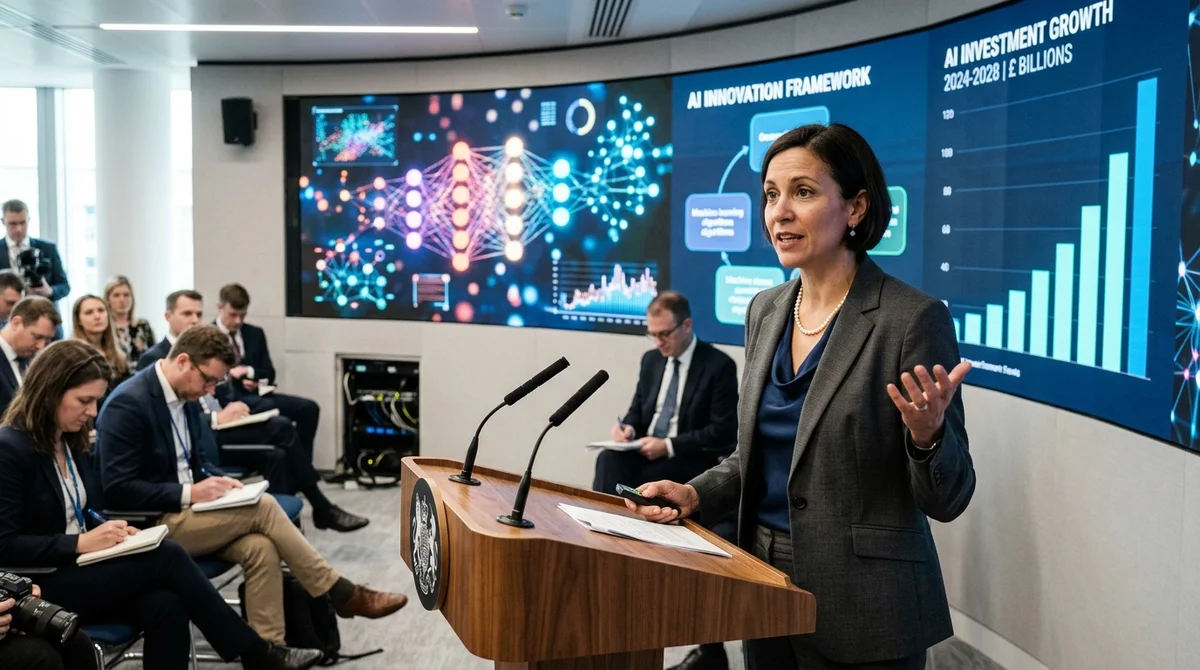
Britain has moved from talking about artificial intelligence to direct state investment. On April 17, 2026, the government announced the first investment from its £500 million sovereign AI fund, and Liz Kendall publicly called on the country not to fear the technology but to put it to work in its own interest. The message is simple: London wants to sell AI not as an abstract innovation but as a tool for economic growth, new jobs, and tackling big public challenges — even as debates over safety and the displacement of workers grow louder.
The fund's first decision matters not only because of the amount but because of its format. This isn't a grant or a splashy political promise about the future. The state is actually taking an equity stake in a British AI company. For London, it's a way to show that the country wants to do more than regulate technology and write rules for the industry — it wants to help build its own players. Amid fierce competition with the US and China, the approach looks like an attempt to keep talent, companies, and the future value the AI market may create in the coming years inside the country.
Kendall is leaning on a fairly pragmatic argument: if Britain is entering an era of mass AI adoption anyway, the question is no longer whether to let it in, but who captures the benefits. Her formula — "making AI work for Britain" — targets several audiences at once. For the public, it's a promise that the technology doesn't necessarily mean a wave of layoffs. For business, it's a signal that the state is ready to support the domestic market and has no intention of taking a purely defensive stance. For investors, it's a reminder that the government wants to treat AI not only as a risk but as a full-fledged industrial priority.
Still, the anxieties the British government is trying to ease are very real. In April, US company Anthropic reported that it had developed a model capable of creating potentially serious cyber threats. That intensified the debate over whether generative AI may not only automate routine tasks but also lower the barrier to entry for sophisticated attacks. Meanwhile, an older fear persists: that productivity gains will translate into cuts to office, administrative, and entry-level analyst roles. So the claim that AI entrepreneurs will be able to create jobs remains, for now, a political bet that still has to be backed up by numbers, reskilling, and demand from companies.
In this context, the £500 million sovereign fund looks like one piece of a broader industrial strategy. Britain has long been strong in university research, research teams, and early-stage startups, but it often falls behind at the scaling stage, when companies need large compute resources, patient capital, and market access. If the state is genuinely willing to become a co-investor rather than simply hand out subsidies, it gets a chance to influence where national AI champions grow — and who ultimately gets the tax base, the jobs, and the intellectual property. But a single fund isn't enough: the country also needs data centers, access to chips, public procurement, and clear safety rules.
The main takeaway is that Britain is trying to shift from cautious talk about AI to a more assertive model — with public money, open political backing, and a bet on homegrown companies. For the market, it's a signal that London wants to compete in the AI race not only as a regulator but also as an investor. For the public, it's a test of trust: if the new tools really do bring jobs and growth, skepticism will fade; if the first effects are layoffs and rising cyber risks, convincing people of AI's benefits will become much harder.
- Nov 2, 2026Bun creator uses Claude Code to port 750K lines from Zig to Rust in 11 days
- Nov 2, 2026mcp-linter finds 18 undescribed parameters in Anthropic's filesystem server
- Nov 2, 2026The Verge reviewer builds a $50 Meta Muse Charm alternative with Claude Code
- Nov 2, 20268 Skills for video in Claude Code: from 244 pixel effects to rough-cut editing
Ship AI Faster with Founders, Engineers & Weekly Architecture Reviews
Inside Vibe Club (hamidun.com/club) — weekly live masterminds with Zhemal Khamidun, Tech Radar, full LMS access, and 370+ production Claude Code skills.
The AI world, distilled — once a week
Seven stories that actually mattered, hand-picked. No noise, no reposts, no press releases.
Done! Check your inbox for a confirmation.