How Google DeepMind and Rivals Are Changing Music: Five AI Services for Generating Tracks
Music AI has quickly moved from demo to working tool. Today these systems can build a song from a text prompt, help with arrangement and speed up content production. The focus here is on five services already used by millions of people, from hobbyists to marketing teams and indie developers. The main shift is that getting into music has become noticeably cheaper, faster and more accessible.
AI-processed from Habr AI; edited by Hamidun News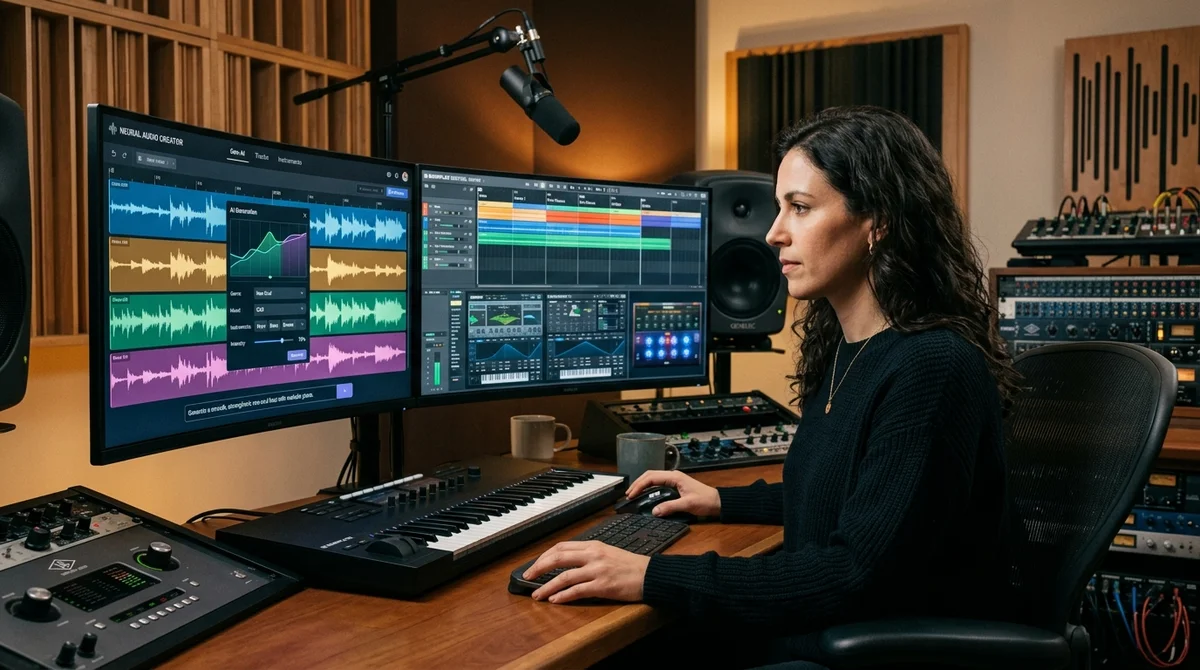
Music has entered a stage where an idea no longer has to pass through a studio, expensive software and years of practice before it becomes a finished composition. Describe a mood, genre, tempo or story, and a neural network will assemble a song with melody, vocals, arrangement and a clear structure. This does not eliminate the role of the musician, but it sharply lowers the barrier to entry and widens the circle of people who can release their own tracks.
The focus here is on five services that have already moved beyond labs and early demos. They are not experimental toys but products used by millions of people worldwide: from hobbyists making music for themselves to bloggers, marketing teams and indie developers. Some tools can produce a nearly finished song from a single text prompt; others are better suited to sketches, hunting for a sound or quickly producing background music.
The main change is not only technological but cultural. Between an idea and a release there was almost always a chain of composer, arranger, vocalist, sound engineer and studio time. Now a significant part of that chain can be compressed into a few minutes of prompting and a few rounds of editing. For professionals, it is a way to speed up the draft stage and test ideas without extra cost; for beginners, it is a chance to get into music at all without formal training.
It is telling that the market has long since stopped being limited to small startups. Among the notable players are projects backed by people with Google DeepMind experience, solutions recognized as virtual composers, and services that ultimately attracted the interest of large technology companies. This is a good marker of maturity: AI music generation is no longer a niche pastime for enthusiasts and has entered the world of big business, where scale, licensing, output quality and everyday usability matter.
The value of these tools is also not limited to quickly generating a track for a wow effect. They are already used to create jingles, demos, musical sketches, soundtracks for short videos, prototypes of ad spots and social media content. The shorter the production cycle and the lower the budget, the more visible AI's advantage: you can quickly run through dozens of variants, refine the mood, rework the structure or swap the vocal delivery without re-recording. That is why the new wave of music AI is especially interesting to those working at the intersection of content, product and marketing.
But with accessibility comes a new set of questions. The easier it is to create a song from a description, the sharper the issues of copyright, training-data transparency and predictability of results become. Users get speed, but often run into formulaic output, limited control over nuance and dependence on the model's internal logic. So a service's value today is determined not only by the quality of the first generation, but by how easily you can refine the material, separate tracks, change the structure and achieve the desired character of sound.
The author's role is changing too. If creativity once often started with an instrument, it now increasingly starts with framing the task: you need to be able to describe a reference, emotion, rhythm, dramaturgy and the track's place in a specific product. Against this background, the prompt becomes part of the musical work, and the skill of selecting and editing becomes no less important than the original idea. The winners will not be those who press the button first, but those who can turn generation into a controlled process.
The conclusion is simple: AI does not take humanity away from music, but redistributes access to the tools of creation. The best services among these five are valuable not because they fully replace the author, but because they make music production faster, cheaper and more accessible. For the industry, this means more competition and new disputes over authorship; for users, it is a rare moment when technology genuinely gives more power of expression rather than just another interface.
- Nov 2, 2026Bun creator uses Claude Code to port 750K lines from Zig to Rust in 11 days
- Nov 2, 2026The Verge reviewer builds a $50 Meta Muse Charm alternative with Claude Code
- Nov 1, 202616 models tested on 7 search tools: Exa averaged 10.5 out of 14, SearXNG about 3
- Nov 1, 2026Google's StreamVibe video agent beats other models by 10.7% on response timing and quality
Test Frontier LLMs & Autonomous Agents in One Workspace
Run Claude Opus 5.5, GPT-6, Gemini 3.1, and DeepSeek side-by-side in Nomad AI (nomadnet.ai) — unified model routing, deep research, and multimodal workflows under one subscription.
The AI world, distilled — once a week
Seven stories that actually mattered, hand-picked. No noise, no reposts, no press releases.
Done! Check your inbox for a confirmation.