US MATCH Act aims to curb China's access to chipmaking equipment
The US is pushing the MATCH Act, a bill that could tighten export controls on semiconductor manufacturing equipment and limit shipments to China. Beijing argues the consequences would reach far beyond a bilateral dispute: international trade, service chains and the whole semiconductor market would feel the pressure. It is another turn in the technological standoff between the world's two largest economies.
AI-processed from TNW; edited by Hamidun News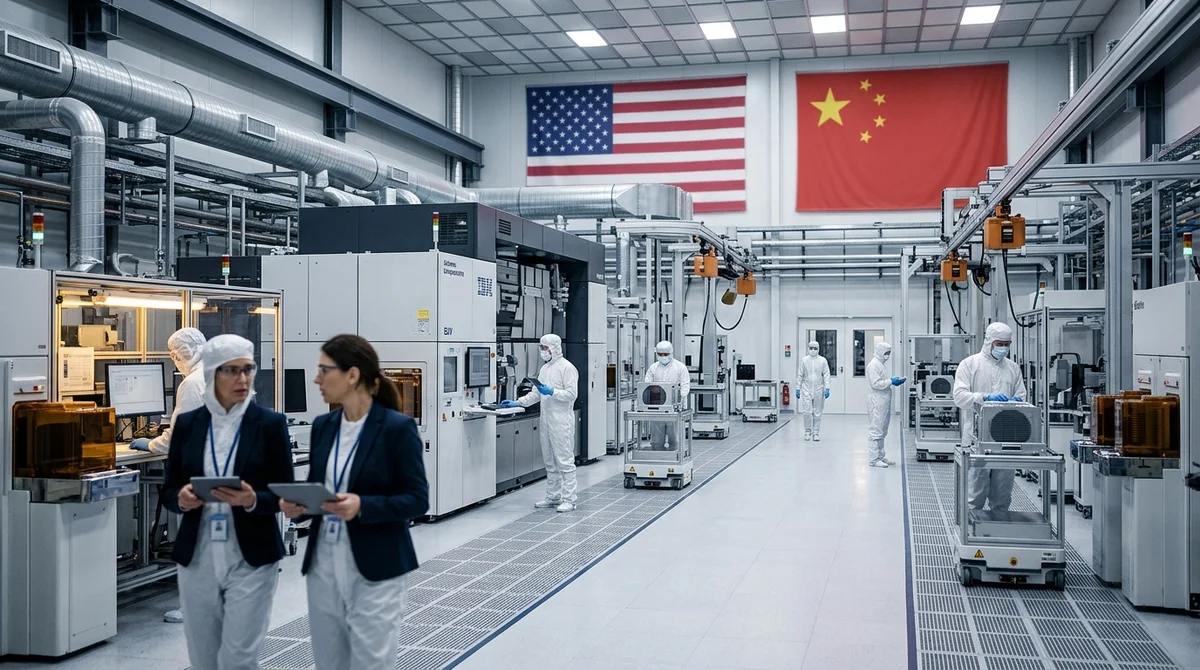
Washington and Beijing are escalating their fight over semiconductors again, and this time the dispute is not about finished chips but about the machines, systems and other infrastructure without which those chips cannot be made at all. China's Ministry of Commerce has warned that the MATCH Act, which is moving through the US Congress, could do more than increase pressure on Chinese manufacturers: it could shake the entire global supply chain in the industry. For the market, this is a signal that the technological rivalry between the biggest economies increasingly shapes the basic rules of the global industry.
The bill is the Multilateral Alignment of Technology Controls on Hardware, or MATCH Act. Its idea is to synchronize export restrictions on critical equipment and technology with US allies, closing the workarounds that let China buy through other jurisdictions. For American lawmakers, it is an attempt to make the restrictions regime tighter and more predictable: if Washington restricts shipments while friendly countries keep selling similar equipment, the measures lose their effect. China, by contrast, sees a step toward even harsher market fragmentation, where access to key production tools is determined not only by commerce but also by geopolitical loyalty.
That is why China's Ministry of Commerce reacted so sharply. The agency said the initiative could seriously disrupt the international economic and trade order and undermine the stability of the global semiconductor supply chain. This is not accidental: producing advanced chips depends on a long network of specialized suppliers, with different countries handling different stages, from design and materials to lithography, etching, packaging and testing. Even targeted restrictions in such a system rarely stay targeted. When one critical node drops out of the chain, the effects quickly spread to adjacent markets, delivery times and costs.
Over the past few years, semiconductors have become a strategic resource rather than a purely technical category. They are needed not only for smartphones and data centers but also for cars, defense systems, industrial automation, telecom infrastructure and AI accelerators. That is why the dispute over equipment is especially sensitive. If restrictions target not finished chips but the means of production themselves, companies' ability to expand capacity, upgrade lines and stay competitive for years ahead is at risk. For China, this is a question of technological sovereignty. For the US, it is a question of controlling how quickly a strategic competitor can close the gap in advanced manufacturing processes.
The risks also extend well beyond US-China relations. Any tightening of the rules forces manufacturers to rethink logistics, contracts, service routes and investment plans. This affects not only direct shipments of new machines but also access to components, software updates, servicing, spare parts and engineering support, without which complex equipment quickly loses efficiency.
Companies in third countries find themselves caught between regulators' demands and their customers' interests, and the market gets a fresh round of uncertainty. In such an environment, businesses more often build extra costs into prices, take longer to agree on deals and invest more cautiously in expansion. For an industry that already runs on long cycles and enormous capital spending, that means slower adaptation and costlier mistakes.
The main takeaway is simple: the fight for technological leadership looks less and less like ordinary trade competition and more like a rebuild of the entire architecture of global electronics. If the MATCH Act advances and is backed by coordination with US allies, pressure on China will grow. But the likelihood will also rise that the global semiconductor industry becomes less unified, less flexible and more expensive for all participants, not only those the restrictions target.
Test Frontier LLMs & Autonomous Agents in One Workspace
Run Claude Opus 5.5, GPT-6, Gemini 3.1, and DeepSeek side-by-side in Nomad AI (nomadnet.ai) — unified model routing, deep research, and multimodal workflows under one subscription.
The AI world, distilled — once a week
Seven stories that actually mattered, hand-picked. No noise, no reposts, no press releases.
Done! Check your inbox for a confirmation.