OpenAI takes GPT-Rosalind into biology: what the new model can do and where its limits lie
OpenAI has introduced GPT-Rosalind, a specialized model for biology and pharma. It ships alongside a Codex module with access to 50+ scientific databases and tools. According to the company, the model beats general-purpose LLMs on domain benchmarks, but there is no independent verification yet. Access is closed at launch: a research preview for qualified Enterprise teams in the US. The company is positioning itself not just as a general LLM vendor but as an infrastructure layer for biological research.
AI-processed from Habr AI; edited by Hamidun News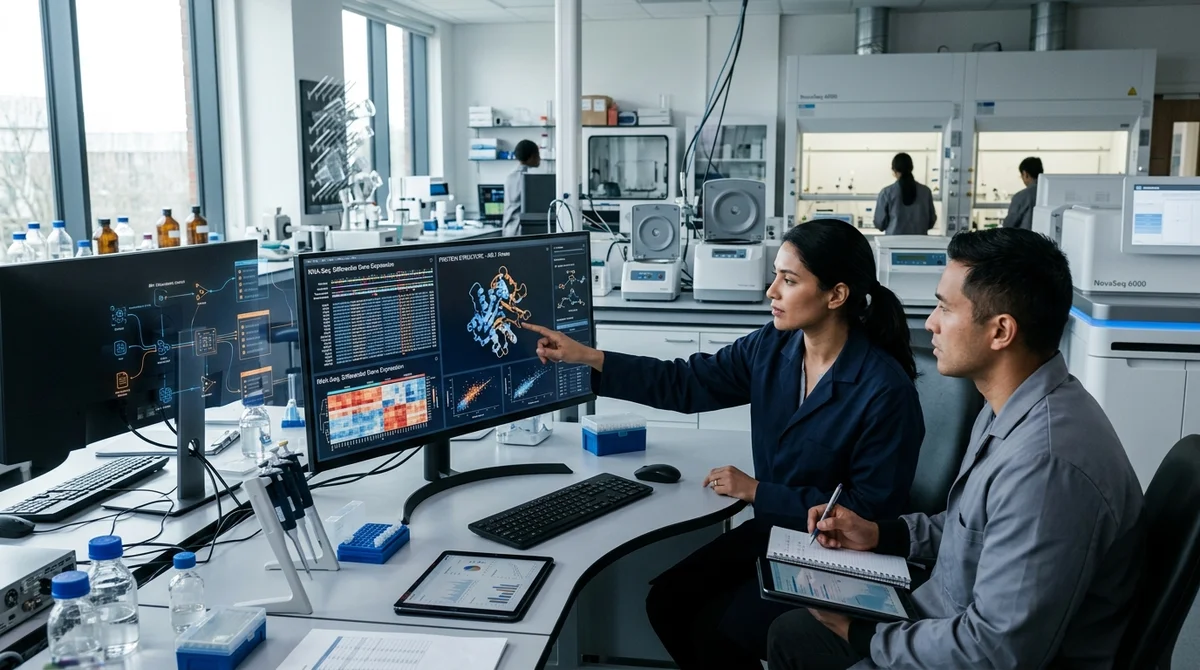
OpenAI is trying to become not just a supplier of a general-purpose LLM, but an infrastructure layer for biological research. GPT-Rosalind looks less like a magic button for discovering a new drug and more like a tool meant to cut the costliest part of the early stage: the time spent gathering data, formulating hypotheses and planning the next experiments.
The interest is easy to understand. In applied biology, and especially in developing therapeutic mRNA, too much of the process is still assembled by hand. Researchers have to weigh at once how well a sequence will be translated, how long it will persist in the cell, and whether it will trigger an unwanted immune response. Individual building blocks for this work already exist, such as DNA Chisel or mRNAid, but the market still lacks a unified open environment that consistently brings together structural, sequence and immunogenicity constraints. Against that backdrop, GPT-Rosalind looks like an attempt to add a shared layer of reasoning and coordination on top of scattered tools.
According to OpenAI's official description, the model is aimed at life-sciences tasks: synthesizing scientific literature, generating hypotheses, planning experiments and multistep research workflows in genomics, biochemistry and protein engineering. Alongside the model, the company released a free research module for Codex that connects more than 50 public databases and specialized tools. The practical point is simple: less manual switching between services, less lost context, and a better chance of building a long analytical chain around a single biological question. At launch, GPT-Rosalind is available only as a research preview for qualified enterprise customers through trusted access, while OpenAI distributes the Codex skills package considerably more widely.
The most interesting part of the release is the domain benchmarks, but this is where a cold eye is needed. According to OpenAI, the model scored a Pass@1 of 0.751 on BixBench and outperformed several general-purpose systems, including GPT-5.4, Grok 4.2 and Gemini 3.1 Pro. On LABBench2, the company reports an advantage over GPT-5.4 in six of eleven tasks, with the most notable gain on CloningQA. Separately, OpenAI cites results from partner testing with Dyno Therapeutics on unpublished RNA sequences: GPT-Rosalind's top ten answers landed in the 95th percentile relative to human experts, and on the sequence-generation task the model reached the 84th percentile.
All of this sounds serious, but the comparison has an important limitation: at the time of publication there was no independent external verification of the full model table. In other words, this is not yet the market's final verdict but a strong, yet still internal, claim by the company.
The reason for closed access is also clear. In biology, the dual-use question is too practical to ignore in a release. Tools that help find therapeutic candidates faster could, in theory, also accelerate undesirable scenarios, so OpenAI began with a trusted-access launch for qualified Enterprise customers in the US, with separate requirements for access management, internal controls and organizational security. During the research preview, the company does not even deduct regular credits and tokens, provided participants comply with anti-abuse restrictions. Among the first participants OpenAI names Amgen, Moderna, Novo Nordisk, Thermo Fisher Scientific, Oracle Health and Life Sciences, NVIDIA, the Allen Institute, Benchling and the UCSF School of Pharmacy, as well as a partnership with Los Alamos National Laboratory.
The competitive backdrop is tightening fast: on April 14, 2026, AWS announced Amazon Bio Discovery, and on April 16, 2026, OpenAI introduced GPT-Rosalind. The stakes in this market are high: according to Precedence Research, AI in pharma could grow from $2.51 billion in 2026 to $16.49 billion by 2034.
The main takeaway so far is not that the new model will replace biologists or instantly kill narrow open-source tools. Rather the opposite: GPT-Rosalind operates at the level of research logic and coordination, while specialized solutions such as mRNAid remain useful for specific computational optimization tasks. If OpenAI's product really shortens the path from hypothesis to a candidate for wet-lab testing, it will be a tangible shift for the industry. But the model's real value will be determined not by a polished release, but by how reproducible the results prove to be beyond the demo and how well it fits into the existing scientific stack.
- Nov 1, 2026Local models lose to Opus and Codex: 0.21 on a MacBook versus 1.00 for Codex
- Nov 1, 2026Kimi scores 96.2% on a 1C database analytics test and emerges as a fallback if Claude access is blocked
- Nov 1, 2026OpenAI Rewrites GPT Behavior Rules: Five Values and a Chain of Command
- Nov 1, 2026Google admits AI Mode cuts search revenue, shares fall 15%
Build & Ship Production AI Agents Without Boilerplate Code
Start your free 72-hour trial at Hamidun Academy (academy.hamidun.com) — interactive lessons on Claude Code & Cursor, live Tech Radar, and production agent templates.
The AI world, distilled — once a week
Seven stories that actually mattered, hand-picked. No noise, no reposts, no press releases.
Done! Check your inbox for a confirmation.