Beauty brands accelerate AI adoption, from virtual try-ons to formula development
AI is becoming a working tool for the beauty market, not just a marketing showcase. Algorithms already help shoppers analyze their skin, try on shades, and get personalized recommendations, while helping companies speed up research, testing, and new product launches. As a result, brands are shortening the path from idea to shelf and making cosmetics selection noticeably more accurate.
AI-processed from Bloomberg Tech; edited by Hamidun News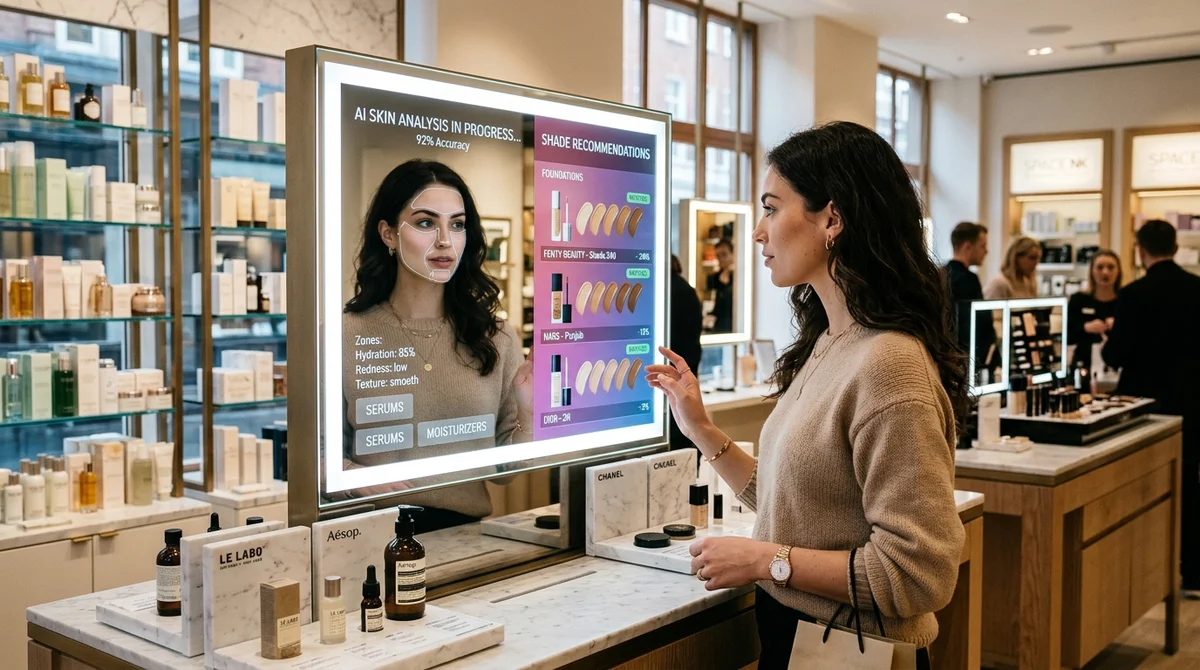
AI is quickly shifting from an experimental feature to one of the beauty industry's core tools. It is reshaping both the customer experience and how companies operate internally, from personalized recommendations to new product development. On the consumer side, AI tackles the problem that costs brands the most: uncertainty before a purchase.
Instead of picking a cream, a shade, or a skincare product blind, a shopper can upload a selfie, run a digital skin assessment, see likely concerns, and get a selection of products matched to their specific profile. Another use case is virtual makeup try-on: the algorithm overlays shades of lipstick, blush, or foundation onto an image of the face and shows how the product will look under different lighting. For the shopper, that means saving time and making a more confident decision.
For the company, it means higher conversion and fewer returns. Behind the storefront, AI is just as visible. Beauty companies use it to analyze large datasets on ingredient composition, the properties of active compounds, customer reviews, and market trends.
These systems help teams find promising formula combinations faster, weed out weak hypotheses before expensive lab cycles, and spot emerging customer demand before competitors notice it. Teams used to cross-reference research, test results, and sales signals by hand; now algorithms handle part of that work and speed up decision-making. In practice, this automation makes the beauty industry far more personalized.
Instead of a product line designed for an abstract average customer, brands can build offerings around narrower scenarios: sensitive skin, a specific type of pigmentation, climate, age-related changes, skincare habits, or even a combination of several factors at once. For large companies, this is a chance to monetize data more effectively and build direct relationships with customers. For smaller players, it is a way to reach the market faster with a product that more precisely targets niche demand.
In this setup, AI stops being decoration in an app and becomes the infrastructure that recommendations, product assortment, and the pace of new launches depend on. The way brands validate demand is changing too. Algorithms can analyze search queries, social media discussions, marketplace reviews, and repeat-purchase trends to see in advance which textures, formats, and product claims actually interest customers.
That matters in a category where packaging, shade, how a product feels on the skin, and price all weigh equally on the decision. When AI pulls these signals into a single picture, a company gets more than a report on last quarter: it gets a tool for planning assortment, campaigns, and even inventory allocation across sales channels faster. But as convenience grows, so do the demands on the quality of these systems.
Any error in skin analysis, skincare recommendations, or shade matching directly hurts trust, because users see the result literally on their own faces. Companies also have to handle sensitive data carefully: images, behavioral patterns, purchase histories, and reactions to products. That is why the winners will not be those who simply add the word AI to their interface, but those who manage to connect algorithms with the real expertise of chemists, dermatologists, product teams, and testing labs.
The main takeaway is simple: in beauty, AI is no longer a standalone innovation and is becoming part of the entire value chain, from the first consultation to the formula on the production line. The more precisely companies learn to use it for personalization and research, the faster the market will move away from mass-market, one-size-fits-all products toward a more targeted, flexible, and data-driven model. For consumers, that means easier choices and fewer disappointments.
For businesses, it sets a new standard for speed and precision.
Test Frontier LLMs & Autonomous Agents in One Workspace
Run Claude Opus 5.5, GPT-6, Gemini 3.1, and DeepSeek side-by-side in Nomad AI (nomadnet.ai) — unified model routing, deep research, and multimodal workflows under one subscription.
The AI world, distilled — once a week
Seven stories that actually mattered, hand-picked. No noise, no reposts, no press releases.
Done! Check your inbox for a confirmation.