NVIDIA releases Ising, the first open family of AI models for quantum-classical systems
NVIDIA has launched Ising, the first open family of AI models for quantum processors. The release includes a 35-billion-parameter model for QPU calibration and two error decoders that, according to the company, run up to 2.5 times faster than traditional decoders and are up to 3 times more accurate than classical approaches. The bet is simple: bring hybrid quantum-classical systems closer to real-world problems.
AI-processed from MarkTechPost; edited by Hamidun News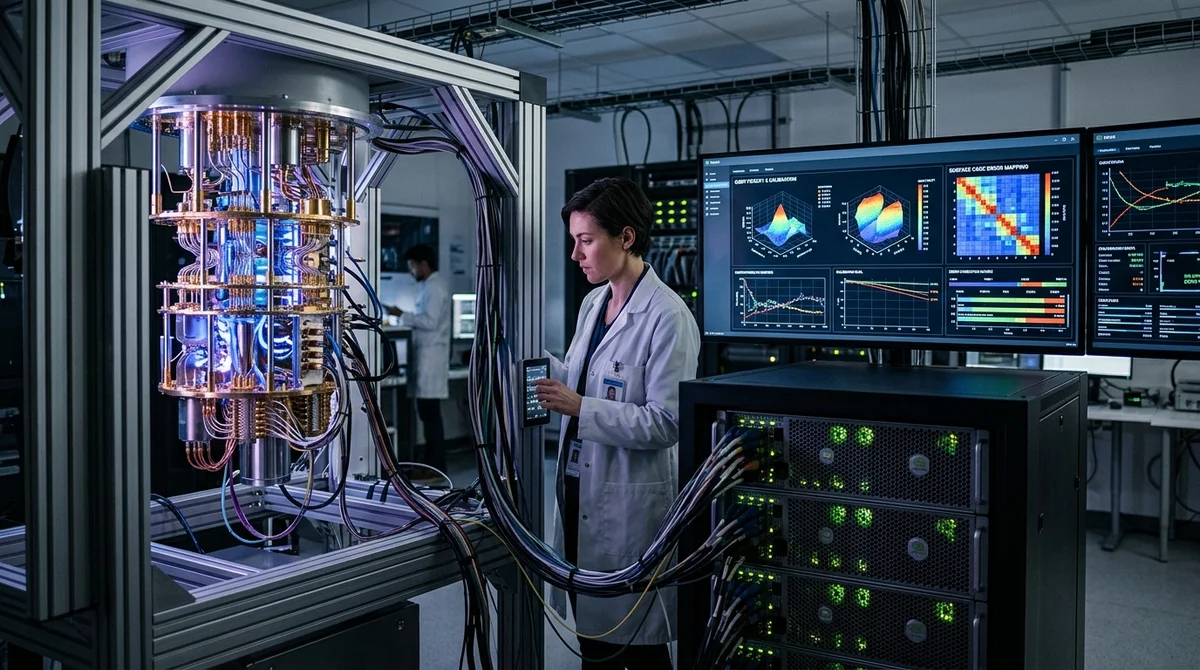
On April 14, 2026, NVIDIA introduced Ising, the first open line of AI models built not for chatbots but for running quantum processors. The launch targets the industry's two most painful bottlenecks: calibrating quantum hardware and decoding errors in real time. Without them, the road from lab demonstrations to useful workloads remains too long.
Quantum computers have long promised a breakthrough, but in practice qubit count is not their only constraint. These systems are noisy, unstable and need constant tuning. Even when a processor has been calibrated, qubit errors pile up faster than conventional software can correct them. That is why a quantum chip almost always needs a powerful classical control loop next to it, one that continuously analyzes measurements, recalculates parameters and helps keep the system operational. NVIDIA has been betting on this pairing of a quantum processor, GPUs and classical software for several years.
NVIDIA Ising comes in two parts. The first is Ising Calibration, a 35-billion-parameter vision-language model trained to interpret the results of quantum experiments and suggest next steps for tuning the processor. According to the company, combined with an agentic workflow, the model can cut calibration from days to hours.
The second is Ising Decoding, a family of two 3D-CNN models for pre-decoding errors during quantum error correction. The fast version has about 0.9 million parameters, the accurate one about 1.8 million. Compared with the open-source standard pyMatching, NVIDIA claims up to 2.5 times faster decoding and up to 3 times higher accuracy. In some benchmarks it reports a 1.53x improvement in logical error rate alongside lower latency.
An important aspect of the release is that it opens up not only the weights but also the surrounding tooling. NVIDIA is publishing the models, training frameworks, datasets, quantization and fine-tuning recipes, and a new benchmark, QCalEval, for evaluating calibration on real data from quantum devices. This matters because different architectures, such as superconducting, trapped-ion and neutral-atom, have their own noise profiles and degradation patterns. A general-purpose model is useful as a starting point, but the real value appears when a lab or vendor can adapt it to its own QPU without sending sensitive data outside.
The partner list suggests this is not a lab experiment run for a press release. Ising Calibration is already used by Atom Computing, IonQ, IQM, Infleqtion, Harvard SEAS, Fermilab and the UK's National Physical Laboratory. The decoding models are being tested by Cornell, UC San Diego, UC Santa Barbara, the University of Chicago, Sandia and other teams. The whole lineup complements the CUDA-Q platform for hybrid quantum-classical computing and NVQLink, which lets QPUs and GPUs exchange data with low latency. For NVIDIA the move is logical: the company does not build its own quantum processors, but wants to become the standard compute layer around them, from model training to real-time control and error correction.
More broadly, the release shows how the logic of quantum industry development is changing. The conversation used to center on qubit counts and physical architectures. Now more attention goes to control software, decoders, telemetry and AI tools that squeeze more out of existing hardware. According to analysts at Resonance, the quantum computing market may exceed $11 billion by 2030, but that forecast depends directly on whether the industry learns to calibrate and scale error-corrected systems quickly. If Ising's claimed metrics hold up outside demo scenarios, AI could become not an add-on layer around quantum computers but a mandatory operational layer between fragile qubits and real applications.
The practical takeaway is simple: NVIDIA is not selling "quantum AI" as a catchy label but infrastructure that lets quantum machines sit idle less often, get tuned faster and hold a useful state longer. For research centers and companies, it is a chance to shorten experiment times and bring closer the moment when hybrid quantum-classical systems start solving commercially meaningful problems rather than textbook ones.
- Nov 2, 2026TensorFold 1.2.0 boosts Qwen3.8-27B throughput on M3 Ultra by 44.2% at 16 streams
- Nov 1, 2026Local models lose to Opus and Codex: 0.21 on a MacBook versus 1.00 for Codex
- Nov 1, 2026Habr author fine-tunes YOLOv8l on dental X-rays and pushes mAP50 to 0.642
- Nov 1, 2026Voice bots built on LLMs turn to Jev, a fast classifier, for decisions in 200–500 ms
Test Frontier LLMs & Autonomous Agents in One Workspace
Run Claude Opus 5.5, GPT-6, Gemini 3.1, and DeepSeek side-by-side in Nomad AI (nomadnet.ai) — unified model routing, deep research, and multimodal workflows under one subscription.
The AI world, distilled — once a week
Seven stories that actually mattered, hand-picked. No noise, no reposts, no press releases.
Done! Check your inbox for a confirmation.