NVIDIA released Ising — the first open family of AI models for quantum-classical systems
NVIDIA launched Ising — the first open family of AI models for quantum processors. The release includes a 35-billion parameter model for QPU calibration and two error decoders that, according to the company, perform up to 2.5x faster than traditional decoders and up to 3x more accurate than classical approaches. The goal is simple: make hybrid quantum-classical systems closer to real-world applications.
AI-processed from MarkTechPost; edited by Hamidun News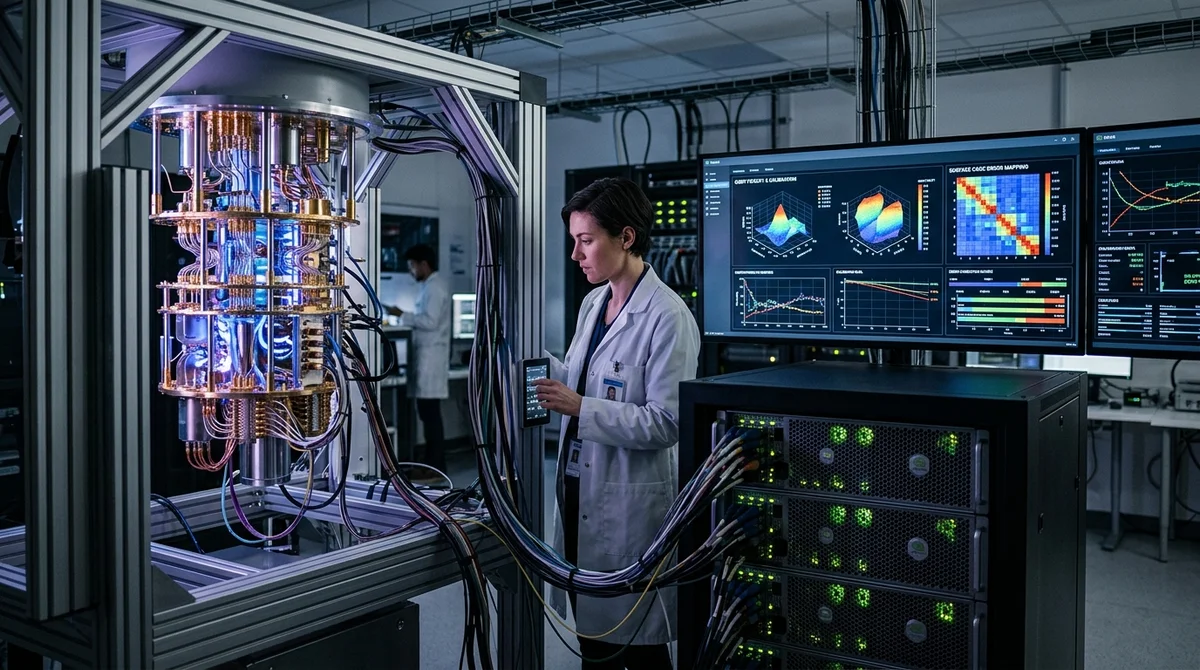
On April 14, 2026, NVIDIA presented Ising — the first open family of AI models designed not for chatbots, but for servicing quantum processors. The launch targets two of the most critical bottlenecks in the industry: quantum hardware calibration and real-time error decoding, without which the path from laboratory demonstrations to practical applications remains far too long. Quantum computers have long promised breakthroughs, but in practice their limitations stem not only from qubit count.
Such systems are noisy, unstable, and require constant tuning. Even if a processor manages to be calibrated, errors in qubits accumulate faster than conventional software can correct them. Therefore, next to a quantum chip there is almost always a need for a powerful classical control loop, which continuously analyzes measurements, recalculates parameters, and helps keep the system in working order.
It is precisely on this combination — "quantum processor plus GPU and classical software" — that NVIDIA has been betting for several years now. NVIDIA Ising arrives in two directions. First — Ising Calibration, a vision-language model with 35 billion parameters, trained to understand the results of quantum experiments and suggest next steps for processor tuning.
According to the company, paired with an agent-based scenario, such a model can reduce calibration from days to hours. Second — Ising Decoding, a family of two 3D-CNN models for preliminary error decoding in quantum error correction. The fast version contains approximately 0.
9 million parameters, the precise one — approximately 1.8 million. Compared to the open standard pyMatching, NVIDIA claims acceleration of up to 2.
5x and accuracy improvement of up to 3x, with certain benchmarks showing a 1.53-fold improvement in the logical error rate metric while simultaneously reducing latency. An important aspect of the release is openness not only of the weights, but also of supporting tools.
NVIDIA releases the models, training frameworks, datasets, recipes for quantization and fine-tuning, as well as a new QCalEval benchmark for evaluating calibration on real quantum facility data. This is necessary because different architectures — superconducting, ion-based, neutral-atom, and others — have their own noise characteristics and degradation scenarios. A universal model is useful here as a starting point, but real value emerges when a laboratory or vendor can adapt it for their own QPU without exposing sensitive data.
Judging by the partner list, this is not a laboratory experiment for a press release. Ising Calibration is already being used by Atom Computing, IonQ, IQM, Infleqtion, Harvard SEAS, Fermilab, and the UK National Physical Laboratory. The decoding models are being tested by Cornell, UC San Diego, UC Santa Barbara, University of Chicago, Sandia, and other teams.
The entire lineup complements the CUDA-Q platform for hybrid quantum-classical computing and the NVQLink interconnect, through which QPU and GPU can exchange data with low latency. For NVIDIA this is a logical move: the company does not build its own quantum processors, but wants to become the standard computational layer around them — from model training to actual control and error correction. At a broader level, the release demonstrates how the logic of quantum industry development itself is changing.
Previously, the main discussion centered on qubit count and physical architectures; now increasingly more attention goes to control software, decoders, telemetry, and AI tools that allow extracting more value from existing hardware. According to Resonance analysts, the quantum computing market could exceed $11 billion by 2030, but this forecast directly depends on whether the industry succeeds in rapidly calibrating and scaling error-correction systems. If Ising's stated metrics hold up outside demo scenarios, AI could become not an additional layer around quantum computers, but a mandatory operational interface between fragile qubits and real application tasks.
The practical conclusion is simple: NVIDIA is selling not "quantum AI" as a nice label, but infrastructure to keep quantum machines from idling, enable faster configuration, and maintain useful operational states longer. For research centers and companies, this is a chance to reduce experimental time and bring closer the moment when hybrid quantum-classical systems will solve not academic, but commercially significant tasks.
Need AI working inside your business — not just in your newsfeed?
I build production AI for companies — custom CRM, internal tools, autonomous agents, workflow automation. Owned by you, shaped to your process, no per-seat tax. Built by Zhemal Khamidun, CPO of AlpinaGPT (AI platform, 6,000+ users).
The AI world, distilled — once a week
Seven stories that actually mattered, hand-picked. No noise, no reposts, no press releases.
Done! Check your inbox for a confirmation.