Anthropic and the White House discuss Mythos AI after it finds thousands of vulnerabilities
Anthropic has pushed its Mythos model into the center of the political agenda. According to the company, Mythos can find code vulnerabilities in the major operating systems and browsers. Because of those capabilities, Anthropic's leadership is going to the White House directly. Officials want to understand where a defensive tool ends and a national security risk begins.
AI-processed from 3DNews AI; edited by Hamidun News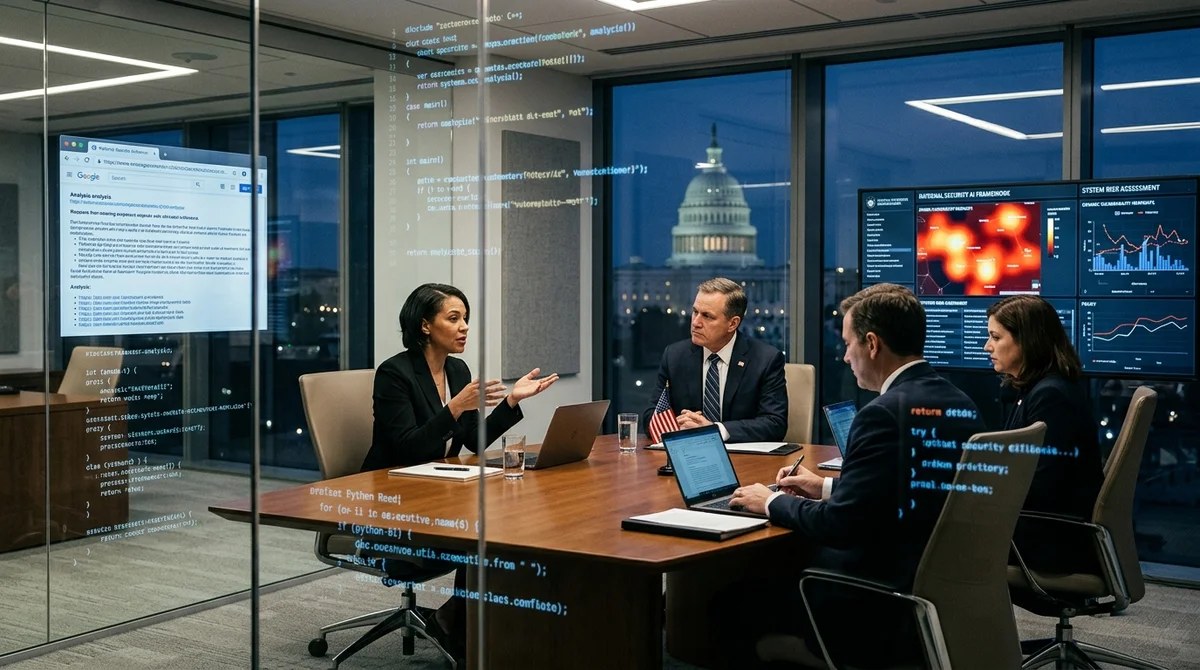
The Mythos story shows how thin the line has become between "useful AI for security" and a tool of strategic importance. If Anthropic's model can really find vulnerabilities in code at scale, faster and deeper than traditional teams of researchers, this is no longer a question only for developers and vendors. It also concerns the state, which is responsible for the resilience of digital infrastructure.
According to Anthropic, the new Mythos model is built to find weak points in software code and has already identified thousands of vulnerabilities across all major operating systems and browsers. That claim put the company squarely in the sights of the US administration. Anthropic's head is due to meet the White House chief of staff, and officials in the president's circle are studying the model's capabilities. The phrase "national security risk" is not mere rhetoric here: if a single tool can quickly find systemic flaws in mass-market software, the consequences could reach millions of devices.
The White House's interest is easy to explain by the dual nature of such systems. On the one hand, a model that speeds up bug hunting can help the industry fix critical errors faster, cut the cost of audits and find problems before attackers exploit them. On the other hand, the very same capabilities can be used offensively: to automate reconnaissance, find entry points and pick the most promising targets. The better the analysis, the less time an attack takes to prepare.
Then there is the separate question of what lies behind the claim of "thousands of vulnerabilities." In cybersecurity, a count alone does not equal a level of threat: some findings may be low-severity bugs, some may belong to long-known classes of problems, and some may indeed pose serious risk. Even so, the scale of the search matters. If a model can consistently scan large volumes of code, match error patterns and prioritize findings faster than people, it changes the economics of security. Companies get a chance to speed up defense, and governments get a reason to revisit the rules for access to such tools.
For Anthropic, this episode is both a technological win and a reputational stress test. The company has long staked its identity on safe, controllable AI, but cases like this show how hard it is to balance usefulness against restrictions. If Mythos is really this effective, hard questions follow: who gets access to it, how are requests monitored, can malicious scenarios be restricted, how quickly are discovered vulnerabilities passed to software developers, and who is responsible if information about flaws leaks before a patch ships. In cybersecurity, a tool's power always raises the cost of a mistake.
More broadly, the Mythos situation fits a new stage in relations between AI companies and governments. Authorities used to discuss generative models mainly in terms of disinformation, copyright and the labor market. Now the cyber dimension is increasingly on the agenda: AI is assessed not only as an assistant for office tasks but as a factor that can change the pace of vulnerability discovery, the protection of critical infrastructure and the overall shape of digital risk. Direct contact with the White House therefore looks like a logical next step: officials need to understand not only what the system can do, but also how it is operated.
The conclusion is fairly stark: the most valuable AI models will increasingly land in a gray zone between commercial product, research tool and object of state control. If Mythos confirms its claimed results, the market gets a new standard for automated vulnerability discovery, and authorities get one more argument for closer oversight of frontier models. For the industry, this means something simple: the question is no longer whether AI can find critical flaws, but who will run that process, on what terms and at what speed.
- Nov 1, 2026Local models lose to Opus and Codex: 0.21 on a MacBook versus 1.00 for Codex
- Nov 1, 2026Kimi scores 96.2% on a 1C database analytics test and emerges as a fallback if Claude access is blocked
- Nov 1, 2026OpenAI Rewrites GPT Behavior Rules: Five Values and a Chain of Command
- Nov 1, 2026Google admits AI Mode cuts search revenue, shares fall 15%
Test Frontier LLMs & Autonomous Agents in One Workspace
Run Claude Opus 5.5, GPT-6, Gemini 3.1, and DeepSeek side-by-side in Nomad AI (nomadnet.ai) — unified model routing, deep research, and multimodal workflows under one subscription.
The AI world, distilled — once a week
Seven stories that actually mattered, hand-picked. No noise, no reposts, no press releases.
Done! Check your inbox for a confirmation.