MIT Presented EnergAIzer — A Fast Way to Assess AI Energy Consumption in Data Centers
MIT presented EnergAIzer — a system that assesses AI task energy consumption in seconds, not hours or days. The tool helps data center operators understand…
AI-processed from MIT News; edited by Hamidun News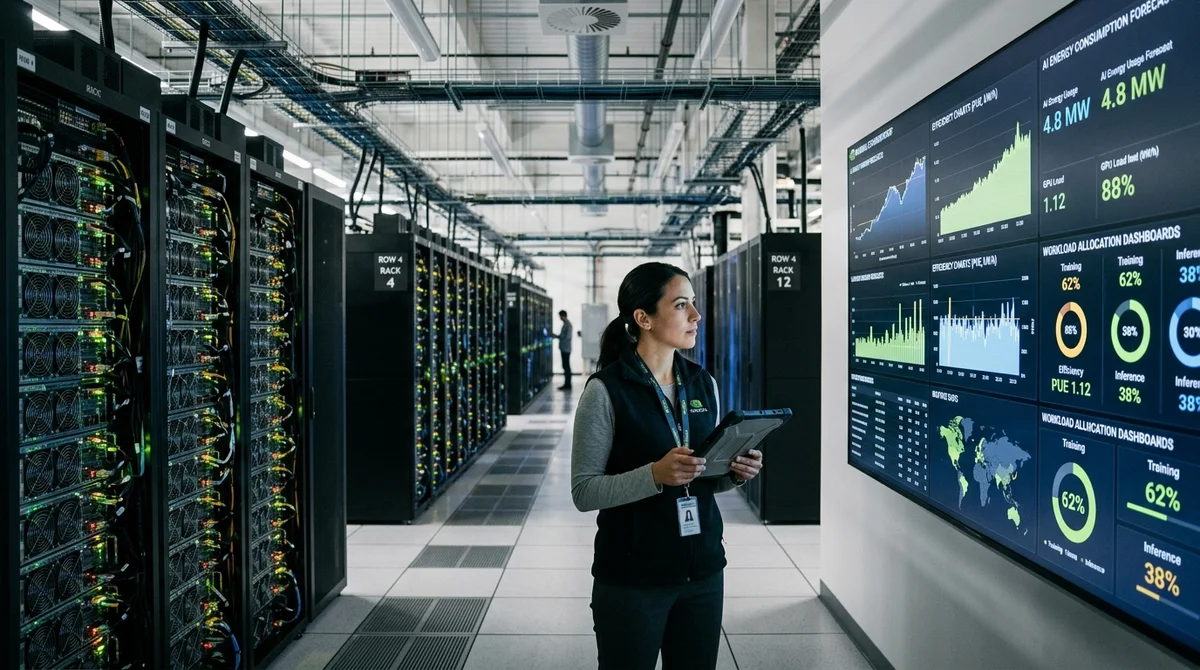
AI has become so electricity-hungry that assessing its energy consumption is turning into a separate engineering task. Researchers from MIT and the MIT-IBM Watson AI Lab have proposed EnergAIzer — a method that predicts in seconds how much energy a specific AI workload will consume on a chosen processor or accelerator. For data centers, this provides the opportunity to make decisions before running a model, rather than after wasting electricity.
The problem is no longer theoretical. According to estimates from Lawrence Berkeley National Laboratory, by 2028 data centers could consume up to 12% of all electricity in the United States, and a significant portion of this growth is linked to AI development. Operators have to divide limited GPU resources between model training, inference, and data preprocessing, but it's difficult to understand in advance the energy cost of each scenario.
Classical methods typically break down the workload into many separate operations and gradually emulate the operation of GPU internal modules. This approach can take hours or even days, which is not suitable for quick engineering decisions. EnergAIzer is built on a lighter model.
The MIT team noticed that AI workloads often contain repeating computational patterns, especially when developers have already optimized code for GPU: parallelized computations, properly distributed data, and configured memory block transfers. Instead of full detailed simulation, the system uses these regular structures to quickly assess the energy consumption profile. The idea is to take less low-level information, but extract enough data from it for reliable prediction.
At the same time, researchers didn't limit themselves to rough estimation. They accounted for the fact that each run has a fixed energy cost for program preparation and configuration, and then there are additional expenses for processing each data block. There are also hardware factors: fluctuations in hardware operation, memory access conflicts, incomplete bandwidth utilization.
To compensate for these effects, the team collected real measurements from GPU and added corrective coefficients. As a result, the method retained high speed but became noticeably more accurate than simple approximation models. In practice, a user can pass EnergAIzer the parameters of their workload: what model they want to run, how many input requests need to be processed, and what length these requests are.
In response, the system provides an energy consumption estimate within seconds. Additionally, one can change GPU configuration or operating frequency and see how this affects the final energy consumption. In tests on real AI workloads and real GPUs, the average error was about 8% — this is comparable to traditional approaches, which require much more time.
The authors also note that the method can be applied to promising accelerator configurations if the hardware architecture doesn't change radically. The work was presented on April 27, 2026, and results are also being presented at the IEEE International Symposium on Performance Analysis of Systems and Software. Among the authors are MIT postdoc Kyoungmi Lee, graduate student Zhiye Song, researchers from IBM Research, and senior author Anantha Chandrakasan, MIT Provost.
The next step is to test EnergAIzer on the newest GPU configurations and scale it to scenarios where a single workload is jointly processed by multiple accelerators. This is important because large AI workloads are increasingly distributed across multiple GPUs. The main conclusion is simple: AI energy efficiency depends not only on new chips, but also on the ability to quickly measure the cost of computations before running them.
If energy assessment takes seconds instead of days, it can be integrated into the routine work of data centers, model training teams, and algorithm developers. Then energy consumption becomes not a post-hoc metric from a report, but a real parameter for choosing architecture, tuning accelerators, and planning computations.
Want to stop reading about AI and start using it?
AI News is a curated feed of AI/tech news. Hamidun Academy teaches you to use AI systematically in your work.