DeepSeek cuts DeepSeek-V4-Pro prices by 75% and makes repeat requests 10 times cheaper
DeepSeek has announced a 75% discount on its new flagship model, DeepSeek-V4-Pro, and at the same time cut the price of repeated and similar requests 10-fold through input caching. For developers, the signal is direct: strong models are getting cheaper not just on paper but in real workloads with templated traffic, long instructions and stable context. The move shifts the competition further from loud announcements toward the real economics of running models.
AI-processed from 3DNews AI; edited by Hamidun News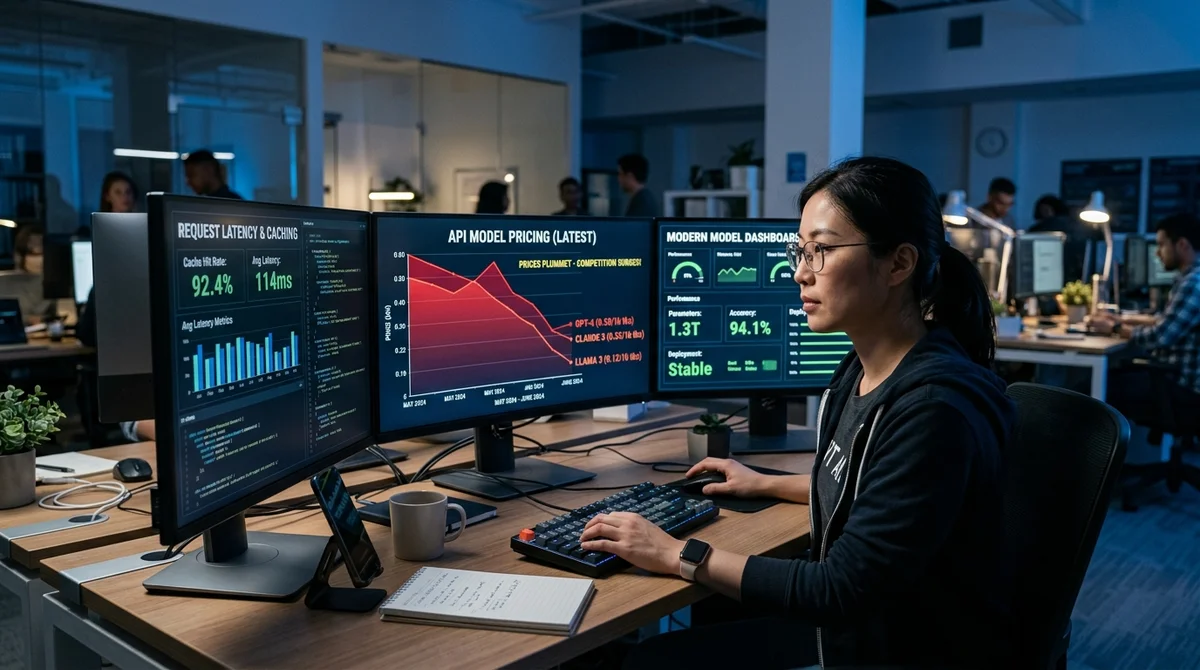
DeepSeek has sharply cut the cost of access to its new flagship AI model, DeepSeek-V4-Pro: the company has announced a 75% discount for developers. At the same time, it has made repeated and similar requests ten times cheaper across all its platforms, using input caching. For the AI market this is not a cosmetic price-list update but a sign that competition is moving further from loud announcements toward the real economics of using models.
Two changes are involved. The first is aggressive price cuts for access to DeepSeek-V4-Pro, which the company promotes as its new flagship model. The second is a separate price reduction for requests in which a significant part of the input is repeated or barely changes. In such cases the provider does not need to process the whole body of text from scratch, provided the system can recognize and reuse fragments it has already processed. For developers this matters most in products with many long system instructions, templated prompts and repeating context.
In practice, not only large platforms stand to gain from this move, but small teams too. Many applied AI services today are built around the same scenarios: chat assistants, customer support, search over a corporate knowledge base, document generation, and agent pipelines with fixed roles and rules. In all of these, a significant part of the request often stays constant, while only the user's message, a document or a few parameters change. If exactly such requests become several times cheaper, the cost of each session falls, and so does the barrier to scaling the product.
The effect on unit economics matters separately. For startups and teams that count costs per user, API prices often determine whether a feature can go into production at all. Even a strong model loses its appeal if it is too expensive to run on real traffic. A 75% discount on a flagship model makes DeepSeek-V4-Pro noticeably more accessible for tests, pilots and large-scale deployment. And the tenfold price cut on similar requests gives an extra incentive to design products with more reusable context and less unnecessary variation at the prompt level.
There is a technical side too. Input caching benefits above all systems where the static part of the request is large: instructions, response policy, tool descriptions, reference blocks, dialogue history, standard documents. The more of this stable structure there is, the higher the potential savings. This may push developers to rethink their application architecture: move unchanging fragments into templates, handle dialogue memory more carefully, trim noise from the context and group similar requests. In other words, DeepSeek is effectively making cheaper not only the model call itself but also a disciplined approach to designing LLM products.
The step also fits into the broader context of price competition in the generative AI market. Providers have long competed not only on benchmarks, context length and multimodality, but also on how much one useful business scenario costs. For corporate customers the question is usually simple: how much will it cost to process a thousand dialogues, a catalog of documents, a queue of support tickets or a single business process from start to finish. If a vendor offers comparable quality at a noticeably lower price, that quickly changes the model selection funnel. That is why DeepSeek is now betting not only on technology but also on the financial appeal of its ecosystem.
The economic effect will, however, be uneven. Projects with unique, rarely repeated requests will feel the price cut less than services with a large volume of templated traffic. Even so, the logic of the offer matters: the market gets a clear benchmark showing that a flagship model does not have to stay expensive by default. And for companies that use several providers at once, it is one more reason to compare not only answer quality but also the cost structure of typical operations.
What this means: DeepSeek is trying to win not only on model quality but on the cost of owning it. If the company maintains the DeepSeek-V4-Pro level and at the same time keeps these API terms, pressure on competitors will grow. For developers it is a good moment to recalculate the economics of their AI features, and for the whole market it is one more confirmation that the next big battle is not over the loudest release but over the most cost-effective way to bring a model to a real product.
- Nov 2, 2026DeepSeek open-sources Super-agent prototype: p95 task completion time of 15.7 minutes vs. 29.5
- Nov 1, 202616 models tested on 7 search tools: Exa averaged 10.5 out of 14, SearXNG about 3
- Nov 1, 2026MoneyGate safety layer blocked all 42 fraudulent requests to local AI models
- Oct 31, 2026DeepSeek-V4.1-Flash cuts HBM KV cache to 890 bytes per token, down from 3514
Test Frontier LLMs & Autonomous Agents in One Workspace
Run Claude Opus 5.5, GPT-6, Gemini 3.1, and DeepSeek side-by-side in Nomad AI (nomadnet.ai) — unified model routing, deep research, and multimodal workflows under one subscription.
The AI world, distilled — once a week
Seven stories that actually mattered, hand-picked. No noise, no reposts, no press releases.
Done! Check your inbox for a confirmation.