Anthropic investigates possible unauthorized access to its restricted Mythos model
Anthropic has opened an investigation after reports that a small group of people gained unauthorized access to Mythos, a restricted model that can find vulnerabilities and could potentially assist in cyberattacks. The company did not release the tool publicly precisely because of these risks. The key question now is whether this was an isolated incident or a sign of weak access controls around sensitive AI systems.
AI-processed from Guardian; edited by Hamidun News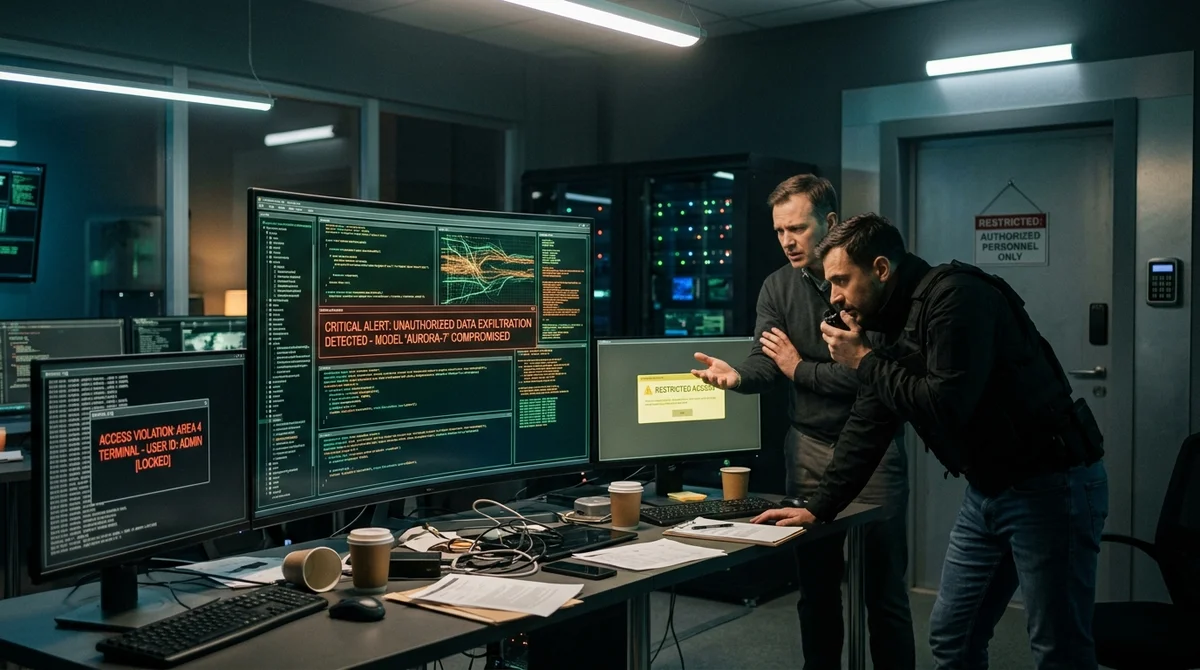
Anthropic is checking a report that a small group of outside users may have gained access to Mythos, the company's restricted model, which was withheld from public release because of the risk of its use in cyberattacks. If the information is confirmed, this is not just an internal failure but a possible breach of one of the most sensitive security perimeters in the AI industry: control over systems that can speed up vulnerability discovery and help malicious actors.
The investigation was prompted by a Bloomberg report, after which Anthropic officially confirmed that it is looking into the circumstances of the incident. According to available information, only a few people may have gained access, but even that scale looks serious, because Mythos itself has so far not been opened to a broad audience. The company had previously warned that the model's capabilities pose cybersecurity risks, which is why it kept Mythos out of public release and did not offer it to ordinary users.
Mythos matters as an example of a dual-use model. Systems of this class can analyze code, services, application architecture and known attack vectors much more deeply than general-purpose chatbots. In the hands of defense teams, that is useful: they can find weak points faster, assess configurations, test hypotheses and cut audit time. But the same abilities can serve attackers too, helping with reconnaissance, speeding up the assembly of exploitation chains and lowering the barrier to entry for less skilled adversaries.
For this reason, developers of frontier models try to build layered restrictions: a limited circle of testers, internal access rules, action logging, separate environments for experiments and additional checks before access is widened. The fact that a model is not released publicly usually means the company considers ordinary safeguards insufficient and prefers a stricter handling regime. That is why the story of possible unauthorized access hits the very logic of this approach: if a tool is deemed potentially dangerous, its internal perimeter must be especially solid.
The episode is also sensitive for Anthropic for reputational reasons. The company has long tried to establish itself as a cautious player that bets on safety, risk control and staged deployment of powerful models. Amid the broader race among AI developers, such claims have become an important part of competition: users, enterprise customers and regulators need to understand not only the quality of a model but also how responsibly it is managed. When a closed system deliberately kept out of public access surfaces in reports of outside use, it is not only the technology that is in question but also the practical soundness of the safeguards around it.
Anthropic has not yet disclosed how the access was obtained or what consequences followed. It is unclear whether this involved full use of Mythos's capabilities, a test interface or a more limited interaction with the model. There is also no confirmed data on whether the outside users managed to put those capabilities to practical use. Even without these details, the incident shows how complex security is becoming in the era of specialized AI systems: the risk lies not only in publishing a model but also in how reliably a company controls it within its own processes.
If the investigation confirms an access leak, it will be one more argument for stricter procedures for dual-use models: access segmentation, independent audits, continuous usage monitoring and a firmer separation between research and production environments. For the whole market the signal is simple: the danger begins not at the moment of mass release but much earlier, at the point where a closed system stops being truly closed.
- Nov 2, 2026mcp-linter finds 18 undescribed parameters in Anthropic's filesystem server
- Nov 2, 2026The Verge reviewer builds a $50 Meta Muse Charm alternative with Claude Code
- Nov 2, 20268 Skills for video in Claude Code: from 244 pixel effects to rough-cut editing
- Nov 1, 2026Local models lose to Opus and Codex: 0.21 on a MacBook versus 1.00 for Codex
Ship AI Faster with Founders, Engineers & Weekly Architecture Reviews
Inside Vibe Club (hamidun.com/club) — weekly live masterminds with Zhemal Khamidun, Tech Radar, full LMS access, and 370+ production Claude Code skills.
The AI world, distilled — once a week
Seven stories that actually mattered, hand-picked. No noise, no reposts, no press releases.
Done! Check your inbox for a confirmation.