Good American's Emma Grede: AI is reshaping the business, but humans will keep designing the jeans
Emma Grede, co-founder and CEO of Good American, has drawn a clear line on AI use: almost everything can be automated except design, innovation and other work that needs a human eye. She says AI is already noticeably changing the company's business processes. For the fashion market, that is a meaningful signal: brands are willing to speed up operations, but not to hand taste and customer understanding over to a machine.
AI-processed from Bloomberg Tech; edited by Hamidun News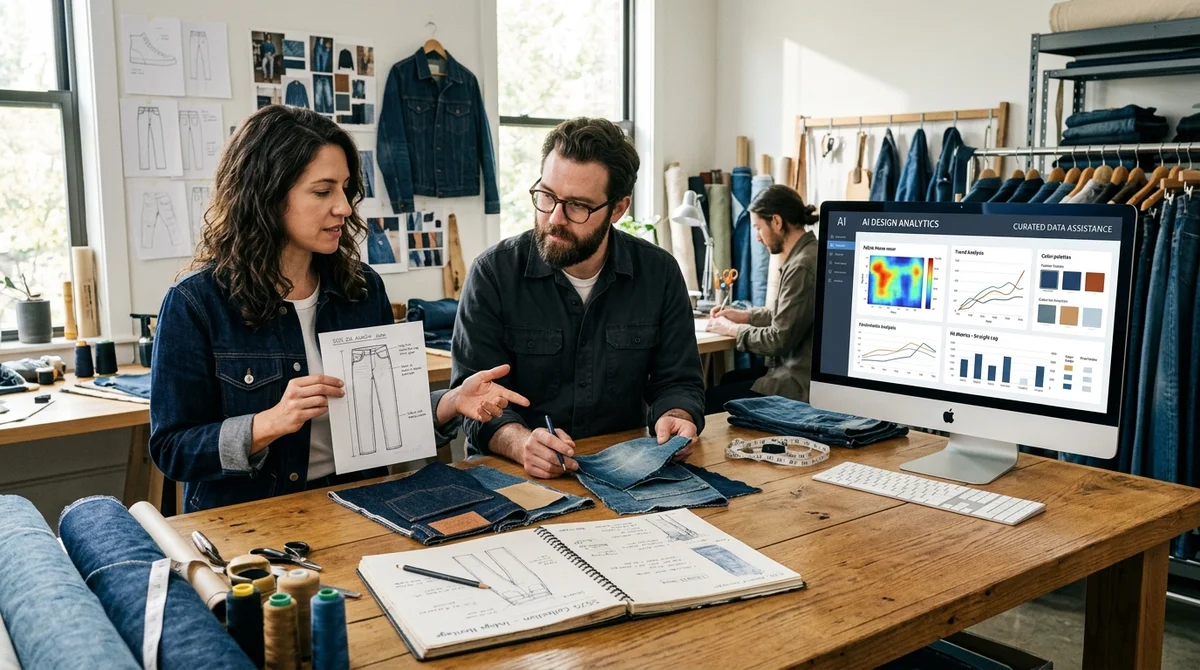
Emma Grede, co-founder and CEO of Good American, has offered the fashion industry a surprisingly sober formula for working with AI: use it almost everywhere speed and efficiency matter, but keep it away from the areas where a brand is built on a human understanding of taste and customer needs. She says AI is already noticeably changing her companies, but creative work, innovation and design should stay with people. Grede made the comments in an interview for the Leaders with Francine Lacqua series, published on April 27, 2026.
Her stance doesn't read as resistance to technology. On the contrary, she openly acknowledges that AI is already restructuring business processes. But she has a clear red line.
Anything that requires a human touch, empathy and the ability to understand another person should not be handed to a machine. Translated into fashion-market terms, that means neural networks can speed up a company's work, but they should not decide what the clothes people wear will look like. For Good American, this is a particularly important question.
Launched in 2016, the brand was built from the start around inclusivity and a precise understanding of the real customer rather than an averaged-out fashion ideal. The company debuted with the biggest launch in denim-market history and pulled in $1 million in sales on its first day. Good American later grew from a jeans label into a broader fashion line while keeping its focus on size inclusivity.
That's why Grede's comments sound less like an abstract debate about the future of AI and more like a management rule for a business that sells not just clothing, but the feeling of a product that fits a need exactly. Judging by Grede's framing, AI at her companies should take on everything that can be described as repetitive, analytical or operational work. This is an interpretation of her words rather than a direct quote, but the logic is clear: demand forecasting, drafting, working with internal data, speeding up team processes, planning support and other routine tasks are easier to standardize and hand off to algorithms.
Design, innovation and creative decisions, by contrast, remain human territory, because they depend not only on patterns in past data but also on intuition, cultural context, risk and an understanding of what customers haven't yet managed to put into words. The stance also fits Grede's broader image as an operator who builds brands at the intersection of culture and hard-nosed business discipline. Besides running Good American, she is a founding partner of Skims, and in recent appearances she has consistently talked about decision-making speed and bringing AI into workflows.
Even the descriptions of her recent interviews and podcasts repeat the same idea: automation should strengthen the business, not replace its creative core. In a market where many companies either embrace generative content uncritically or, conversely, publicly fear AI, this is an important middle ground. Grede's point is broader than the argument over whether a neural network can come up with good jeans.
She is effectively proposing to split the business in two: what can be optimized, and what shapes the product's identity. In the first part, AI becomes a tool for moving faster and cutting costs. In the second, people still make the calls, because that is where a brand sets itself apart from an endless stream of auto-generated variations.
For consumer companies, this may be the most realistic scenario for the next few years: not "AI instead of the team," but AI around a team that remains responsible for taste, choices and meaning.
Test Frontier LLMs & Autonomous Agents in One Workspace
Run Claude Opus 5.5, GPT-6, Gemini 3.1, and DeepSeek side-by-side in Nomad AI (nomadnet.ai) — unified model routing, deep research, and multimodal workflows under one subscription.
The AI world, distilled — once a week
Seven stories that actually mattered, hand-picked. No noise, no reposts, no press releases.
Done! Check your inbox for a confirmation.