Emma Grede of Good American: AI Is Changing Business, But Jeans Design Stays With People
Emma Grede, co-founder and CEO of Good American, has drawn a clear line on AI use: almost everything can be automated except design, innovation, and work requiring human perspective. AI is already noticeably reshaping the company's business processes, she says. For the fashion market, it's a telling signal: brands are willing to accelerate operations but won't hand over taste and customer understanding to machines.
AI-processed from Bloomberg Tech; edited by Hamidun News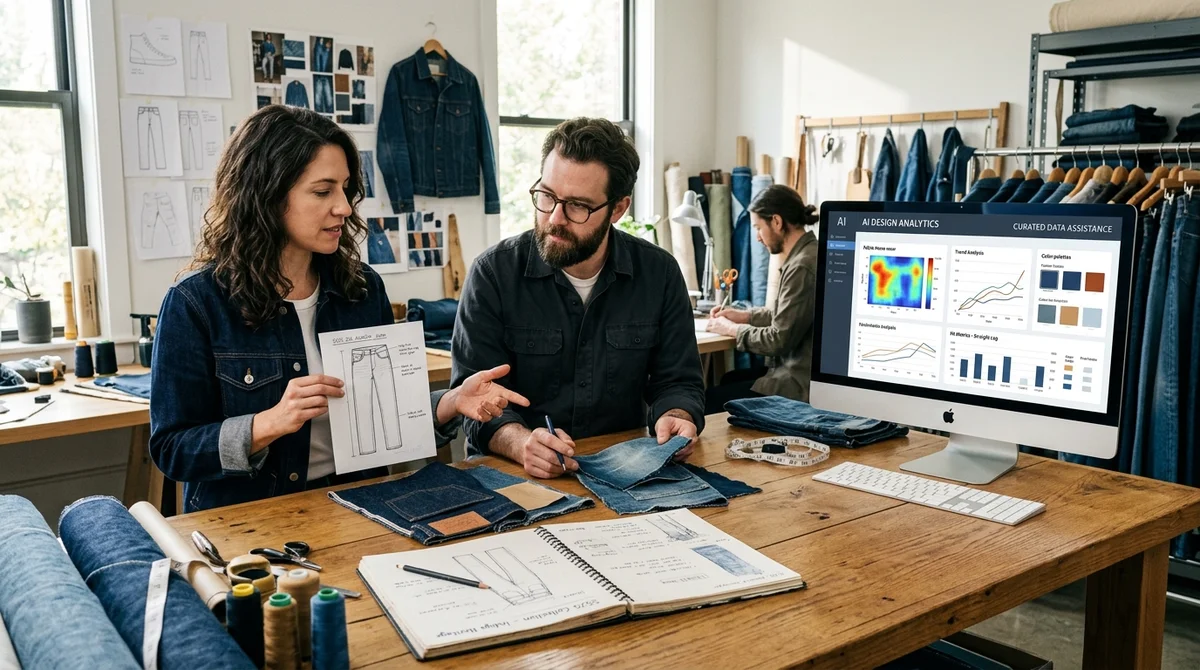
Emma Grede, co-founder and CEO of Good American, has offered the fashion industry an unexpectedly sobering formula for working with artificial intelligence: use it almost everywhere speed and efficiency matter, but keep it away from areas where a brand is built on human understanding of taste and customer needs.
According to her, AI is already noticeably transforming her companies, but creativity, innovation, and design should remain with people.
Grede said this in an interview from the Leaders with Francine Lacqua series, published on April 27, 2026.
Her position does not look like resistance to technology; on the contrary, she directly acknowledges that AI is already restructuring business processes.
But for her, there is a clear red line.
Everything that requires human touch, empathy, and the ability to understand another person should not be handed over to machines.
In fashion market terms, this means that neural networks can accelerate the company's work, but should not determine what things people wear.
For Good American, this is a particularly important question.
The brand, launched in 2016, was built from the start around the idea of inclusivity and precise understanding of the real customer, rather than an averaged fashion ideal.
The company started with the largest denim market launch in history and already on the first day achieved 1 million dollars in sales.
Later, Good American grew from a jeans brand into a broader fashion line while maintaining its emphasis on size inclusivity.
Therefore, Grede's words sound not like an abstract discussion about AI's future, but like a management rule for a business that sells not just clothing, but the feeling of hitting the customer's needs precisely.
Based on Grede's formulation, AI in her companies should take on everything that can be described as repetitive, analytical, or operational work.
This is already an interpretation of her words, not a direct quote, but the logic is clear: demand forecasting, draft preparation, working with internal data, accelerating team processes, helping with planning, and other routine tasks are easier to standardize and hand over to algorithms.
Conversely, design, innovation, and creative solutions remain human territory, because what matters there is not only patterns from past data, but also intuition, cultural context, risk, and understanding what the customer hasn't yet managed to articulate.
This position fits well with the broader image of Grede as an operator who builds brands at the intersection of culture and strict business discipline.
She not only leads Good American but also serves as a founding partner of Skims, and in recent appearances consistently speaks about decision-making speed and implementing AI in work processes.
At the same time, even in descriptions of her recent interviews and podcasts, the same idea is repeated: automation should strengthen the business but not replace the creative core.
For a market where many companies either unconditionally embrace generative content or, conversely, publicly fear AI, this is an important middle-ground position.
The meaning of Grede's statement goes beyond the debate about whether a neural network can come up with good jeans.
She is essentially proposing to divide business into two parts: what can be optimized, and what shapes product identity.
In the first part, AI becomes a tool for acceleration and cost reduction.
In the second part, people still decide, because that is where the brand's distinction from an endless stream of automatically generated variants is born.
For consumer companies, this may well be the most realistic scenario for the coming years: not "AI instead of a team," but AI around the team, which still bears responsibility for taste, choice, and meaning.
Need AI working inside your business — not just in your newsfeed?
I build production AI for companies — custom CRM, internal tools, autonomous agents, workflow automation. Owned by you, shaped to your process, no per-seat tax. Built by Zhemal Khamidun, CPO of AlpinaGPT (AI platform, 6,000+ users).
The AI world, distilled — once a week
Seven stories that actually mattered, hand-picked. No noise, no reposts, no press releases.
Done! Check your inbox for a confirmation.