Lina Bessonova Presents a Russian Cognitive Architecture as an Alternative to Transformers
Lina Bessonova has outlined her own "Russian cognitive architecture" as an alternative to transformers. In her design, the system is built on biomimetic models, learns by accumulating experience, and can run locally without scarce GPU clusters. The project is also being prepared for patenting in Russia. The author sharply criticizes the current corporate push toward RLHF, large data centers, and imported architectures.
AI-processed from Habr AI; edited by Hamidun News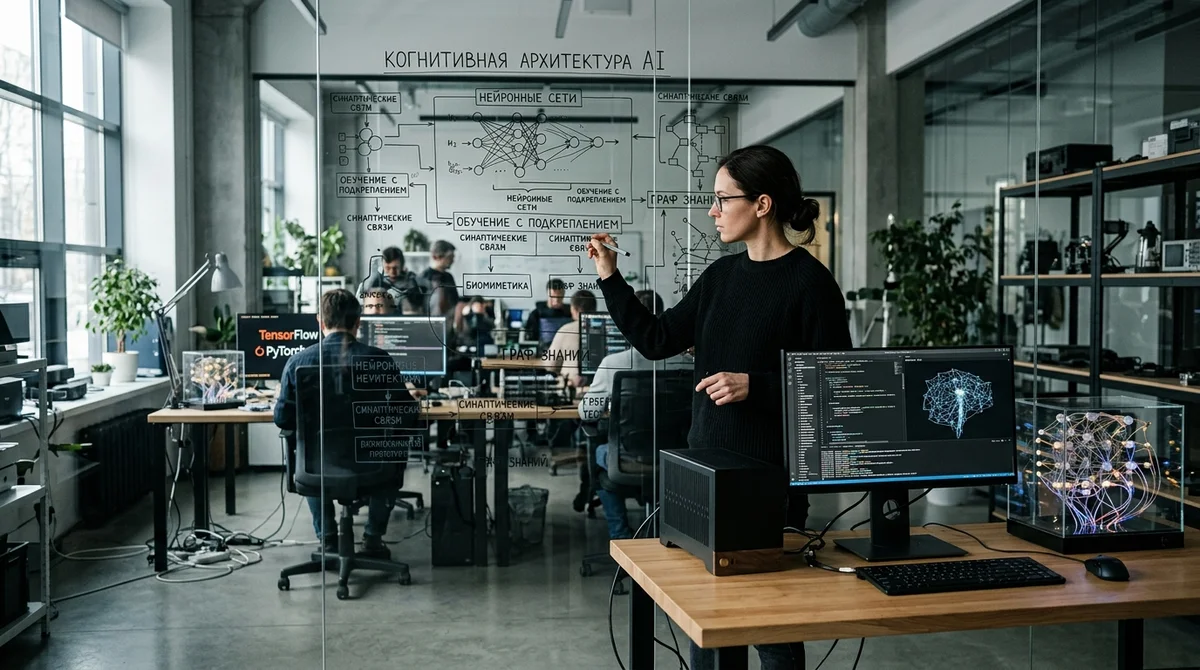
Developer Lina Bessonova has presented the concept of a "Russian cognitive architecture," which she proposes as an alternative to the usual race for large language models. The central argument is simple: according to the author, sovereign AI starts not with a local dataset or the purchase of expensive accelerators, but with an attempt to redefine the architecture of the system itself. Instead of predicting the next token, Bessonova proposes relying on a biomimetic approach, internal states, and the accumulation of experience.
The text is framed as a polemic against what is often called "sovereign AI" in Russia today. The author asks pointed questions: are Russian-language data, a domestic brand, or access to scarce H100s enough to call a model truly independent? Her answer is no. If the foundation remains foreign and the core logic is borrowed from American models, then in her view localization does not turn a product into an independent technological school. In this sense, the article reads not as the announcement of a finished mass-market service but as a manifesto about what a national AI stack should look like at all.
Bessonova describes the practical side of the concept through her own stack built on Python, NumPy, and SciPy. By her account, the system does not require massive training on huge GPU clusters and can run in real time on a local machine, up to a home server or a Mac Mini M4 Pro. This matters not only as an engineering choice but also as a political-economic argument: the less dependent a country is on sanctioned and scarce hardware, the better its chances of developing autonomously. The author also stresses that such an architecture is potentially better suited to edge devices, where compactness, power consumption, and the ability to work without the cloud are critical.
The key technical idea of the article is biomimetics instead of statistical prediction. Bessonova contrasts transformers with a system in which an agent's behavior is determined not only by word probabilities but also by the dynamics of internal variables. She names analogues of excitation, inhibition, adaptation, and resource, which are continuously recalculated and shape the model's responses.
In the author's design, this allows one to speak not merely of text generation but of a more coherent cognitive scheme, in which an answer emerges from the system's internal state. As scientific grounding, Bessonova cites the Russian physiological school and the names of Bekhterev, Chizhevsky, and Pavlov, emphasizing that she looks for a foundation not in the Californian engineering tradition but in a domestic scientific lineage.
Another important element is learning through "sedimentation of experience." Unlike models that first absorb giant volumes of internet data and are then fine-tuned, the article proposes a different path: the agent should accumulate personal experience from interacting with the user and its environment. This logic makes the system resemble a developing organism more than a conventional language model.
At the same time, the author is betting on the legal independence of the project: she says the architecture is being prepared for registration with Rospatent as a computer program, and later for patent protection of individual inventive solutions. The concept is thus presented as an attempt to create not only a new tech stack but also a formally independent Russian intellectual asset.
The sharpest part of the text is its criticism of the corporate mainstream. Bessonova believes that models from major players built on the Transformer architecture remain dependent on someone else's "blueprints," even if the interface, language, and brand are local. RLHF, reinforcement learning from human feedback, comes in for particular criticism. The author interprets this approach as a mechanism that makes assistants safe and predictable but at the same time smooths away cultural edge, controversy, and intellectual individuality. In her interpretation, the problem lies not only in ideology but also in infrastructure: if the entire strategy hinges on large data centers and supplies of rare chips, any talk of technological sovereignty is vulnerable.
The article's conclusion amounts to changing the frame of the debate. The question is essentially this: is national AI whatever catches up with the leaders faster on their own turf, or whatever offers a different basic model of machine thinking? For now, the architecture described looks more like a research program and a statement of worldview than a product ready to compete with mainstream LLMs. But the framing of the problem matters: the author urges that the argument be not about the number of GPUs and dataset sizes, but about who sets the founding principles of future intelligent systems.
- Nov 1, 2026Local models lose to Opus and Codex: 0.21 on a MacBook versus 1.00 for Codex
- Nov 1, 2026Adobe's EditAgent judge picks a usable edit 81.3% of the time, versus 74.8% for EditScore
- Nov 1, 202616 models tested on 7 search tools: Exa averaged 10.5 out of 14, SearXNG about 3
- Nov 1, 2026Google's StreamVibe video agent beats other models by 10.7% on response timing and quality
Test Frontier LLMs & Autonomous Agents in One Workspace
Run Claude Opus 5.5, GPT-6, Gemini 3.1, and DeepSeek side-by-side in Nomad AI (nomadnet.ai) — unified model routing, deep research, and multimodal workflows under one subscription.
The AI world, distilled — once a week
Seven stories that actually mattered, hand-picked. No noise, no reposts, no press releases.
Done! Check your inbox for a confirmation.