The Musk-Altman Trial May Determine OpenAI's Future Corporate Structure
Jury selection began on April 27 in Oakland in Elon Musk's case against Sam Altman and OpenAI. Musk claims the company abandoned its nonprofit mission and restructured its corporate model for profit. At stake: OpenAI's governance structure, Altman's and Brockman's positions, and the company's ability to raise capital. Opening statements were expected on April 28.
AI-processed from Bloomberg Tech; edited by Hamidun News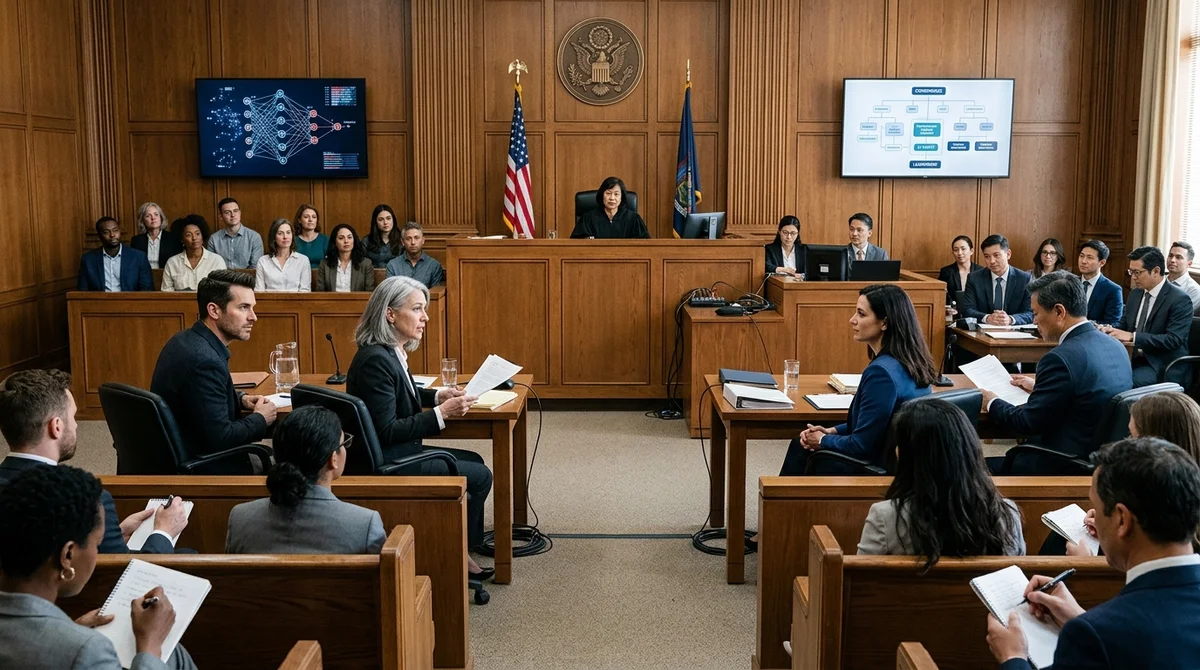
On April 27, a jury trial began in federal court in Oakland regarding Elon Musk's case against Sam Altman and OpenAI. Formally, the dispute concerns the company's corporate structure, but in essence, it is a trial about whether one of the world's key AI companies can definitively abandon its original non-profit logic. The court's decision could affect not only OpenAI's management, but also its ability to peacefully restructure its business, attract capital, and prepare for the next stage of growth.
The history of the conflict stretches back to OpenAI's founding in 2015. Musk was one of the co-founders of the project and helped with money, connections, and hiring the first key employees. Now he argues that the original agreement was simple: OpenAI should develop strong AI in the interests of society, not as a regular commercial company.
In a lawsuit filed in August 2024, Musk accuses Altman, OpenAI's president Greg Brockman, and related defendants of departing from the original mission, building a profitable structure behind his back, and turning the organization into a profit-extraction mechanism.
On April 27, jury selection began, with opening statements from both sides expected on April 28. The key subject of the dispute is the evolution of OpenAI's structure. The company started as a non-profit organization, then in 2019 created a commercial division to receive external investments and scale research.
In October 2025, OpenAI completed another restructuring: the commercial part became a public benefit corporation, while control, according to the company itself, remained with the non-profit structure. For Musk, this very path is proof of the departure from the original promises. OpenAI responds with the diametrically opposite thesis: Musk himself participated in early discussions about possible reorganization, sought greater control, and later began legal and public pressure as head of competing xAI.
The defense is built around the idea that without a more flexible corporate scheme and larger external funds, the company simply would not have been able to finance the computing power, research, and products at the scale of ChatGPT.
The stakes are very high. As of spring 2026, OpenAI is valued at more than $850 billion and remains one of the central players in generative AI. Against this backdrop, any blow to the corporate governance structure could affect negotiations with investors, long-term partnerships, and plans for further capital attraction.
The court has already divided the proceedings into two parts: first, jurors in an advisory capacity consider questions of liability, and then the judge separately decides on possible remedies. According to the pretrial order, the remedies phase should begin on May 18. This emphasizes that the case is not only about loud statements, but also about very concrete consequences for the board of directors, management, and the company's corporate structure.
For the entire AI industry, this is also a stress test of the very idea that a laboratory claiming a public mission can simultaneously remain a center of attraction for multi-billion-dollar capital. OpenAI has long been the most prominent example of such a hybrid, so the dispute between Musk and Altman will be read as a precedent far beyond one company. If the court finds that the transition to a more commercial model violated the original obligations, it will increase pressure on other AI companies with similar structures.
If OpenAI's position holds, the market will receive a strong signal that a hybrid model with non-profit control and a commercial operational part is legally viable even at scales comparable to the largest technology corporations.
The main conclusion is simple: the trial in Oakland is not just another series of public hostility between Musk and Altman. It is a legal stress test for the entire logic on which the most expensive AI companies today are built: can one promise benefits to humanity, collect giant private capital, and not go beyond the original mission. For OpenAI, the answer to this question could determine who and under what rules will control its future.
Need AI working inside your business — not just in your newsfeed?
I build production AI for companies — custom CRM, internal tools, autonomous agents, workflow automation. Owned by you, shaped to your process, no per-seat tax. Built by Zhemal Khamidun, CPO of AlpinaGPT (AI platform, 6,000+ users).
The AI world, distilled — once a week
Seven stories that actually mattered, hand-picked. No noise, no reposts, no press releases.
Done! Check your inbox for a confirmation.