GPT-5.2 outscores this year's applicants on University of Tokyo and Kyoto University entrance exam questions
GPT-5.2 in thinking mode posted the best result on entrance exam questions from the University of Tokyo and Kyoto University. In LifePrompt's test, the model beat this year's applicants and even exceeded the maximum passing scores in the most competitive medical programs. The result matters beyond the record itself: it shows that strong reasoning models can now pass academic filters that until recently were considered purely human territory.
AI-processed from 3DNews AI; edited by Hamidun News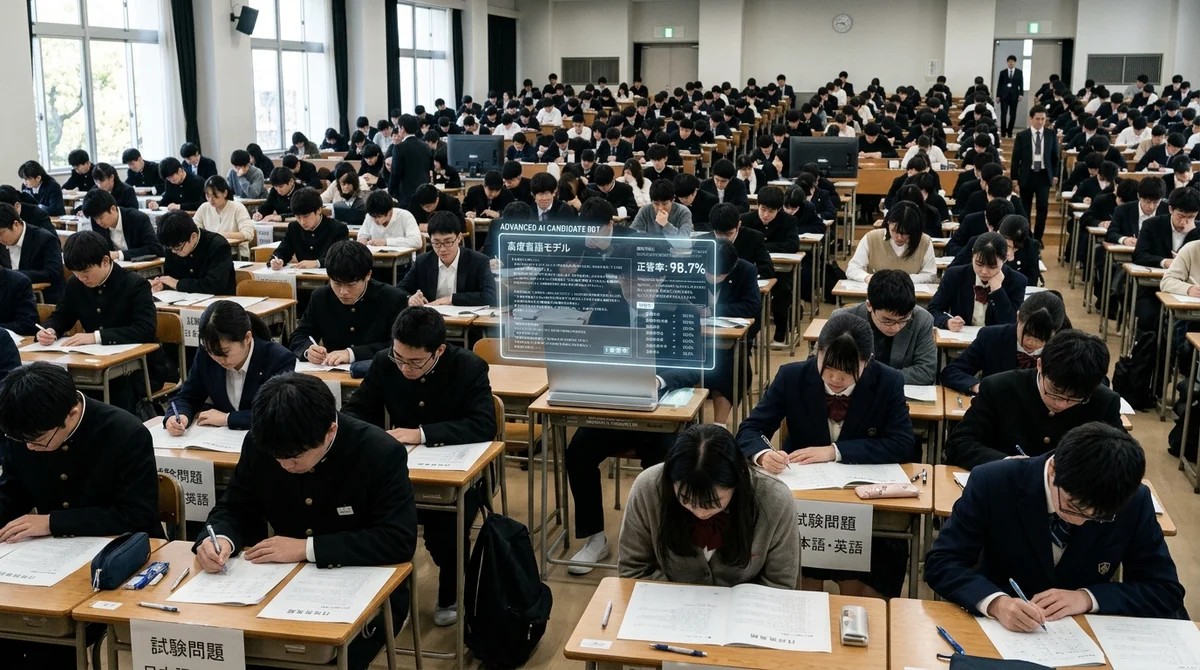
GPT-5.2 has reached another milestone long considered human territory: on entrance exam questions from the University of Tokyo and Kyoto University, the model scored higher than this year's applicants. And this is not merely a matter of clearing a threshold. According to LifePrompt, the system in thinking mode reached a level that exceeds even the highest passing scores in a number of programs, including medicine.
The tests were run by LifePrompt, which compared the model's answers with current exam questions and the results of the actual admissions cycle. It is important to note that this is not an official entry of the AI into Japanese admissions, nor a story about university enrollment. Rather, it is a stress test of the model's academic abilities in an extremely competitive setting. But that format is exactly what makes it valuable: it measures not an abstract benchmark but how AI handles complex tasks that are used to filter out the strongest candidates.
The choice of venue is no accident either. The University of Tokyo and Kyoto University are the two most prestigious and selective universities in Japan, and medical programs are traditionally among the hardest to get into. If the model really does beat the upper bound of passing scores in such programs, that means more than good general knowledge. It signals a durable ability to handle tasks that demand logic, long chains of reasoning, careful calculation and the ability not to lose context across several conditions.
By the description of the test, thinking mode played the key role. In it, the model spends more time analyzing the problem internally before giving a final answer. This matters especially for entrance exams: such tasks often penalize not ignorance of a fact but a single wrong intermediate step. As a result, the progress of these systems looks less and less like "guessing from statistics" and more and more like genuine step-by-step problem solving. At the same time, this does not remove the limitations: even an outstanding score on exam sets does not yet prove that the model is equally reliable in live dialogue, research work or clinical decisions.
For education, this is a signal in several directions at once. First, standard exams work less and less as a pure knowledge filter if a strong reasoning model can consistently pass them better than most people. Second, the value of preparation itself is changing: what matters more is not mechanically solving familiar problems but the ability to formulate questions, check intermediate steps, defend conclusions and work alongside AI tools. Finally, such results push universities to rethink assessment methods, adding more oral components, project work and tasks where independent argumentation is critical, not just the final answer on an answer sheet.
For the AI market, this is also a demonstration of where competition between models is heading. The winner is no longer the system that words text more elegantly, but the one that withstands long cognitive loads and stays accurate under the pressure of complex conditions. Academic exams are convenient precisely because they carry a high cost of error and a clear success criterion. If a model starts winning confidently in such an environment, its potential quickly extends beyond education, into analytics, engineering calculations, certification prep and other areas that demand disciplined thinking.
The main takeaway is simple: the bar for "smart" AI has risen again, and the question is no longer whether a model can pass a hard exam, but how people and institutions should rebuild the rules around that fact. For now, such tests remain more a demonstration of capability than a replacement for real expertise. But the gap between academic tasks for humans and for a strong model keeps narrowing fast.
- Oct 28, 2026Anthropic reveals how it builds Claude with Claude: the brain separate from the hands
- Oct 28, 2026Bayer Launches Multi-Agent Engine on AgentCore: 80% of Questions Handled Without Engineers
- Oct 28, 2026Liquid AI releases LFM2.5-24B-A2B: an agent model with 2B active parameters
- Oct 28, 2026AgentOrch: Pre-Planned AI Agents Now Trail Step-by-Step Execution by Just 8.5 Points
Test Frontier LLMs & Autonomous Agents in One Workspace
Run Claude Opus 5.5, GPT-6, Gemini 3.1, and DeepSeek side-by-side in Nomad AI (nomadnet.ai) — unified model routing, deep research, and multimodal workflows under one subscription.
The AI world, distilled — once a week
Seven stories that actually mattered, hand-picked. No noise, no reposts, no press releases.
Done! Check your inbox for a confirmation.