DeepSeek, Qwen and Moonshot Raise the Pressure on Silicon Valley With Affordable Models
China's DeepSeek, Qwen and Moonshot models are no longer just cheaper alternatives; they have become a real threat to the US business model. They have nearly caught up with the leaders on quality, but win on price, flexible fine-tuning and an open-weight approach. For Silicon Valley, this is a warning: the market is starting to pay not only for peak intelligence, but also for the economics of deployment.
AI-processed from Bloomberg Tech; edited by Hamidun News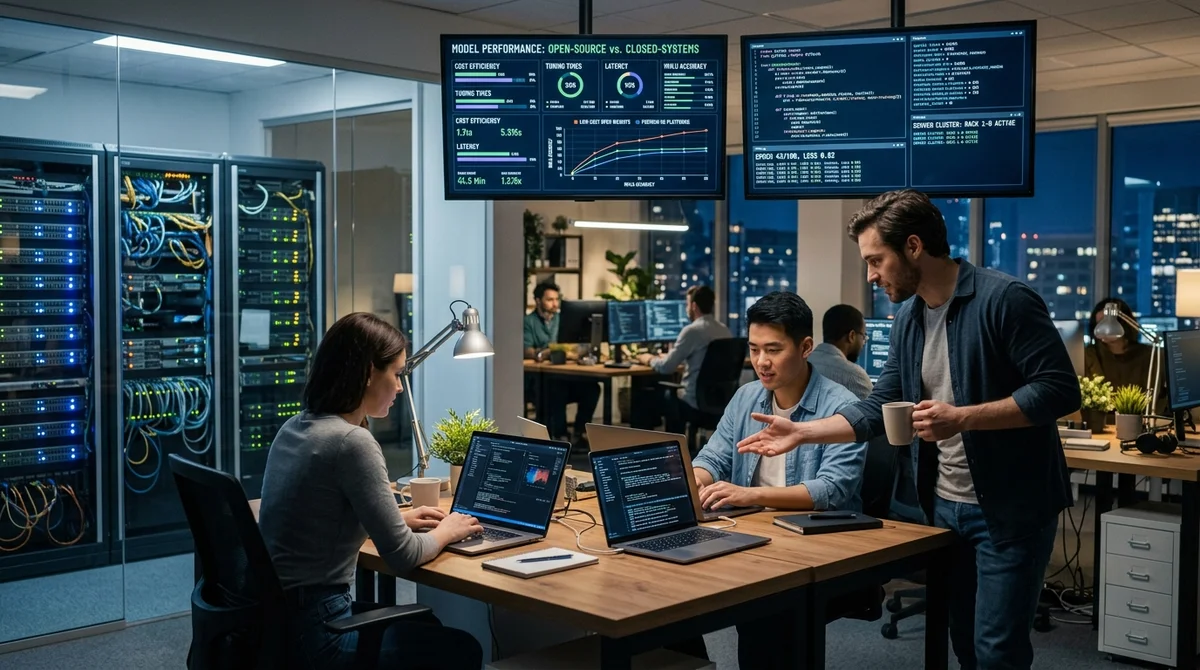
Chinese AI developers have stopped playing catch-up and have begun to change the economics of the market itself. DeepSeek, Qwen and Moonshot models no longer look like a compromise "budget" choice: on many tasks they come close to the best American systems, yet cost noticeably less and give developers more freedom to customize. For Silicon Valley, this is an uncomfortable signal. If the market concludes that a high level of quality is achievable without gigantic budgets, without the scarcest chips and without strict lock-in to a closed API, the pressure falls not only on US technological leadership but on the entire way frontier AI is monetized.
The paradox is that the constraints partly worked in China's favor. US export restrictions on the most powerful chips, and markedly less access to capital, pushed local labs away from the head-on path of endlessly scaling compute and toward a more economical engineering strategy. Instead of betting only on the "biggest cluster," Chinese companies accelerated work on training efficiency, inference optimization and practical fine-tuning of models for specific use cases.
At the same time, they bet on the open-weight approach: model weights are available to developers, who can study them, adapt them and build them into their own products. This is not just an ideology of openness but a way to spread the technology quickly across the economy and build an ecosystem around it. By this logic, China began to compete not necessarily on the absolute maximum on benchmarks, but on the combination of price, flexibility and speed of adoption.
Stanford HAI's December review noted that Chinese open-weight models, after several years of lagging, had begun to catch up with global competitors and in places overtake them in capability and distribution. The researchers separately highlighted a focus on compute-efficient models optimized for flexible use in downstream tasks. This is an important difference from the American approach, where the best systems more often stay closed and are sold as a premium service. For businesses building assistants, agents, search features or internal copilot tools, the ability to take a strong model, fine-tune it and cut the cost per request is sometimes more important than winning a few points on a prestigious test.
Still, it would be premature to say China has clearly pulled ahead. According to an Epoch AI estimate dated January 2, 2026, since 2023 Chinese models have on average trailed the American frontier by about seven months, and the gap ranged at various points from four to fourteen months. In other words, the US lead at the very cutting edge remains. But that is exactly where Silicon Valley's nervousness comes from: the threat is not that DeepSeek or Qwen must be the best at everything, but that the gap has shrunk to months rather than years. If a model costs substantially less, deploys faster and is still "good enough" for most commercial tasks, the market starts counting money differently.
Hence the main challenge for American companies. Their current logic rests on enormous capital expenditure, scarce infrastructure and selling access to closed models at a high price. Chinese players press on this structure from another side: they offer cheaper entry, freer customization and faster spread through the developer community. The wider this ecosystem grows, the weaker the argument looks that only an ultra-expensive closed model can serve as the basis for a serious product.
For startups, corporate teams and integrators, this means a real alternative. For investors, it is a risk that part of the future margin in AI will go not to whoever reached the frontier first, but to whoever managed to make a strong model mainstream.
This also changes the logic of competition itself. Not long ago the AI race was seen as a contest won by whoever spends the most on chips, data centers and training. Now it is becoming clear that openness, adaptability and deployment cost matter no less. American labs still set the pace at the top of the market, but China has shown that it is possible to approach that level quickly and start winning on distribution. For Silicon Valley, this is bad news not because it has already been overtaken, but because it no longer holds a monopoly on the best economic format for AI.
- Nov 1, 202616 models tested on 7 search tools: Exa averaged 10.5 out of 14, SearXNG about 3
- Nov 1, 2026MoneyGate safety layer blocked all 42 fraudulent requests to local AI models
- Oct 31, 2026DeepSeek-V4.1-Flash cuts HBM KV cache to 890 bytes per token, down from 3514
- Oct 30, 2026Mistral opens Large 4 weights: strong at code, but Chinese models score 32 to its 26
Test Frontier LLMs & Autonomous Agents in One Workspace
Run Claude Opus 5.5, GPT-6, Gemini 3.1, and DeepSeek side-by-side in Nomad AI (nomadnet.ai) — unified model routing, deep research, and multimodal workflows under one subscription.
The AI world, distilled — once a week
Seven stories that actually mattered, hand-picked. No noise, no reposts, no press releases.
Done! Check your inbox for a confirmation.