European Commission Wants Google to Open Android to Rival AI Services
The European Commission has proposed that Google open key Android features to third-party AI services on the same terms as Gemini. The aim is deeper integration with apps and system capabilities on the phone, so that assistants can, for example, send emails, share photos or trigger actions in other apps. The final decision on DMA compliance is expected by the end of July.
AI-processed from Bloomberg Tech; edited by Hamidun News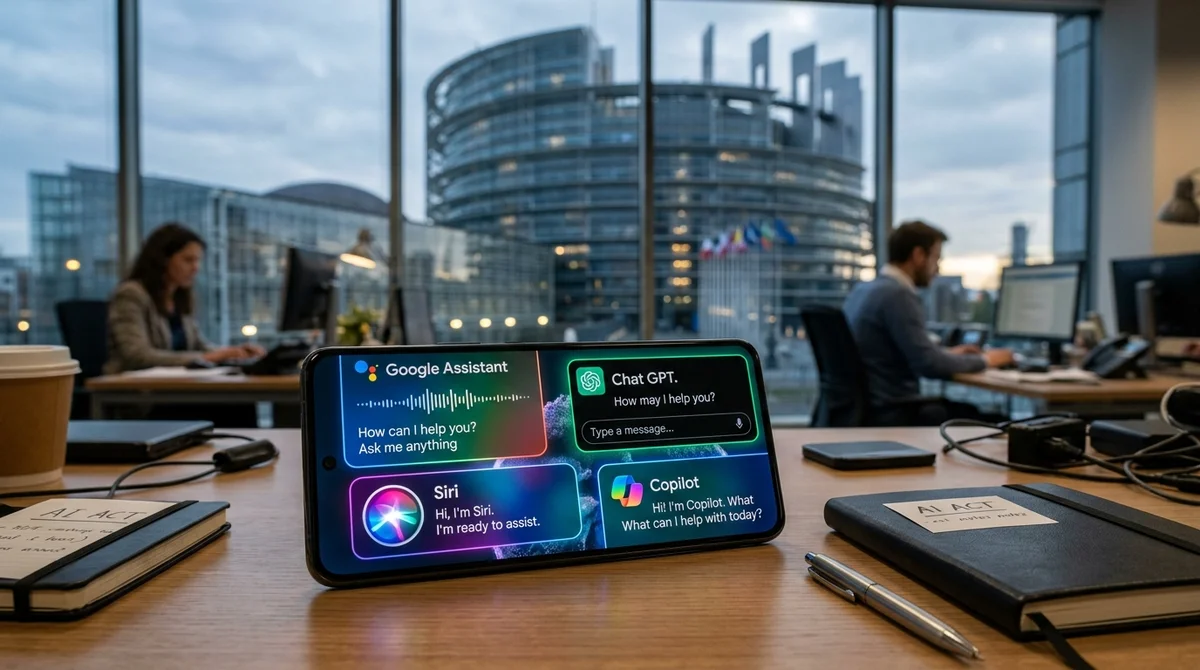
The European Commission is moving to directly curb Google's advantage on Android: the regulator wants third-party AI services to get the same practical access to system capabilities that Gemini enjoys today. If the proposals are adopted, Android in Europe will no longer be a platform where the deepest level of integration is reserved by default for Google's own AI.
On 27 April 2026, the European Commission presented a package of preliminary measures aimed at Google under the Digital Markets Act. This is not an immediate fine, nor a final decision on a violation, but the next stage of a so-called specification proceeding, in which Brussels describes exactly how the company must meet its DMA obligations. At the center of the dispute is Android, and whether Google can effectively keep key system functions as a privilege for Gemini while restricting rivals such as ChatGPT or Claude.
The requirements are fairly practical. According to the Commission, competing AI services must be able to interact effectively with apps on an Android device and carry out actions on the user's behalf. That means more than just being available in Google Play: it means access to the same hardware and software capabilities that underpin Gemini's native experience on smartphones and tablets. In the examples the regulator gives, a third-party assistant should be able to send an email through the user's preferred mail app, order food or share a photo in another service, without artificial restrictions from the platform.
The case dates back to 27 January 2026, when the Commission opened two parallel proceedings against Google. The first concerns Article 6(7) of the DMA and Android interoperability for third-party AI providers. The second concerns Article 6(11) and access to Google Search data for rival search engines, including AI chatbots with search features. On 16 April, Brussels already published separate preliminary measures on search data, and now it has turned to the mobile side of the dispute.
This matters to Brussels because on mobile, the level of system integration often decides which assistant the user keeps as their default: the one that launches faster, understands device context better and can act through other apps gains an advantage before the quality of the model itself is even compared. Third parties can submit comments until 13 May 2026, after which the Commission plans to adopt a final decision on Google's compliance with the DMA by the end of July 2026.
Google, predictably, disagrees. The company says Android is already an open ecosystem in which device makers can configure AI features themselves, and that Brussels' new requirements pose risks to privacy and security. Google's key argument is that if the regulator forces it to open access to sensitive hardware capabilities and system permissions, this will raise the cost of maintaining the platform and weaken protections for European users. In effect, the dispute is no longer only about competition, but about where the line falls between fair interoperability and dangerous exposure of overly deep system privileges.
For the market, this is an important test of whether mobile AI becomes a new case of platform lock-in. If the Commission pushes its measures through, Android users in the EU will get a real choice not only between app icons, but between assistants that can work with the device equally deeply. If Google's position holds, Gemini will keep its main strategic advantage: being built into the operating system, which rivals will struggle to match even with strong models.
In other words, what is being decided in Europe now is not a minor dispute over Android settings, but whether the next layer of mobile AI will be an open market or yet another closed ecosystem.
- Nov 2, 2026Karpathy builds a YouTube clone with 6454 videos from Hacker News recommendations in two hours
- Nov 2, 2026Karpathy used Claude to build HackerTube from 6,454 videos recommended on Hacker News
- Nov 2, 2026Anthropic needs to grow revenue 32% a year to cover $850 billion in contracts
- Nov 2, 2026Bun creator uses Claude Code to port 750K lines from Zig to Rust in 11 days
Test Frontier LLMs & Autonomous Agents in One Workspace
Run Claude Opus 5.5, GPT-6, Gemini 3.1, and DeepSeek side-by-side in Nomad AI (nomadnet.ai) — unified model routing, deep research, and multimodal workflows under one subscription.
The AI world, distilled — once a week
Seven stories that actually mattered, hand-picked. No noise, no reposts, no press releases.
Done! Check your inbox for a confirmation.