DeepSeek unveils two new AI models, claims it has nearly closed the gap with market leaders
DeepSeek has announced two new AI models at once and says they are noticeably more efficient than DeepSeek V3.2. Its central claim: architectural improvements lifted results on reasoning tasks and nearly let the models catch up with the leading open and closed models. If independent tests confirm this, the market gets another serious contender at flagship level, especially for enterprise products where price, speed and scaling matter.
AI-processed from TechCrunch; edited by Hamidun News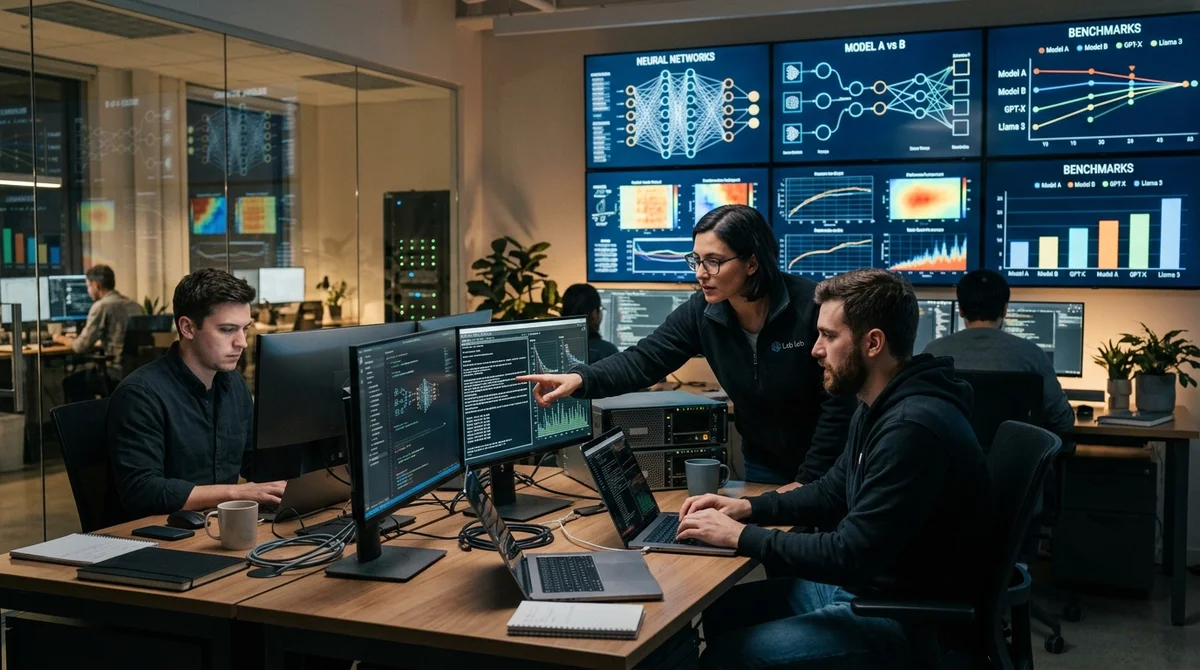
DeepSeek has shown a preview of two new AI models and made perhaps the most important claim for the entire affordable-LLM segment: according to the company, the gap between its systems and the leading flagships has almost disappeared on reasoning tasks. If this holds up outside internal benchmarks, the market gets more than just another update. It gets a clear signal that the race for top-tier quality is no longer limited to a handful of closed platforms.
The announcement centers on two models that DeepSeek compares with its own previous version, V3.2. The company says the new releases are both more powerful and more efficient, and that architectural improvements made the key difference. In other words, this is not only about better answers but also about using compute more sensibly: lower costs for the same level of results, or stronger results on comparable infrastructure. For developers and product teams this matters, because inference cost, response speed and model stability often decide whether a model can be deployed in real services rather than just demonstrated on tests.
The main metric DeepSeek is betting on is reasoning benchmarks: tests where a model must do more than reproduce memorized patterns. It has to solve tasks step by step, hold context, build a chain of reasoning and avoid obvious logical failures. Such scenarios are now considered one of the key marks of frontier-level performance.
When the company says it has nearly closed the gap with leaders among open and closed models, it is in effect trying to move itself from the category of strong alternative player into the category of direct competitors in the top tier. This is especially important for DeepSeek, which has already drawn the industry's attention with a combination of high performance and relatively aggressive usage economics.
The word "preview" deserves separate attention. This is not a full market release with a long list of results confirmed by independent labs, but rather an early demonstration of the direction in which the DeepSeek lineup is heading. In such announcements companies usually highlight their best cases and their own measurements, so the market will almost certainly wait for more details: model sizes, hardware requirements, inference speed, quality on code, math and multilingual tasks, and performance in real agentic scenarios. Even in its current form, though, the message is loud enough: DeepSeek wants to show that architectural decisions are again a source of leaps forward, not only scaling datasets and training budgets.
This is an important shift for the ecosystem also because nearly catching the leaders is already a commercially meaningful position. In many applied products, users do not need an absolute benchmark record if the model is noticeably cheaper, faster or easier to integrate. So even a small remaining quality gap may stop being critical if the market gets better economics and flexibility in return. This applies especially to companies building their own assistants, copilots, internal document search, or support and sales automation, where the cost of scaling quickly becomes as important as the percentages in rankings.
The takeaway is simple: DeepSeek is trying to establish itself not on the periphery of the AI race but among those who are genuinely contending for leadership in reasoning quality. For now this is the company's own claim, and it still has to be verified by independent tests. But the direction is already clear: competition in the top segment is intensifying, which means pressure on prices, release speed and openness of technology will only grow. That is a good scenario for the market, especially if the new models really deliver the promised balance of quality and efficiency in mass use and enterprise scenarios.
- Nov 2, 2026DeepSeek open-sources Super-agent prototype: p95 task completion time of 15.7 minutes vs. 29.5
- Nov 1, 202616 models tested on 7 search tools: Exa averaged 10.5 out of 14, SearXNG about 3
- Nov 1, 2026MoneyGate safety layer blocked all 42 fraudulent requests to local AI models
- Oct 31, 2026DeepSeek-V4.1-Flash cuts HBM KV cache to 890 bytes per token, down from 3514
Test Frontier LLMs & Autonomous Agents in One Workspace
Run Claude Opus 5.5, GPT-6, Gemini 3.1, and DeepSeek side-by-side in Nomad AI (nomadnet.ai) — unified model routing, deep research, and multimodal workflows under one subscription.
The AI world, distilled — once a week
Seven stories that actually mattered, hand-picked. No noise, no reposts, no press releases.
Done! Check your inbox for a confirmation.