Compute instead of checks: why Sequoia is handing out hardware to AI developers
Venture firm Sequoia Capital has found an unconventional way to back AI work that it traditionally cannot invest money in. At the closed-door event "AI at the Frontier," Sequoia partner Alfred Lin personally handed out 200 custom Mac Minis to attendees. The devices carry a unique engraving that blends antique cartography with machine learning charts, and hide digital "Easter eggs" about the firm's philosophy. The gesture points to a fundamental shift in Silicon Valley: developers now value access to local compute more highly than a standard seed investment. By supplying engineers with independent hardware, Sequoia builds loyalty in the open AI community and lays the groundwork for future markets.
AI-processed from TNW; edited by Hamidun News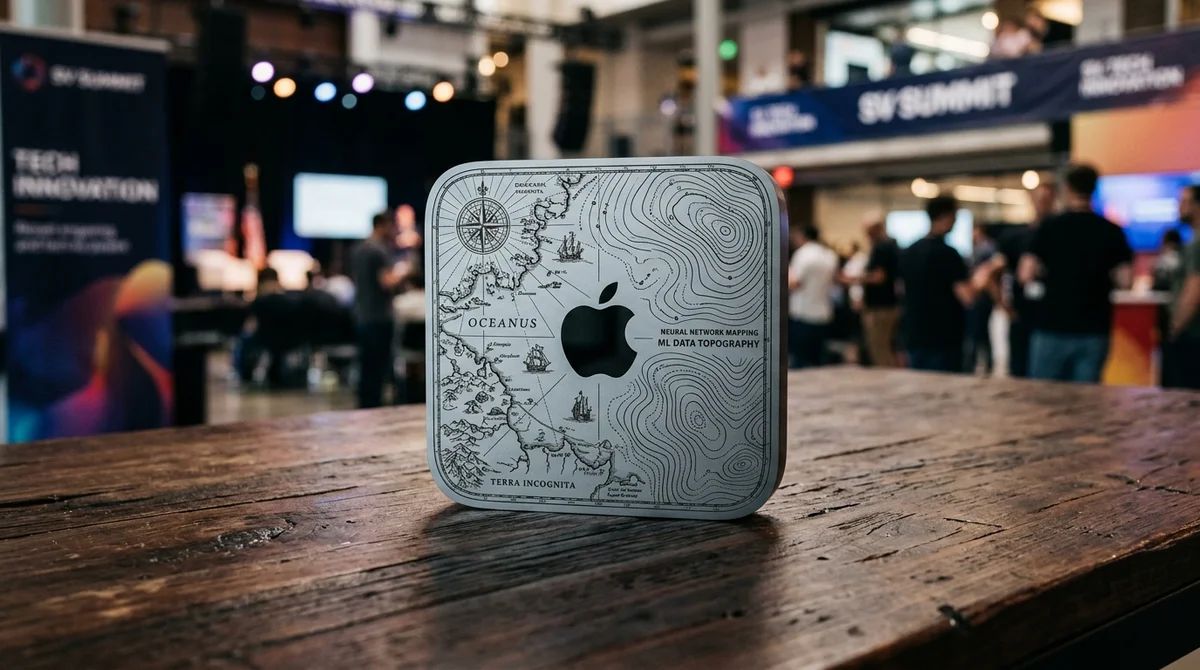
Silicon Valley venture capital is undergoing a quiet but tectonic transformation. The era when an investor's influence was measured purely by the zeros on a check and aggressive terms in a corporate agreement is giving way to subtler strategies. A recent move by Alfred Lin, managing partner at the legendary firm Sequoia Capital, is a striking marker of that shift. At the closed-door event "AI at the Frontier," he did not announce new mega-rounds of funding. Instead, he personally handed out custom Mac Mini computers to two hundred attendees. This seemingly simple gesture reflects a deep understanding of how the future of artificial intelligence is actually being forged today.
Each of the gifted computers was turned into a physical artifact symbolizing the meeting point of tradition and cutting-edge technology. The Mac Mini cases were laser-engraved with a unique design in which elements of antique cartography blended seamlessly with contour plots from machine learning. Beyond their aesthetic value, the devices contained digital "Easter eggs": Sequoia's manifesto on supporting creative minds and outsiders, along with a quote generated by a neural network. But the point of the campaign lies not in the souvenir appeal of the gift. It lies in the very fact of donating hardware, free of charge, for projects the firm by its nature cannot invest in.
To understand Sequoia's logic, it helps to look at the technical landscape of modern AI. The choice of Mac Mini as a gift is far from accidental. Thanks to Apple Silicon and its unified memory architecture, these compact machines have become a favorite tool of engineers working with local language models. In traditional PCs, video memory is rigidly capped by expensive graphics cards. Apple's architecture, by contrast, lets tens of gigabytes of shared RAM be used to load neural network weights. That makes the Mac Mini an ideal platform for local inference, experiments with open-source models and development of edge AI that does not depend on expensive cloud APIs.
The central paradox is that the most innovative and groundbreaking AI work today often happens outside traditional corporate structures. Decentralized networks, academic consortia, open-source movements and AI safety initiatives: none of these formats involve issuing shares that a venture fund could buy. Sequoia Capital, like other giants of the industry, recognizes the problem. If you try to impose the venture model on a decentralized community, you will only scare off talent. But if you cannot buy a stake in a company, you can invest in the environment where that talent lives.
By giving away compute, Sequoia Capital effectively acts as an infrastructure provider for independent researchers. The firm is subsidizing the scarcest resource of our time: access to hardware. That builds enormous loyalty within the community. Developers get tools for independent work, while the fund secures a place at the center of the ecosystem, watching ideas emerge at their earliest, not yet commercialized stage.
The implications of this approach for the whole industry are hard to overstate. The fight for engineers' minds is moving to even earlier stages. Competition among investors is now playing out not at the level of startups seeking seed funding, but at the level of lone visionaries and small research groups who for now need only computers and freedom to work. Other major funds will have to rethink how they engage with the community so they are not left on the sidelines while Sequoia builds relationships with the creators of tomorrow's technology.
Ultimately, Alfred Lin's initiative is a classic long game, adapted to the realities of the AI revolution. Sequoia Capital is not just handing out hardware; it is seeding the soil from which new computing paradigms will inevitably grow. And when today's independent researchers stumble on a commercially successful breakthrough tomorrow and decide to found a company, they will certainly remember whose machine sat on their desk during their first experiments.
- Nov 2, 2026TensorFold 1.2.0 boosts Qwen3.8-27B throughput on M3 Ultra by 44.2% at 16 streams
- Nov 1, 2026Local models lose to Opus and Codex: 0.21 on a MacBook versus 1.00 for Codex
- Oct 29, 2026Claude Code Edits Video From a Transcript: How the video-use Skill With 30 000 Stars Works
- Oct 29, 2026Stanford AI tool verifies part of Signal's code in half a day for under $500, versus five months of expert work
Ship AI Faster with Founders, Engineers & Weekly Architecture Reviews
Inside Vibe Club (hamidun.com/club) — weekly live masterminds with Zhemal Khamidun, Tech Radar, full LMS access, and 370+ production Claude Code skills.
The AI world, distilled — once a week
Seven stories that actually mattered, hand-picked. No noise, no reposts, no press releases.
Done! Check your inbox for a confirmation.