Multibillion-Dollar Deal: Meta Moves AI Agents to Amazon Graviton5 Processors
Meta has signed a multibillion-dollar deal with Amazon to rent tens of millions of Graviton5 ARM cores in the AWS cloud. The move was driven by an unprecedented surge in computing demand: a huge capital budget of $135 billion proved insufficient to meet it with Meta's own capacity. Notably, Meta is buying not AI accelerators or GPUs but classic central processors. They are needed for complex multistep tasks, where autonomous AI agents require less raw math power for generating tokens than reliable logic and process orchestration. The deal marks an important shift in the industry: the focus is moving to efficient infrastructure for real-time computing. *Meta is designated an extremist organization and banned in Russia.
AI-processed from TNW; edited by Hamidun News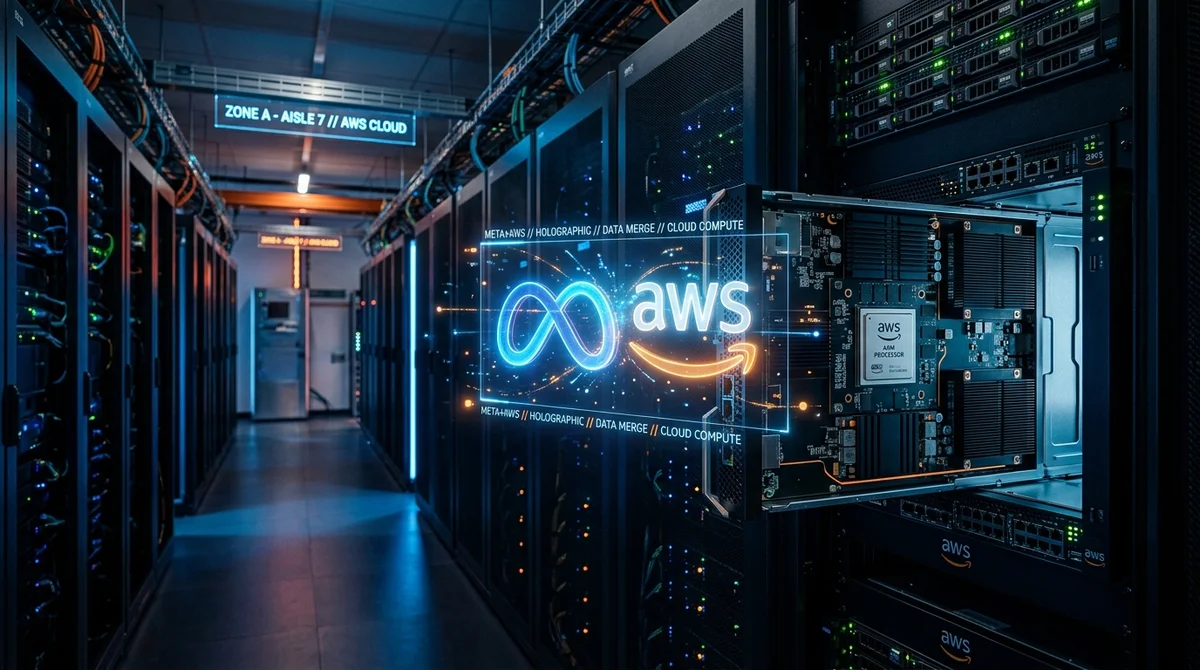
Even a capital budget of $135 billion turns out to be insufficient when it comes to building infrastructure for the next generation of artificial intelligence. Meta has officially acknowledged this reality by signing a multibillion-dollar, multiyear agreement with Amazon Web Services. The tech giant is renting tens of millions of proprietary ARM cores from Amazon Graviton5 processors to run its fast-growing AI services. This unprecedented step highlights a critical turning point for the industry: the scale of computing that modern autonomous systems require exceeds what even the wealthiest corporations can build in their own data centers.
Over the past several years, Mark Zuckerberg's company has aggressively expanded its physical infrastructure, building giant computing clusters based on Nvidia GPUs to train large language models in the Llama family. The record budget was meant to give Meta full computational independence. But the way AI is used is changing faster than supply chains can deliver server racks and new data centers can go up. Meta's leadership realized that relying solely on its own hardware no longer allows it to meet explosive demand for deploying finished products, which pushed the company toward the cloud resources of the market's leading player.
The most intriguing technical detail of the deal is what exactly Meta is buying. The company is not renting access to Amazon's specialized AI accelerators or to conventional graphics processors. Instead, it is reserving enormous volumes of Graviton5: classic general-purpose central processors built on the ARM architecture. This choice reveals a fundamental change in how neural networks operate in real-world conditions. The industry is rapidly moving from simple chatbots to autonomous AI agents capable of carrying out complex multistep tasks. Generating text itself demands heavy math work from GPUs, but orchestrating an agent's actions, checking logic and managing processes in real time fall exclusively to central processors.
Agentic workloads run very differently from pure content generation. When a user asks an AI to analyze data, find information on the internet and compile a report, the underlying system constantly sends requests to external interfaces, parses raw code and evaluates conditional logic. GPUs are highly inefficient at such sequential tasks. Fifth-generation Graviton processors, designed from the start for high energy efficiency in cloud environments, offer an ideal architecture for managing millions of these simultaneous micro-decisions without burning megawatts of expensive power. In effect, Meta is splitting the process: graphics chips keep generating ideas, while central processors take over the job of continuous action.
The partnership sends a strong signal to the entire cloud computing and semiconductor market. Historically, Meta has been one of the most committed advocates of owning its own infrastructure. Turning to AWS for basic computing capacity is a major endorsement of Amazon's strategy of designing its own processors. The deal shows that even giants able to buy Nvidia chips by the hundreds of thousands find great value in specialized, economical ARM solutions from cloud providers. What's more, it sets a new standard for the industry: hybrid architectures in which a company's own data centers do the heavy lifting of training neural networks, while public clouds absorb the elastic, unpredictable loads of deployed AI agents.
Ultimately, the agreement between Meta and Amazon offers a glimpse into the future of enterprise AI. The next battle in the tech sector will be fought not only over building the smartest language model, but over owning infrastructure that can efficiently keep millions of autonomous assistants running in the background. As neural networks become active participants in business processes, classic central processors are enjoying an unexpected renaissance. Meta's large-scale investment shows that the era of AI agents requires a fundamentally different compute base, where orchestration logic and absolute energy efficiency become as critical as raw computing power.
*Meta is designated an extremist organization and banned in Russia.
- Nov 2, 2026Meta's Muse assistant keeps dossiers on loved ones and gets root on Ubuntu by default
- Nov 2, 2026The Verge reviewer builds a $50 Meta Muse Charm alternative with Claude Code
- Nov 1, 2026MoneyGate safety layer blocked all 42 fraudulent requests to local AI models
- Oct 31, 2026Open-source LLM gateway KTMS 1.0 plugs your own GPUs into the cloud and survives outages
Ship AI Faster with Founders, Engineers & Weekly Architecture Reviews
Inside Vibe Club (hamidun.com/club) — weekly live masterminds with Zhemal Khamidun, Tech Radar, full LMS access, and 370+ production Claude Code skills.
The AI world, distilled — once a week
Seven stories that actually mattered, hand-picked. No noise, no reposts, no press releases.
Done! Check your inbox for a confirmation.