Why DeepSeek is Delaying V4 Release: Forced Transition to Chinese Chips
DeepSeek V4's release is being delayed, with the root cause lying in hardware architecture. According to Chinese government media, the postponement stems from the developer's strategic transition to the domestic semiconductor ecosystem. Facing strict U.S. export restrictions on advanced Nvidia accelerators, Chinese AI labs are forced to restructure their compute clusters for local alternatives, such as solutions from Huawei. This move means DeepSeek V4 will be more than just another language model—it will be a critical stress test for China's sovereign silicon industry. If the company succeeds in maintaining previous innovation pace on new hardware, it could fundamentally shift the global AI market balance.
AI-processed from Bloomberg Tech; edited by Hamidun News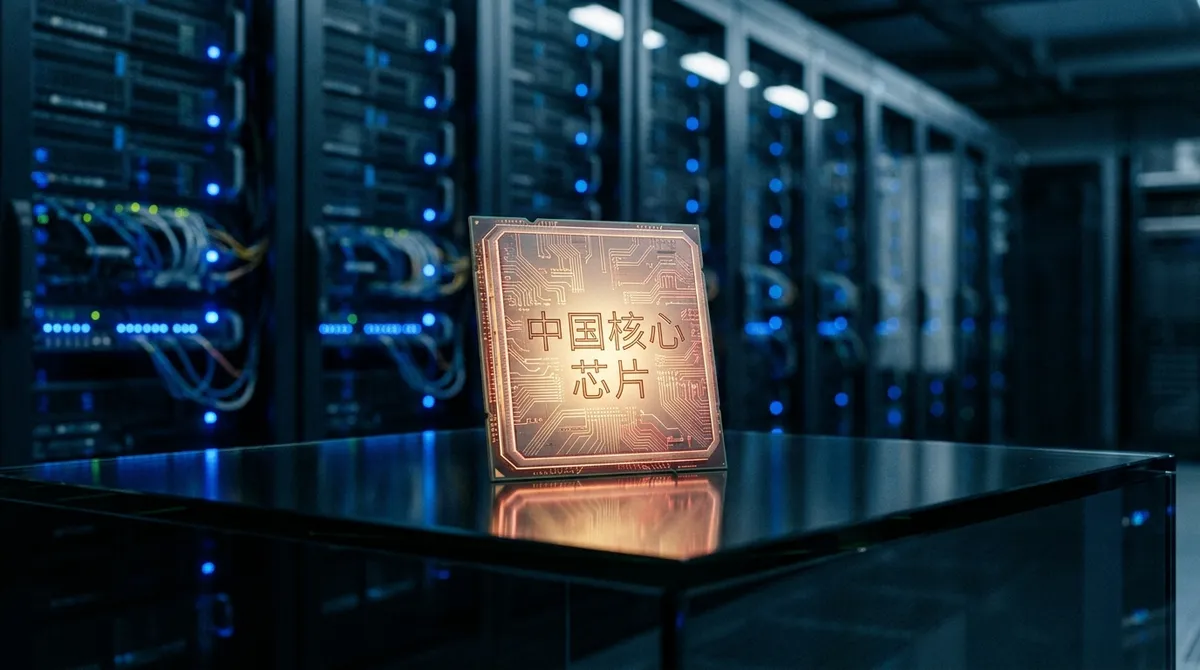
Chinese laboratory DeepSeek, whose previous releases literally shook the global artificial intelligence market with their phenomenal efficiency and innovative approach to architecture, has unexpectedly slowed its pace. At the time, second and third generation models caused genuine shock in Silicon Valley, demonstrating the ability of Chinese engineers to achieve the level of flagship American neural networks at significantly lower training costs. The fourth generation model, anticipated by many developers and analysts, is experiencing delays, generating numerous rumors in the industry.
However, the reason for this pause lies not in an algorithmic dead end or lack of quality training data. As it turned out, the delay is dictated by a large-scale and extremely painful process of abandoning the familiar hardware base in favor of domestic market solutions. DeepSeek is fundamentally restructuring its computing clusters to fully integrate the new model with China's national semiconductor ecosystem.
The primary source of this information is the Yuyuantantian account, closely affiliated with China's Central Television, which immediately gives the news a distinct state-strategic character. The presentation of this delay through official channels is intended to demonstrate that the technological lag in the release schedule is a conscious and controlled sacrifice for the sake of achieving genuine digital sovereignty. Under conditions of unprecedented pressure from U.
S. government structures and a series of harsh export restriction packages on supplies of advanced computational accelerators from Nvidia and AMD, Chinese technology giants can no longer afford the luxury of building long-term strategies based on imported silicon. Equipment purchases through gray market schemes or use of truncated chip versions specifically created to bypass sanctions have ceased to meet the scale of tasks facing leading AI laboratories.
The transition to domestic computational platforms becomes not merely a patriotic gesture, but the only reliable way to ensure research continuity in conditions of rising geopolitical turbulence.
From a technical perspective, such migration represents a colossal challenge for engineers. For many years, Nvidia's CUDA software platform has been the de facto golden standard in machine learning, around which the entire modern global artificial intelligence development industry has been lovingly built. The transfer of massive training processes to alternative processors, such as Huawei's flagship Ascend series accelerators, requires more than just physical equipment replacement in data centers.
It means a critical need to completely rewrite low-level code, reinvent memory distribution mechanisms, and adapt ultra-complex architectures, such as sparse computation systems or Mixture of Experts, to entirely different hardware specifications and bandwidth limitations. The DeepSeek team has traditionally been renowned for their outstanding ability to extract absolute maximum performance from every available transistor through deep algorithmic optimization. Now the entire massive body of unique knowledge must be revisited and adapted by engineers to the new, still-forming silicon reality, which currently lags behind Western counterparts in software maturity levels.
The consequences of this forced, yet strategically important maneuver extend far beyond a single corporation and radically transform the entire global landscape of artificial intelligence. If DeepSeek succeeds in completing large-scale training of an advanced fourth-generation language model exclusively on domestic computing resources, this will become the most convincing proof that technological blockade is unable to paralyze China's progress in the neural networks field. Previously, Western skeptics confidently claimed that without constant and unlimited access to the latest architectures from California vendors, Chinese laboratories would inevitably hit an invisible ceiling and lag behind in the global race to create artificial general intelligence.
A successful V4 release on local accelerators will completely shatter this entrenched narrative, proving to the world that exceptional architectural ingenuity and meticulous software optimization are perfectly capable of compensating for the lack of raw computational power of advanced American chips.
In the long term, the delay in DeepSeek V4 release marks a historic point of no return in the rapid process of fragmentation of the global technology market. We are witnessing in real time the formation of two grand, completely isolated and parallel-evolving machine learning ecosystems, each of which will henceforth rely on its own silicon capabilities and independent software stacks. For DeepSeek itself, the forthcoming launch will become a critical test of technological survival and adaptability.
When the V4 model finally sees the light, the industry will evaluate not only its ability to generate coherent text, write complex program code, or solve unconventional mathematical problems. The primary criterion for success will be the fact that this architecture was successfully born and nurtured under the strictest conditions of hardware isolation. This inexorably transforms the future release from yet another routine software product update into the most important indicator of the viability of a sovereign technological strategy of an entire superpower.
Want to stop reading about AI and start using it?
AI News is a curated feed of AI/tech news. Hamidun Academy teaches you to use AI systematically in your work.
The AI world, distilled — once a week
Seven stories that actually mattered, hand-picked. No noise, no reposts, no press releases.
Done! Check your inbox for a confirmation.