Mirror bacteria could kill everything alive, and Chinese workers are fighting their AI doubles
Scientists still don't know how dangerous synthetic "mirror life" would be — organisms built from mirror-image molecules that the immune system fails to recognize. Meanwhile in China, thousands of presenters and content creators are losing work to AI doubles: companies clone their voices and appearances for pennies. Two stories about boundaries humanity has already crossed.
AI-processed from MIT Technology Review; edited by Hamidun News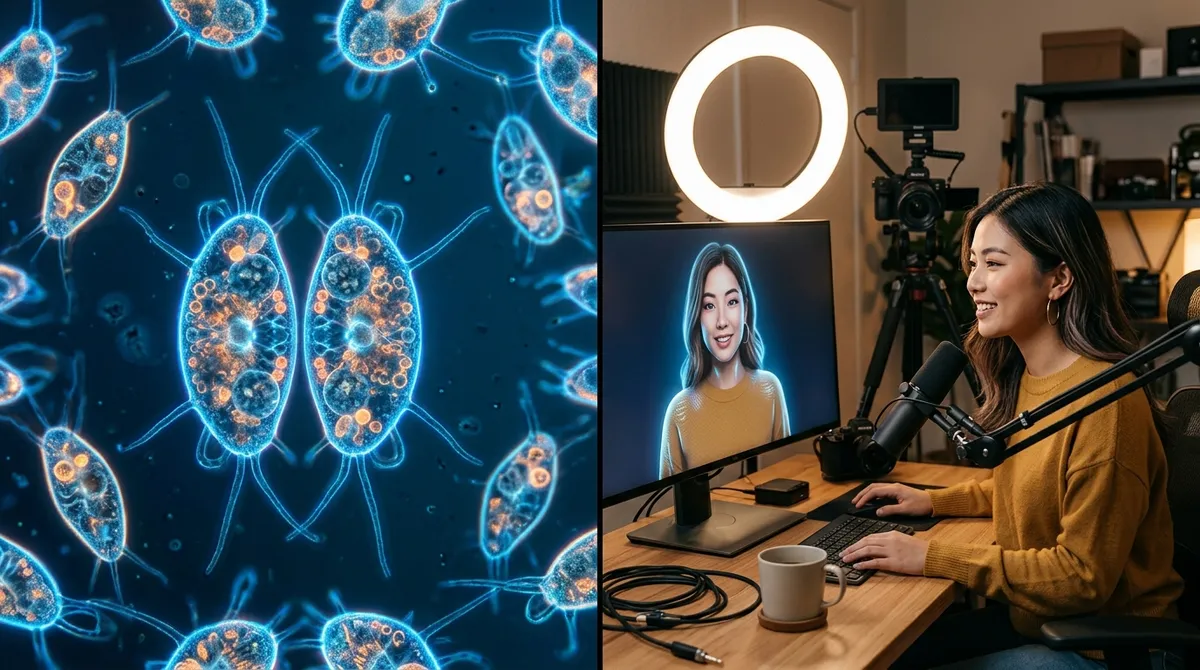
A single issue of MIT Technology Review brought together two stories that look unrelated at first glance — and both force you to think hard about the consequences of progress that can no longer be stopped.
Nobody knows whether mirror life will kill us
In February 2019, a group of scientists pitched the US National Science Foundation an idea bordering on science fiction: build synthetic organisms made of "mirror" molecules. All of living nature uses L-amino acids and D-sugars. Mirror organisms would run on their opposites — D-amino acids and L-sugars. This isn't mere exotica: a mirror cell would be invisible to most pathogens and immune systems, because those are tuned to ordinary biochemistry.
The project looked like an academic utopia. But synthetic biology has moved a long way forward in recent years, producing tools for building ever more complex mirror molecules. In 2023, several labs independently reported progress in synthesizing mirror polymerases — the enzymes that copy DNA.
If a self-replicating mirror organism can be created, it would sit beyond the reach of most immune mechanisms. Neither antibiotics, nor antibodies, nor phages are tuned to that kind of biochemistry.
The problem is that nobody knows how dangerous this is — or how close we are to that line. Some researchers consider the risks catastrophic and comparable to nuclear weapons. Others insist mirror organisms would be too metabolically weak to survive in the real world. The truth, it seems, lies somewhere in between. But not a single international regulatory mechanism exists for this field yet.
Chinese workers against AI doubles
In parallel, a different conflict is unfolding in China — far more down-to-earth, but no less sharp. Presenter Liu Ya from Hunan province spent several years building a career in video content: recording clips, appearing in livestreams, growing an audience. Last year her agency offered her a contract allowing it to create an AI clone of her appearance and voice. She refused. The agency found someone else — and trained a model on her own videos without permission.
This is not an isolated story. Chinese industry associations estimate the country's AI avatar market tripled over 2024 and topped 10 billion yuan by year's end. Platforms like Douyin actively push the format: it's cheaper for brands to license an AI host than to keep a live employee. A single AI avatar costs anywhere from a few thousand to tens of thousands of yuan as a one-time payment; a human content creator runs into the hundreds of thousands per year.
Chinese workers have started organizing. Several major cities have hosted meetings of presenters, voice actors and livestream operators — people trying to win legal protection for their digital likenesses. In March 2025, Shenzhen saw the first public demonstration: several dozen people demanded that the regulator require platforms to obtain explicit written consent before training models on workers' biometric data.
What it all means
One logic links both stories: technology is advancing faster than society can work out the rules. With mirror life, those are biosafety rules that don't yet exist. With AI doubles, they're rules protecting digital identity that are only beginning to take shape.
The Chinese example matters especially: what is being tested today in a market of 1.4 billion consumers will be global tomorrow. The presenter from Hunan is a harbinger of conflicts that will soon reach Europe and the US. And mirror bacteria are a reminder that not all risks of new technologies are obvious right away. Sometimes the realization comes too late.
- Nov 2, 2026Cosmos generated training video for drones: detector mAP@50–95 up 10.3%
- Nov 2, 2026Karpathy builds a YouTube clone with 6454 videos from Hacker News recommendations in two hours
- Nov 2, 2026Karpathy used Claude to build HackerTube from 6,454 videos recommended on Hacker News
- Nov 2, 2026The Verge reviewer builds a $50 Meta Muse Charm alternative with Claude Code
Test Frontier LLMs & Autonomous Agents in One Workspace
Run Claude Opus 5.5, GPT-6, Gemini 3.1, and DeepSeek side-by-side in Nomad AI (nomadnet.ai) — unified model routing, deep research, and multimodal workflows under one subscription.
The AI world, distilled — once a week
Seven stories that actually mattered, hand-picked. No noise, no reposts, no press releases.
Done! Check your inbox for a confirmation.