Reform UK Deputy Leader Accused of Posting AI-Fabricated Rally Photo
Richard Tice, deputy leader of the British party Reform UK, posted a photo of a campaign rally and quickly came under suspicion. Deepfake experts and sleuths on social media counted five clear signs of AI generation: unnatural crowd geometry, background artifacts, anomalous shadows and blurred faces. It is the latest example of politicians using AI to simulate grassroots support.
AI-processed from Guardian; edited by Hamidun News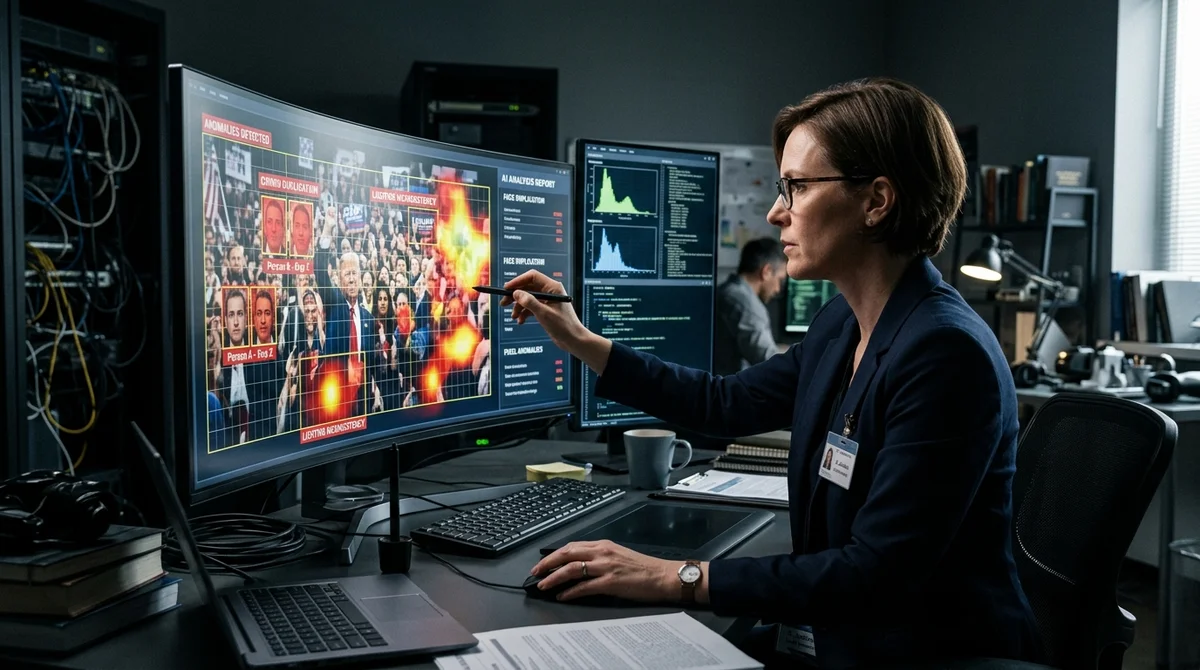
Richard Tice, deputy leader of the British right-wing party Reform UK, is at the center of a scandal after posting a photo of a campaign event that digital forensics experts and ordinary social media users say was generated or substantially edited with artificial intelligence.
The story began on Sunday, when Tice posted on his accounts an image apparently showing a packed rally of party supporters. The picture was meant to underline broad public support for Reform UK in the thick of the election campaign. Instead, it triggered a wave of criticism: followers noticed a number of details atypical of a real photograph.
The Guardian consulted media analysis specialists, who identified five key signs pointing to AI generation or post-processing.
The first and most telling is the geometry of the crowd. The people in the frame are arranged with an unnatural symmetry typical of image-generation algorithms: a real crowd is always uneven and chaotic, with irregular gaps between people. Here the figures look as if they were stamped from a single template.
The second sign is the faces. At a glance, the features of people in the back of the frame look blurred or implausibly smooth. Generative models still handle second- and third-plane detail poorly: faces lose their individuality and turn into an averaged "template person."
Third, artifacts in the background. In the transition zones between figures and surroundings, there are telltale smears and illogical continuations of objects, a classic trace of diffusion models, which generate pixels statistically rather than from an understanding of the scene.
The fourth sign is hands and fingers. AI models traditionally get hand anatomy wrong. One specialist found limbs in the image with the wrong number of finger segments, a detail virtually impossible in a real photograph.
Fifth, lighting. Shadows in the image fall at different angles, which is physically impossible with a single light source. This points either to a crude composite of several shots or to a neural network generating the lighting for each element independently.
Tice's team and Reform UK itself have not yet given any official comment on whether the photo is authentic. The UK still has no mandatory requirement to label political content created with AI, unlike a number of US states that have already passed such laws.
The incident comes amid a broad debate about the role of generative AI in politics. In 2024–2025, several election campaigns around the world faced accusations of using synthetic images to create fake "evidence" of public support, from simulated packed halls to forged quotes from opponents.
The Tice case is also notable because the detection was done not by professional labs but by ordinary users without specialized tools. That is the new reality: the line between genuine and synthetic keeps blurring, and the burden of finding it increasingly falls on readers themselves.
Test Frontier LLMs & Autonomous Agents in One Workspace
Run Claude Opus 5.5, GPT-6, Gemini 3.1, and DeepSeek side-by-side in Nomad AI (nomadnet.ai) — unified model routing, deep research, and multimodal workflows under one subscription.
The AI world, distilled — once a week
Seven stories that actually mattered, hand-picked. No noise, no reposts, no press releases.
Done! Check your inbox for a confirmation.