Hugging Face: Open AI Gives Defenders the Same Capabilities as Attackers
Hugging Face has published an analysis of how AI is changing cybersecurity. Its key thesis: closed systems create a single point of failure, while open ecosystems spread defense across the whole community. The company argues that semi-autonomous agents built on open code are the safest path: a human stays in the control loop and can verify every action the system takes.
AI-processed from Hugging Face Blog; edited by Hamidun News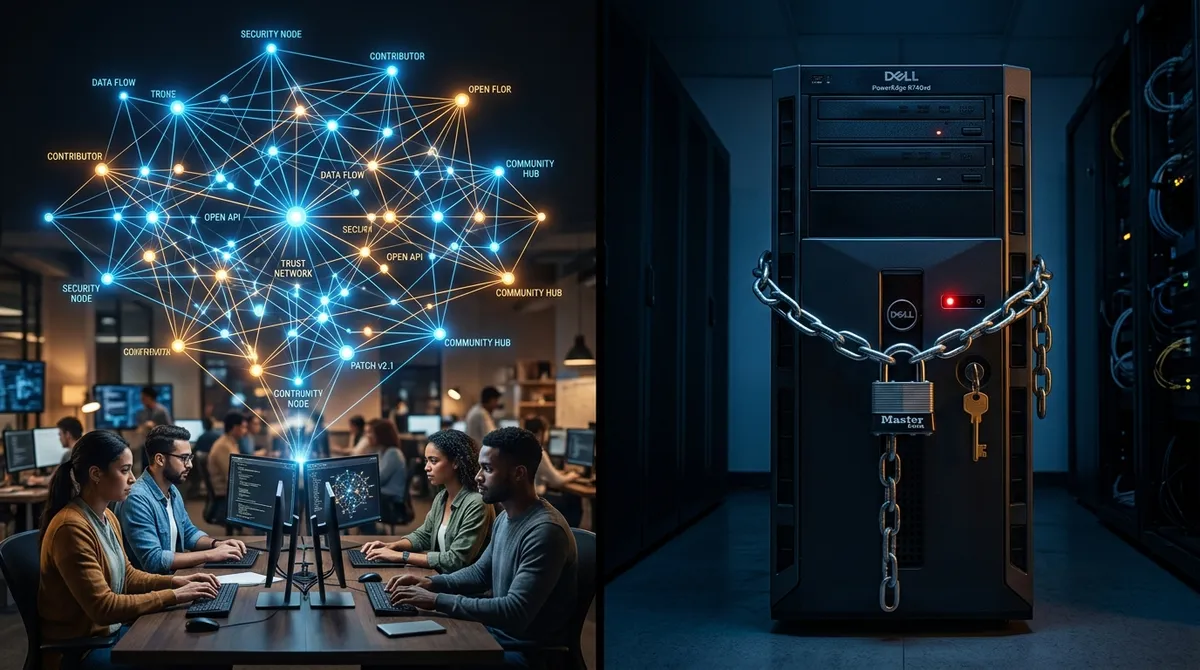
Hugging Face has published an in-depth piece on how artificial intelligence is shifting the balance of power in cybersecurity, and why the openness of models and tools matters as much as their raw power. The article centers on Mythos, a language model wrapped in a narrowly specialized harness for finding and patching vulnerabilities.
The authors stress that the capabilities of such systems are nonlinear. A small model embedded in a well-designed agentic pipeline with domain expertise can compete with far larger closed solutions, which is especially valuable for defenders on limited budgets.
The central argument is the structural advantage of open ecosystems. Once a vulnerability is found, the cycle has four stages: discovery, verification, coordination and patch distribution. Closed vendors run all four stages inside a single organization, which creates a single point of failure. Open communities spread each stage across many teams: the Linux kernel security team, the Open Source Security Foundation, and Hugging Face's specialists in model supply-chain security. An attacker who breaches one node does not bring down the whole ecosystem.
The article also takes on the myth of "security through obscurity." The authors note that AI tools can already help reverse-engineer binaries without source code. A huge body of legacy firmware and embedded code, closed, binary and long unmaintained, is becoming increasingly accessible to automated analysis. Closed code does not protect against attacks; it only slows down defenders who have no access to the source.
The authors propose a concrete defensive architecture: semi-autonomous agents built on open code. The agent operates within predefined boundaries, critical steps require human confirmation, and the system's entire behavior can be audited through open logs and traces. "A human in the control loop only makes sense if that human can look inside the loop" is the article's key line. Closed systems do not allow this.
For organizations with sensitive data, open solutions offer an additional benefit: they can be run entirely within your own infrastructure, fine-tuned on internal data and configured for specific requirements, without handing data to external providers.
The authors conclude that the future of AI cybersecurity will be determined not by individual models but by the ecosystems around them. Open systems give defenders visibility, control, community and shared infrastructure, which is exactly what isolated defense built on proprietary tools lacks.
- Nov 2, 2026Karpathy builds a YouTube clone with 6454 videos from Hacker News recommendations in two hours
- Nov 2, 2026Karpathy used Claude to build HackerTube from 6,454 videos recommended on Hacker News
- Nov 2, 2026Microsoft releases 4B model Mage-VL-Cowork, which solves 66.0% of OSWorld-Verified tasks
- Nov 1, 2026Local models lose to Opus and Codex: 0.21 on a MacBook versus 1.00 for Codex
Test Frontier LLMs & Autonomous Agents in One Workspace
Run Claude Opus 5.5, GPT-6, Gemini 3.1, and DeepSeek side-by-side in Nomad AI (nomadnet.ai) — unified model routing, deep research, and multimodal workflows under one subscription.
The AI world, distilled — once a week
Seven stories that actually mattered, hand-picked. No noise, no reposts, no press releases.
Done! Check your inbox for a confirmation.