Sediment Palace: Local Memory for AI Agents Modeled on Geological Layers
In 2025, AI agents can do almost everything except one thing: remember. A developer has proposed Sediment Palace, a local memory system built on a sedimentation model. Fresh data sits on top, while older data compacts deeper down, like geological layers. It is not RAG and not a vector database. The architecture is fundamentally different.
AI-processed from Habr AI; edited by Hamidun News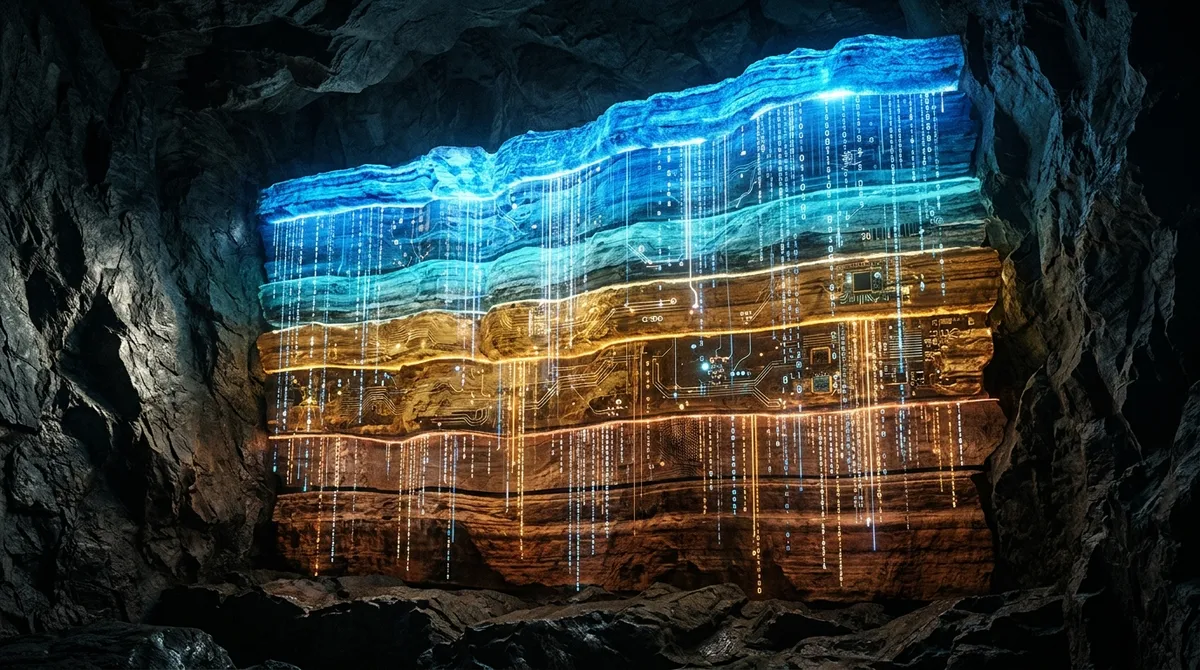
In 2025, AI agents have reached impressive heights: they write code, analyze documents, negotiate and operate tools. But most of them share a fundamental weakness: memory. More precisely, they either have none between sessions or rely on extremely crude ways of organizing it.
A developer who published a write-up on Habr took two existing concepts and combined them into something new: a system called Sediment Palace. The core of the model is an analogy with geology. Memory is organized not as a flat list of records and not as a vector space, but as a layered structure in which data literally "settles" over time.
Fresh information, meaning events from the last minutes or hours, sits in the top layer. It is quickly accessible, takes up a lot of space and is uncompressed. As time passes, records sink deeper: they are compacted and aggregated, losing detail but keeping the essence. The oldest layers are like fossils: still accessible, but heavily compressed and consulted less often.
This is a direct analogy with how human memory works. We remember clearly what we ate for breakfast today, vaguely what happened a month ago, and keep only compressed "imprints" of events from years back. The brain does exactly what Sediment Palace tries to reproduce in software: it automatically compacts old experience while preserving its key patterns.
Unlike classic approaches, such as RAG systems on vector databases or a simple context window, the sedimentation model works locally and deterministically. It needs no external database API, no probabilistic search over embeddings, and does not depend on the size of the model's context window. The agent itself manages what it remembers and in what form.
The author admits the idea is not entirely original. He took two existing approaches, the concept of hierarchical memory and the metaphor of geological layers, and joined them into a working architecture. That candor is what makes the write-up valuable: the AI tooling space is full of work that reinvents the wheel without citing predecessors. Here, the opposite is true.
The system's practical value is most visible in scenarios with long-lived agents: personal assistants, automated researchers, monitoring agents. For tasks where a session lasts not minutes but days or weeks, Sediment Palace offers a compromise between completeness of history and the cost of storing it.
An important question arises when you look at the concept: how does the agent decide what to compact and what to discard as data moves between layers? This is the point where architectural elegance runs into practical difficulty. Any heuristic of "importance" is inevitably subjective, and this is the main challenge for systems like this.
Still, the very appearance of such projects is telling. The developer community is increasingly focused not on model power but on the infrastructure around models. Memory, tools and orchestration are the next frontier. Sediment Palace is one experiment on that frontier, and it deserves attention.
- Nov 2, 2026DeepSeek Open-Sources Super-agent Prototype: p95 Task Time Drops from 29.5 to 15.7 Minutes
- Nov 2, 2026LLM Agent Built a Gearbox in KOMPAS-3D, but Scored Only 50 out of 100 on the Specification
- Nov 2, 2026Agents ignored the prompt to read memory in 7 of 7 sessions: an analysis of 13 thousand logs
- Nov 2, 2026Karpathy Built HackerTube, a Catalog of 6,454 Videos, in Two Hours with Claude Code
Test Frontier LLMs & Autonomous Agents in One Workspace
Run Claude Opus 5.5, GPT-6, Gemini 3.1, and DeepSeek side-by-side in Nomad AI (nomadnet.ai) — unified model routing, deep research, and multimodal workflows under one subscription.
The AI world, distilled — once a week
Seven stories that actually mattered, hand-picked. No noise, no reposts, no press releases.
Done! Check your inbox for a confirmation.