Amazon SageMaker and DVC: End-to-End Tracing of ML Models from Data to Prediction
AWS has published a guide to end-to-end tracing of ML models using DVC, Amazon SageMaker AI and MLflow Apps. It covers two patterns: lineage at the dataset level and at the level of individual records. Both can be deployed in your own AWS account through ready-made notebooks.
AI-processed from AWS Machine Learning Blog; edited by Hamidun News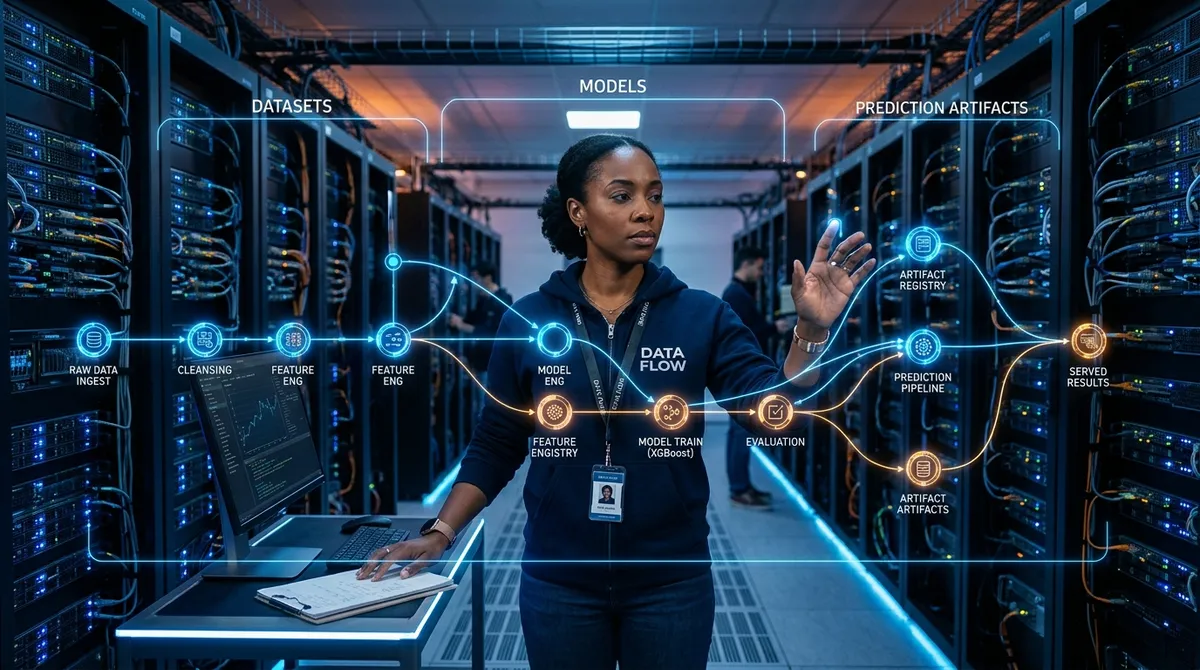
The AWS Machine Learning Blog has published a detailed guide to building end-to-end tracking of ML models, from raw data to the final prediction, using three tools: DVC, Amazon SageMaker AI and Amazon SageMaker AI MLflow Apps.
The problem the article addresses is familiar to teams running production systems: it is unclear exactly which data a given model was trained on, which transformations were applied to it, and how an individual record influenced a prediction. This is critical for audits, for debugging data drift, and for meeting regulatory requirements.
DVC (Data Version Control) is an open-source tool that adds versioning of large files and datasets to Git. Combined with SageMaker, it lets you capture an exact snapshot of the data used in each training run. SageMaker MLflow Apps, in turn, stores experiment metrics, parameters and artifacts. It is a standard MLflow server managed by AWS, with no need to set up infrastructure manually.
The authors describe two concrete patterns. The first is dataset-level lineage: it records the dataset version (via a DVC tag), the parameters of the processing pipeline and a reference to the trained model in MLflow. The second is record-level lineage: each individual record in the training set is linked to the model, which makes it possible to answer the question "which specific examples shaped this prediction." Both patterns are implemented as Jupyter notebooks, ready to run in your AWS account.
The architecture looks like this: data is stored in S3 and versioned by DVC; experiment metadata (parameters, metrics, artifacts) lives in the MLflow App; and the link between the data version and the model version is provided through custom tags and DVC artifacts registered in MLflow.
The practical value of the approach is reproducibility. If six months from now a model turns out to behave unexpectedly on a certain cohort of users, engineers will be able to reconstruct exactly which dataset it was trained on, which records went into it and with which hyperparameters training was run.
The material is aimed at ML engineers and MLOps teams already working in the AWS ecosystem. The ready-made notebooks substantially lower the barrier to entry: there is no need to design the integration from scratch, since it is enough to adapt the examples to your own dataset and processing pipeline. For companies that care about the auditability of ML systems, especially in finance, healthcare and government projects, this approach is becoming a de facto standard.
AWS is consistently building tooling in which lineage stops being an optional "good practice" and becomes a built-in property of the pipeline.
- Nov 2, 2026The Verge reviewer builds a $50 Meta Muse Charm alternative with Claude Code
- Oct 31, 2026Worldwide Express hands disputed invoices to AI agents and cuts unresolved disputes by 75%
- Oct 30, 2026AWS gives coding agents a live site preview straight from an isolated session
- Oct 30, 2026Agent traffic on Zocdoc is up 30x since July, and ChatGPT faces two health lawsuits
Ship AI Faster with Founders, Engineers & Weekly Architecture Reviews
Inside Vibe Club (hamidun.com/club) — weekly live masterminds with Zhemal Khamidun, Tech Radar, full LMS access, and 370+ production Claude Code skills.
The AI world, distilled — once a week
Seven stories that actually mattered, hand-picked. No noise, no reposts, no press releases.
Done! Check your inbox for a confirmation.