Eon Systems announces digital fly brain emulation — but it's not what it seems
Startup Eon Systems set X abuzz with a video of a "digital fly" — supposedly the world's first whole-brain emulation showing several behavioral responses. The company promises to digitize a mouse brain within two years. The Verge and outside experts have cooled the excitement: the reality is far more modest than the claim.
AI-processed from The Verge; edited by Hamidun News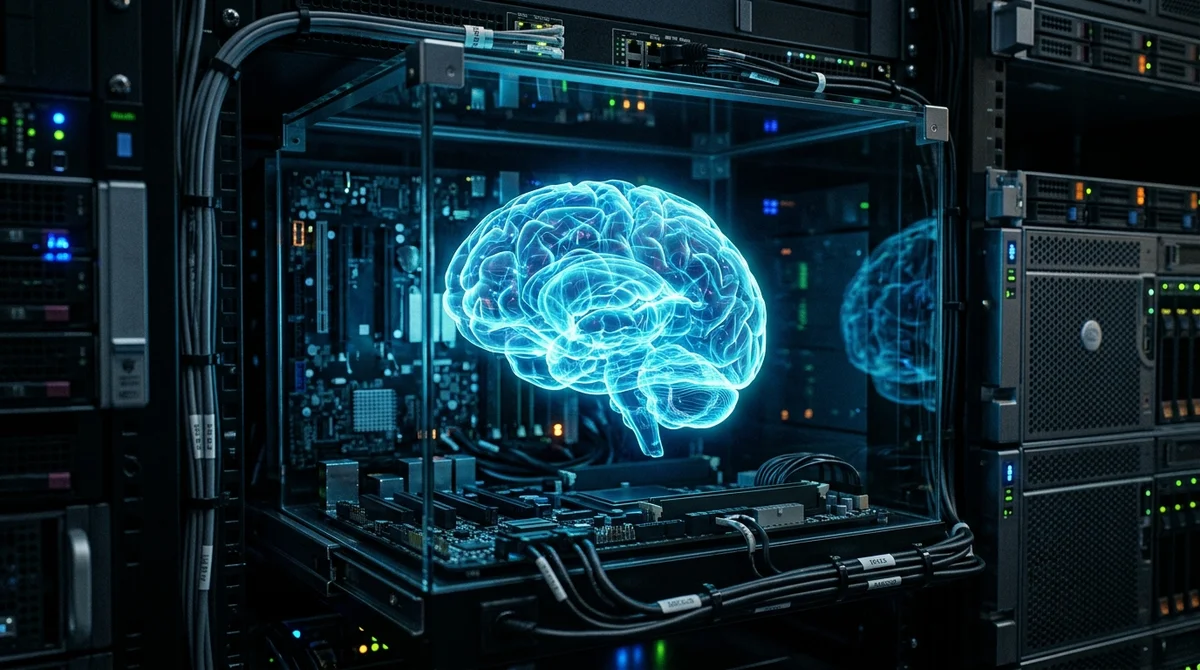
San Francisco startup Eon Systems became the star of last week's AI hype on social media. The company published a video of a so-called "digital fly" — a virtual simulation that co-founder Alexander Wissner-Gross called "the world's first embodiment of whole-brain emulation demonstrating several behavioral responses." The post spread across X, picked up by AI hype accounts and thousands of enthusiastic commenters.
Eon Systems positions itself as a company moving toward "digital human intelligence." As an intermediate goal, it names full digital emulation of a mouse brain — and promises to achieve it within two years. That timeline is, to put it mildly, ambitious: a mouse brain contains about 70 million neurons with tens of trillions of synaptic connections, and no team in the world has yet come close to reproducing it fully on a computer.
What did the video actually show? Based on available materials, it is a simulation of insect behavior built on a neural model — not an upload of a real fly brain into a computer, as many viewers may have assumed. The brain of the fruit fly Drosophila contains about 140 thousand neurons. Its wiring diagram — the connectome — was fully mapped by scientists only in 2023, after years of work. Even with that map in hand, building a functional simulation of all behavior is a completely different task.
The Verge put its skepticism right in the headline: "This is not a fly uploaded to a computer." The outlet notes that the buzz around the Eon Systems video rested largely on the audience's misunderstanding: people reposted the clip without grasping what they were watching. It is a typical AI hype mechanic: an impressive phrase, viral spread, and only then a substantive review.
Such cases have happened in neuroscience before. In 2014, the OpenWorm project recreated the neural network of the worm Caenorhabditis elegans (302 neurons) and "uploaded" it into a Lego robot. Media exploded with headlines about "uploading consciousness." Scientists then spent a long time explaining that it was a simplified model of reflexes, not consciousness and not even full behavior. History, it seems, is repeating itself.
What this means for the industry as a whole: the line between real scientific progress and marketing narrative in neurotech is getting thinner. Startups attract attention and investment with bold claims, and a public raised on AGI news readily believes in breakthroughs. Healthy skepticism here is not pessimism — it is simply a demand for precise wording.
A true brain emulation, even of a fly, would remain one of science's greatest achievements. But until that happens, it is worth reading the fine print.
- Nov 2, 2026The Verge reviewer builds a $50 Meta Muse Charm alternative with Claude Code
- Nov 2, 20268 Skills for video in Claude Code: from 244 pixel effects to rough-cut editing
- Nov 1, 2026Pika Labs releases open video model H3 Flex: 6 steps instead of 50
- Nov 1, 2026Google's StreamVibe video agent beats other models by 10.7% on response timing and quality
Test Frontier LLMs & Autonomous Agents in One Workspace
Run Claude Opus 5.5, GPT-6, Gemini 3.1, and DeepSeek side-by-side in Nomad AI (nomadnet.ai) — unified model routing, deep research, and multimodal workflows under one subscription.
The AI world, distilled — once a week
Seven stories that actually mattered, hand-picked. No noise, no reposts, no press releases.
Done! Check your inbox for a confirmation.