Google teaches Fitbit's AI coach to read users' medical records
Google has updated the Fitbit AI coach: US users will soon be able to connect their medical records to the app, including lab results, medications and doctor visit history. The algorithm will combine this data with readings from the wearable and give personalized recommendations. Amazon, OpenAI and Microsoft have joined Google in the AI health race, and all of them are betting on access to users' most sensitive data.
AI-processed from The Verge; edited by Hamidun News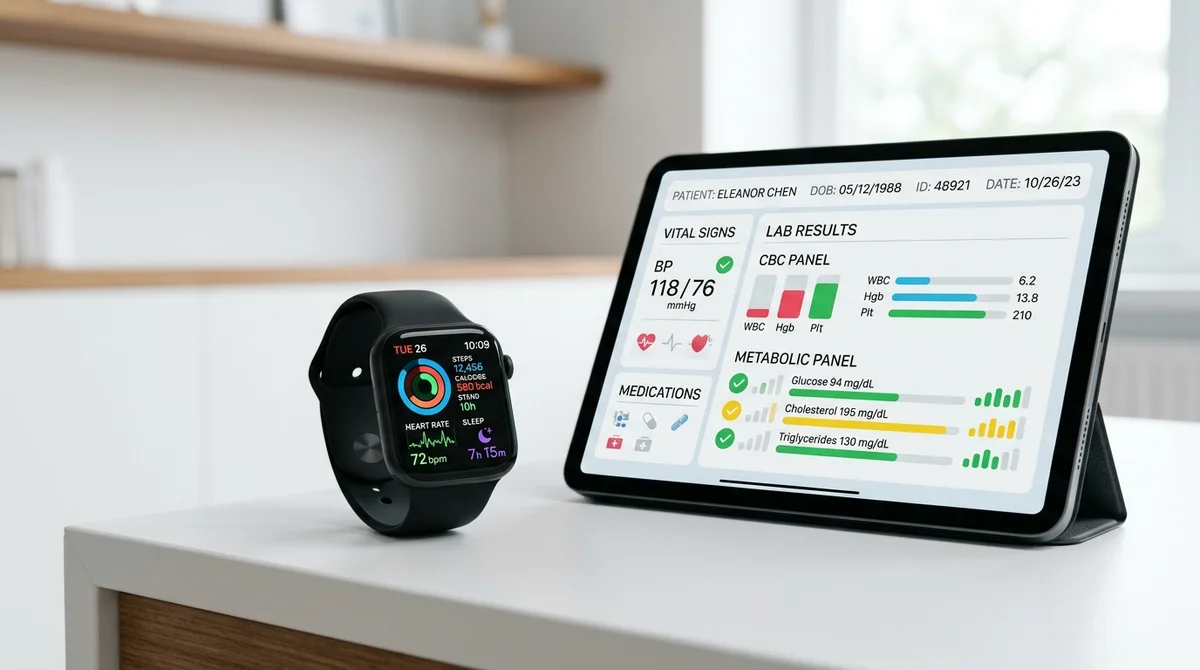
Google has announced a major update to the Fitbit AI coach: next month the service will gain access to users' medical records. Lab results, prescribed medications and doctor visit history will sit alongside wearable data in a single picture, so the algorithm can give far more accurate health advice.
For now, the feature is launching as a preview and is available only in the US. Users will be able to link their medical record to the Fitbit app manually. It is a voluntary choice, and nobody is required to disclose their data. Still, the very existence of this option raises a big question: how far are people ready to trust a corporation that already knows how they sleep, move and how many times their heart beats per minute?
Google is not a pioneer here. Amazon expanded access to its own medical AI agent this year. OpenAI launched an integration of ChatGPT with Health Connect and medical records. Microsoft released Copilot Health. All the biggest tech players have reached the same conclusion: users are ready to hand over their most sensitive data in exchange for personalized advice.
On the surface, the idea looks appealing. Modern medicine is fragmented: a general practitioner does not know what the cardiologist prescribed, and a fitness tracker does not see lab results. In theory, AI can become the connecting link, spotting patterns, warning about abnormalities and adjusting a training plan to account for chronic conditions. This is a scenario in which technology genuinely improves quality of life.
But there is a flip side. Medical data is the most valuable and the most vulnerable of all. A leak of financial information is unpleasant; a leak of a medical record can affect insurance, employment and relationships. Storing such data with a commercial company is a risk that each user takes on voluntarily. Google and OpenAI are not healthcare regulators. In the US, medical data is protected by the HIPAA law, but how it applies to consumer apps remains a subject of dispute.
European users are so far on the sidelines of this race, partly because of the strict requirements of GDPR. The question of storing biometric and medical data is pressing beyond the American market too.
What we are seeing is not just a technical update to one app, but a structural shift in the relationship between people, their bodies and big tech corporations. An AI coach that reads your medical record offers convenience, opportunity and risk all at once. How well those balance out is for each person to decide.
- Nov 1, 202616 models tested on 7 search tools: Exa averaged 10.5 out of 14, SearXNG about 3
- Nov 1, 2026Google's StreamVibe video agent beats other models by 10.7% on response timing and quality
- Nov 1, 2026OpenAI Rewrites GPT Behavior Rules: Five Values and a Chain of Command
- Nov 1, 2026Voice bots built on LLMs turn to Jev, a fast classifier, for decisions in 200–500 ms
Test Frontier LLMs & Autonomous Agents in One Workspace
Run Claude Opus 5.5, GPT-6, Gemini 3.1, and DeepSeek side-by-side in Nomad AI (nomadnet.ai) — unified model routing, deep research, and multimodal workflows under one subscription.
The AI world, distilled — once a week
Seven stories that actually mattered, hand-picked. No noise, no reposts, no press releases.
Done! Check your inbox for a confirmation.