Jensen Huang at GTC: What the Nvidia CEO's Keynote Means for the Company's Future
At the annual GTC conference, Nvidia CEO Jensen Huang delivered the keynote that traditionally sets the tone for the entire AI industry. The Equity podcast team went through the key points in detail, from new chips and the physical AI strategy to competitive pressure from AMD, Intel and startups. The central question is how durable Nvidia's lead is, and what the keynote says about the company's future.
AI-processed from TechCrunch; edited by Hamidun News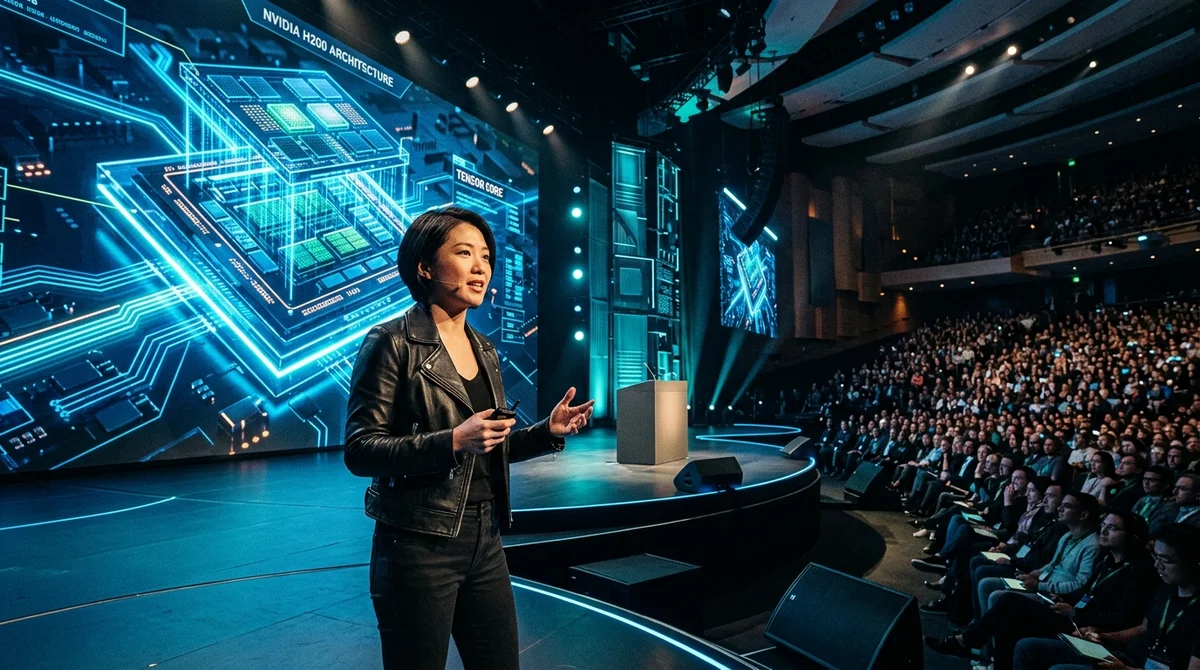
GTC is not just a developer conference. It is an annual ritual in which Jensen Huang, Nvidia's CEO, plays the lead prophet of a new technological era. In 2026, the keynote again drew tens of thousands of attendees and set the agenda for the entire AI industry for the next 12 months. The team at the Equity podcast took the talk apart piece by piece and reached mixed conclusions. The TechCrunch hosts discussed which of Huang's claims are backed by real data and which look more like a strategic signal to the market. The gap between the ambitious presentation and the actual competitive situation turned out to be noticeable, and it became the focus of the episode.
Nvidia today is not just a graphics card maker. Over the past three years, the company has become the infrastructure backbone of the global AI industry. Quarterly revenue has exceeded 30 billion dollars, and its market capitalization lets it compete with Apple and Microsoft for the title of the world's most valuable corporation. The H100 chips, and then the Blackwell architecture, set the industry standard for training large language models. The biggest tech companies (Microsoft, Google, Meta*, Amazon) keep ramping up purchases despite prices that make GPUs one of the scarcest resources on the planet.
GTC 2026 continued that line, but the emphasis shifted toward a new frontier. Huang bet on physical AI: systems capable of acting in the real world, such as industrial robots, autonomous vehicles and intelligent simulators. The Omniverse platform, which Nvidia has been developing for several years, is positioned as the central tool for building digital twins: virtual copies of factories, cities and logistics networks. According to Huang, the next frontier for AI is not another language model but systems that can interact with physical reality and make decisions in real time.
Nevertheless, the Equity team questioned several key narratives. The first is competitive. AMD is actively pushing the MI300X as a cheaper alternative to Nvidia, and cloud providers are increasingly developing their own solutions: Google's TPU, AWS's Trainium, Microsoft's Maia. Startups such as Groq and Cerebras are targeting the fast inference niche. Nvidia still holds the dominant position, but margins may start to shrink, and that is already reflected in analysts' price expectations.
The second issue is geopolitical. US export restrictions on shipping advanced chips to China remain in force and are periodically tightened. Nvidia has to produce special versions of its products for the Chinese market, but even those regularly fall under new sanctions. A potentially huge market remains partly closed, forcing the company to redirect growth toward Europe, India and the Middle East.
The third is valuation. Nvidia's shares trade at levels that price in growth continuing for several years in a row without significant disruptions. Investors are pricing in not only the current lead but also success in new segments: robotics, physical AI and telecommunications. Any slowdown, whether a cut in hyperscalers' capital spending, the emergence of real competitive alternatives or regulatory restrictions, could sharply reprice the market capitalization and put current multiples in question.
GTC 2026 showed Huang in his usual form: confident, visionary and as good at selling ideas as hardware. But the Equity podcast pinpointed the gap between the polished presentation and the real challenges Nvidia will face over the next 12–18 months. The company's dominance in the era of training language models is beyond dispute. But the next era, of inference and physical AI, has not yet been written. This is where competitors will look for entry points that could change the balance of power.
*Meta has been designated an extremist organization and is banned in Russia.
- Nov 2, 2026TensorFold 1.2.0 boosts Qwen3.8-27B throughput on M3 Ultra by 44.2% at 16 streams
- Nov 1, 2026Local models lose to Opus and Codex: 0.21 on a MacBook versus 1.00 for Codex
- Nov 1, 2026Habr author fine-tunes YOLOv8l on dental X-rays and pushes mAP50 to 0.642
- Nov 1, 2026Voice bots built on LLMs turn to Jev, a fast classifier, for decisions in 200–500 ms
Test Frontier LLMs & Autonomous Agents in One Workspace
Run Claude Opus 5.5, GPT-6, Gemini 3.1, and DeepSeek side-by-side in Nomad AI (nomadnet.ai) — unified model routing, deep research, and multimodal workflows under one subscription.
The AI world, distilled — once a week
Seven stories that actually mattered, hand-picked. No noise, no reposts, no press releases.
Done! Check your inbox for a confirmation.