Gimlet Labs raises $80M to run AI inference on chips from NVIDIA, AMD, Intel and others through one layer
Startup Gimlet Labs has closed an $80M Series A round. The company built a software layer that lets AI inference run simultaneously on chips from NVIDIA, AMD, Intel, ARM, Cerebras and d-Matrix, without rewriting code for each stack. In effect, it is POSIX for AI hardware: you write once, and the platform optimizes for whatever hardware is available.
AI-processed from TechCrunch; edited by Hamidun News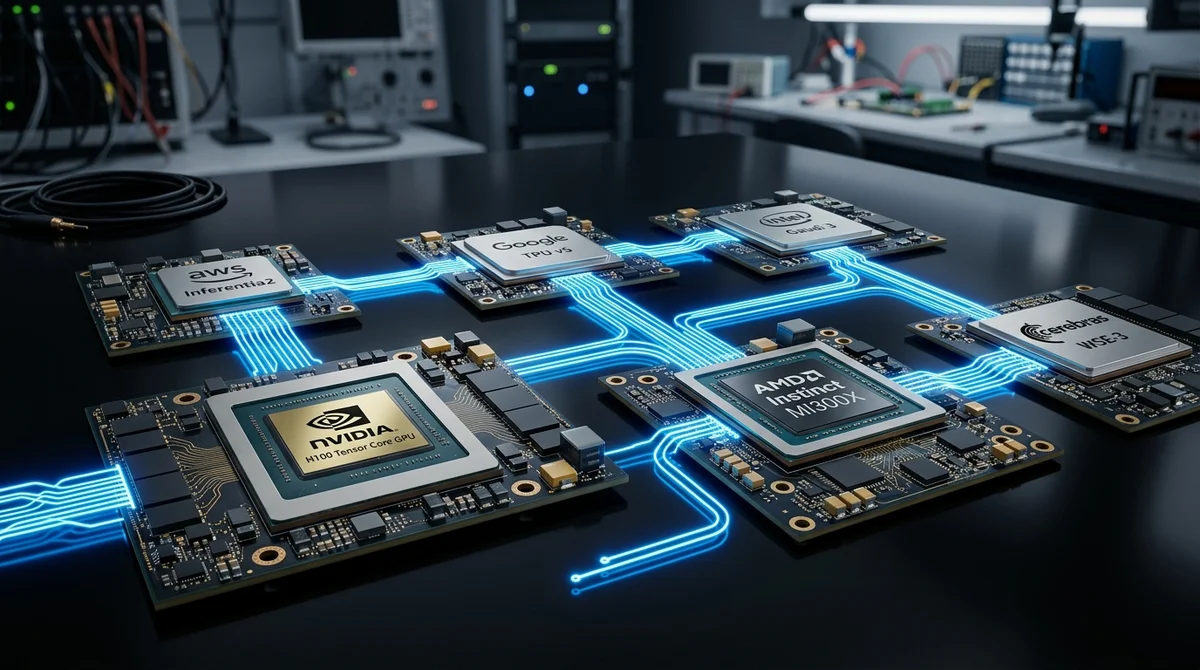
Gimlet Labs has raised $80 million in a Series A round to develop technology that tackles one of modern AI's core problems: models' dependence on specific hardware. The company built a software layer that runs neural network inference simultaneously on chips from six manufacturers: NVIDIA, AMD, Intel, ARM, Cerebras and d-Matrix.
Anyone who has deployed AI in production knows the problem Gimlet Labs is addressing. Each chipmaker ships its own software stack: CUDA at NVIDIA, ROCm at AMD, oneAPI at Intel. Moving from one hardware vendor to another means rewriting code, testing and lengthy debugging. Companies end up locked in to their supplier: even if AMD offers a better price, or Cerebras better performance for a specific workload, the switch costs too much.
Gimlet Labs offers a single API for all supported platforms. It is essentially an abstraction layer between model and hardware, similar to what POSIX once did for operating systems. A developer writes code once, and the platform optimizes execution for the available hardware.
The inclusion of d-Matrix and Cerebras is especially telling. Both are niche players that specialize in inference. It signals to the market that Gimlet Labs is not limiting itself to the mainstream.
$80 million is a serious bet that the fragmentation of the chip market will not resolve itself. Investors clearly believe hardware makers will not agree among themselves, which means the market needs a neutral abstraction layer, and for the long haul. The round highlights that the infrastructure layer of the AI stack is becoming as strategically important as the models themselves.
For enterprise AI buyers, this kind of technology means real negotiating power. Today a huge share of AI infrastructure spending goes to NVIDIA, not because there are no alternatives, but because switching is too painful. If Gimlet Labs really does bring migration costs down to an acceptable level, businesses gain leverage: they can buy from whoever offers the best price at a given moment, rather than from the vendor their codebase already ties them to.
The elegance of the solution lies not in the idea of an abstraction layer itself (it has been known for a long time), but in the team's ability to implement it without a catastrophic loss of performance. This is where such projects usually break down: universality coexists poorly with optimization. How well Gimlet Labs has resolved that contradiction will be shown in production.
- Nov 2, 2026Anthropic needs to grow revenue 32% a year to cover $850 billion in contracts
- Nov 2, 2026TensorFold 1.2.0 boosts Qwen3.8-27B throughput on M3 Ultra by 44.2% at 16 streams
- Nov 1, 2026Local models lose to Opus and Codex: 0.21 on a MacBook versus 1.00 for Codex
- Nov 1, 2026Habr author fine-tunes YOLOv8l on dental X-rays and pushes mAP50 to 0.642
Test Frontier LLMs & Autonomous Agents in One Workspace
Run Claude Opus 5.5, GPT-6, Gemini 3.1, and DeepSeek side-by-side in Nomad AI (nomadnet.ai) — unified model routing, deep research, and multimodal workflows under one subscription.
The AI world, distilled — once a week
Seven stories that actually mattered, hand-picked. No noise, no reposts, no press releases.
Done! Check your inbox for a confirmation.