Deccan AI raises $25 million in data-labeling market, betting on Indian specialists
Deccan AI, a competitor to Mercor in the AI training market, has raised $25 million. The startup concentrates its specialists in India, using managed teams with strict quality control rather than crowdsourcing. Its bet is that the fragmented data-labeling market needs a systemic approach, not just scale.
AI-processed from TechCrunch; edited by Hamidun News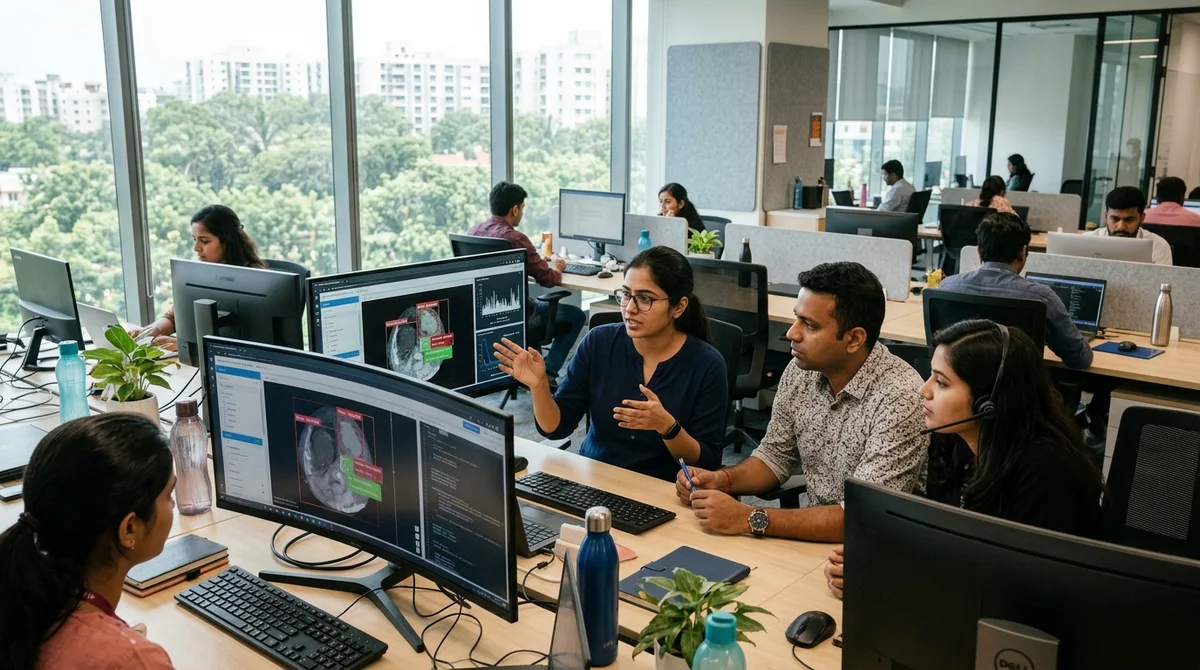
Deccan AI has closed a $25 million funding round, positioning itself as a systemic player in data labeling for AI model training. The company competes directly with Mercor, one of the leading platforms in the AI training talent segment, and builds its edge on a fundamentally different organizational model: not a distributed marketplace of freelancers, but managed teams of specialists concentrated in India.
The market Deccan AI operates in is growing explosively, yet suffers from a systemic problem. Demand for AI model training services rises every quarter: the largest labs, including OpenAI, Anthropic, Google DeepMind and Meta AI*, keep expanding their volumes of RLHF annotation, training-set creation, red-teaming and model safety evaluation. According to various analyst forecasts, the AI training data market will exceed $10 billion by 2028. Meanwhile, the industry chronically struggles with quality: the vast majority of contractors work through crowdsourcing platforms with minimal oversight, which systematically leads to low-quality annotations, inconsistent results and, as a consequence, worse-trained models.
This is where Deccan AI sees room to grow. Unlike competitors that aggregate freelancers from dozens of countries through a single platform, the startup builds managed teams directly in India. Staff receive specialized training for each client's requirements and work in a structured environment with multi-level quality control, and operational processes can be standardized in a way that is impossible with decentralized outsourcing. This model makes it possible to guarantee consistent results at scale, a key requirement for large AI labs that cannot afford variability in training data.
Choosing India as an operational hub is neither accidental nor new, but Deccan AI has concrete arguments in its favor. The country has one of the world's largest concentrations of technically skilled workers, with more than a million engineering and IT graduates every year. English proficiency is considerably higher than in other popular outsourcing regions, which is critical for work with text data. Labor costs, meanwhile, remain an order of magnitude lower than in Western markets. Scale AI, Surge AI and several other sector leaders follow the same path, but most of them bet on scale through a platform aggregator. Deccan AI deliberately chooses smaller scale in exchange for higher quality and predictability.
The competitive environment is getting tougher. Mercor is expanding aggressively beyond engineering recruitment into AI training. Traditional providers such as Appen, Lionbridge and Telus International are actively reorienting their portfolios toward generative AI needs. The large labs themselves are investing in in-house annotator teams to reduce their dependence on outside partners. In this dynamic, Deccan AI will have to keep proving that a premium, managed-team model delivers real ROI compared with the cheap scale of crowdsourcing platforms.
The $25 million will let the company speed up hiring in India, expand its client base among AI labs and technology startups, and invest in its own tools for quality control, workflow automation and team productivity analytics.
The round fits a broader investment trend: venture capital is moving increasingly toward the infrastructure layer of the AI industry, not toward frontier models themselves but toward what keeps them running reliably. High-quality training data, RLHF annotators and human evaluators are becoming a strategically scarce resource, and competition for them is intensifying. Decentralized crowdsourcing cannot deliver systemic quality. A managed, structured, geographically concentrated team can.
*Meta has been designated an extremist organization and banned in Russia.
- Nov 1, 2026Local models lose to Opus and Codex: 0.21 on a MacBook versus 1.00 for Codex
- Nov 1, 2026Kimi scores 96.2% on a 1C database analytics test and emerges as a fallback if Claude access is blocked
- Nov 1, 2026OpenAI Rewrites GPT Behavior Rules: Five Values and a Chain of Command
- Nov 1, 2026Google admits AI Mode cuts search revenue, shares fall 15%
Ship AI Faster with Founders, Engineers & Weekly Architecture Reviews
Inside Vibe Club (hamidun.com/club) — weekly live masterminds with Zhemal Khamidun, Tech Radar, full LMS access, and 370+ production Claude Code skills.
The AI world, distilled — once a week
Seven stories that actually mattered, hand-picked. No noise, no reposts, no press releases.
Done! Check your inbox for a confirmation.